Review
. 2017 Nov 29;6(12):112.
doi: 10.3390/jcm6120112.

Airway Mucus and Asthma: The Role of MUC5AC and MUC5B

Affiliations
Review

Airway Mucus and Asthma: The Role of MUC5AC and MUC5B

Luke R Bonser et al. J Clin Med. .

Abstract

Asthma is characterized by mucus abnormalities. Airway epithelial hyperplasia and metaplasia result in changes in stored and secreted mucin and the production of a pathologic mucus gel. Mucus transport is impaired, culminating in mucus plugging and airway obstruction-a major cause of morbidity in asthma. The polymeric mucins MUC5AC and MUC5B are integral components of airway mucus. MUC5AC and MUC5B gene expression is altered in asthma, and recent work sheds light on their contribution to asthma pathogenesis. Herein, we review our current understanding of the role of MUC5AC and MUC5B in mucus dysfunction in asthma.

Keywords: MUC5AC; MUC5B; asthma.


Conflict of interest statement

The authors declare no conflict of interest.

Figures
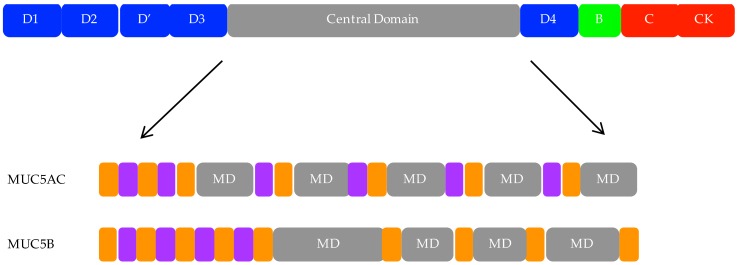
Figure 1
Figure 1
Multidomain structure of the mucins 5AC and 5B (MUC5AC and MUC5B). Top: generic representation of a polymeric mucin. Secreted polymeric mucins possess cysteine-rich vWf-like amino (D1, D2, D’, and D3) and carboxy (D4, B, C, and CK) terminal domains, important for dimerization and polymerization of polymeric mucins, as well as a large, central domain. Bottom: Central domain organization of MUC5AC and MUC5B. The hallmark of the MUC family members are the mucin domains (MDs). These domains are unique in sequence and size, and vary in length and number between different mucins including MUC5AC and MUC5B. They are rich in serine, threonine, and proline, and are the site of O-glycosylation. Additionally, the central region contains repetitive (grey), non-repetitive (purple), and cysteine-rich (orange) domains.
Figure 2
Figure 2
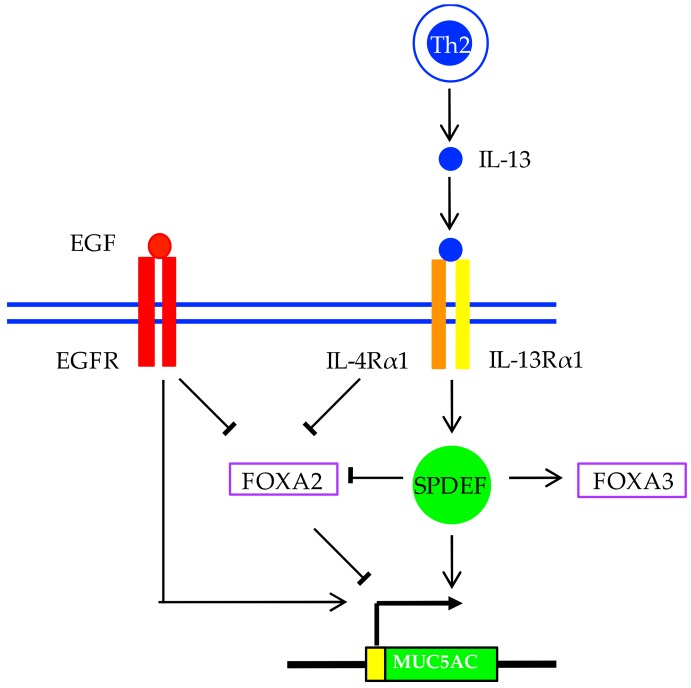
MUC5AC induction and goblet cell differentiation in asthma. Goblet cell metaplasia and hyperplasia are induced by various inflammatory mediators, including type 2 cytokines (e.g., interleukin-13 (IL-13)), and after activation of epidermal growth factor receptor (EGFR) as well as Notch signaling (not illustrated). Goblet cell differentiation is dictated by a large network of regulators, in which transcription factors including SAM pointed domain-containing ETS transcription factor (SPDEF) and the forkhead transcription factor family members, Forkhead box protein A2 (FOXA2) and Forkhead box protein A3 (FOXA3), interact. SPDEF is sufficient and necessary for goblet cell metaplasia, which is regulated in part by FOXA2 inhibition and FOXA3 induction. These pathways are required for MUC5AC induction and goblet cell differentiation.
Figure 3
Figure 3
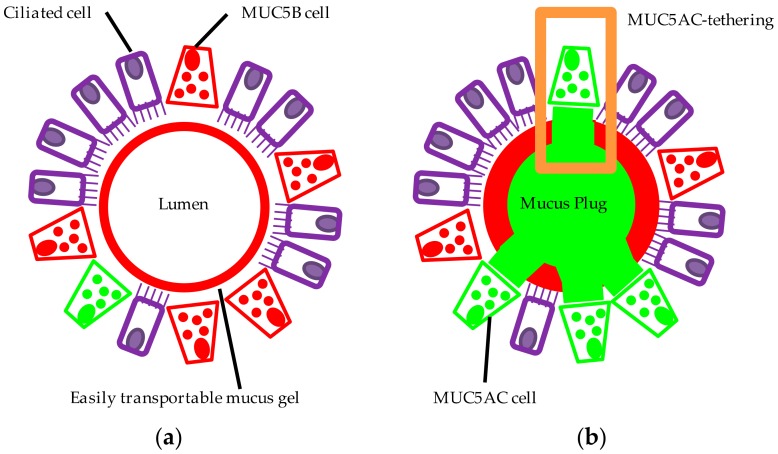
Alterations in MUC5AC and MUC5B contribute to mucus dysfunction in asthma. In this simplified model of the proximal healthy airway (a), MUC5B (red) is the predominant mucin produced and the principal component of the airway mucus gel (the secretion originates in part from submucosal glands not shown). The MUC5B-rich gel is readily transported by the ciliated epithelium (purple) maintaining an unobstructed and uninfected airway. In asthma (b), mucin expression is altered: MUC5AC (green) production is upregulated, while MUC5B production is reduced. This culminates in a heterogeneous airway mucus gel comprising distinct MUC5AC and MUC5B domains. Extracellular MUC5AC domains remain tethered to MUC5AC-producing cells (orange box) compromising mucociliary clearance. Mucus accumulates, forming mucus plugs which occlude the airway. Airway obstruction manifests clinically as breathlessness and wheeze; in some patients, intraluminal occlusion by mucus plugging can lead to asphyxiation.

References

    1. Masoli M., Fabian D., Holt S., Beasley R. Global Initiative for Asthma (GINA) Program The global burden of asthma: Executive summary of the GINA Dissemination Committee Report. Allergy. 2004;59:469–478. doi: 10.1111/j.1398-9995.2004.00526.x. - DOI - PubMed
    1. Pearce N., Aït-Khaled N., Beasley R., Mallol J., Keil U., Mitchell E., Robertson C. Worldwide trends in the prevalence of asthma symptoms: Phase III of the International Study of Asthma and Allergies in Childhood (ISAAC) Thorax. 2007;62:758–766. doi: 10.1136/thx.2006.070169. - DOI - PMC - PubMed
    1. Fuhlbrigge A.L., Adams R.J., Guilbert T.W., Grant E., Lozano P., Janson S.L., Martinez F., Weiss K.B., Weiss S.T. The Burden of Asthma in the United States. Am. J. Respir. Crit. Care Med. 2002;166:1044–1049. doi: 10.1164/rccm.2107057. - DOI - PubMed
    1. Ferkol T., Schraufnagel D. The Global Burden of Respiratory Disease. Ann. Am. Thorac. Soc. 2014;11:404–406. doi: 10.1513/AnnalsATS.201311-405PS. - DOI - PubMed
    1. Fanta C. H. Asthma. N. Engl. J. Med. 2009;360:1002–1014. doi: 10.1056/NEJMra0804579. - DOI - PubMed