


Toenail Manganese: A Sensitive and Specific Biomarker of Exposure to Manganese in Career Welders
- PMID: 29186301
- PMCID: PMC6248604
- DOI: 10.1093/annweh/wxx091
Toenail Manganese: A Sensitive and Specific Biomarker of Exposure to Manganese in Career Welders
Abstract
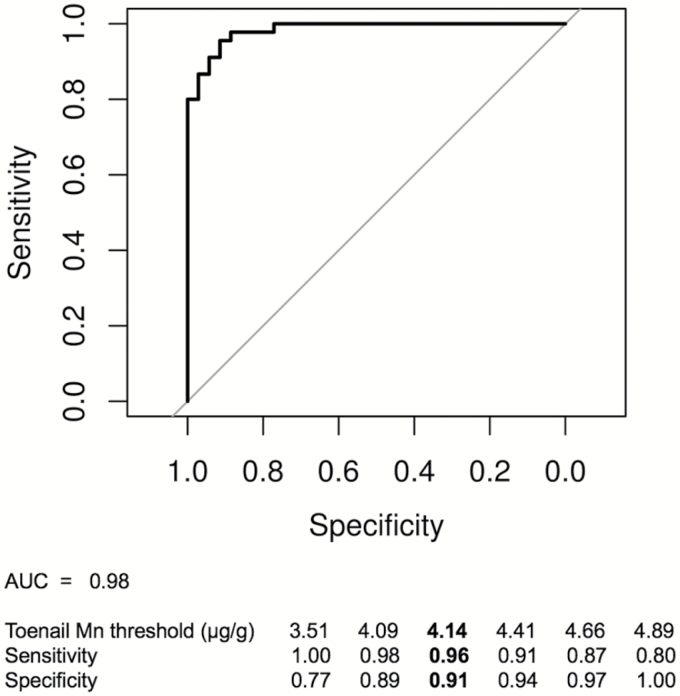
Manganese (Mn) is an essential trace metal. It is also a component of welding fume. Chronic inhalation of manganese from welding fume has been associated with decreased neurological function. Currently, there is not a universally recognized biomarker for Mn exposure; however, hair and toenails have shown promise. In a cohort of 45 male welders and 35 age-matched factory control subjects, we assessed the sensitivity and specificity of toenail Mn to distinguish occupationally exposed subjects from unexposed controls. Further we examined the exposure time window that best correlates with the proposed biomarker, and investigated if non-occupational exposure factors impacted toenail Mn concentrations. Toenail clippings were analyzed for Mn using Inductively Coupled Plasma Mass Spectrometry (ICP-MS). Exposure to respirable Mn-containing particles (<4 µm) was estimated using an exposure model that combines personal air monitoring, work history information, and dietary intake to estimate an individual's exposure to Mn from inhalation of welding fume. We assessed the group differences in toenail concentrations using a Student's t-test between welders and control subjects and performed a receiver operating characteristic (ROC) curve analysis to identify a threshold in toenail concentration that has the highest sensitivity and specificity in distinguishing welders from control subjects. Additionally, we performed mixed-model regressions to investigate the association between different exposure windows and toenail Mn concentrations. We observed that toenail Mn concentrations were significantly elevated among welders compared to control subjects (6.87 ± 2.56 versus 2.70 ± 1.70 µg g-1; P < 0.001). Our results show that using a toenail Mn concentration of 4.14 µg g-1 as cutoff allows for discriminating between controls and welders with 91% specificity and 94% sensitivity [area under curve (AUC) = 0.98]. Additionally, we found that a threshold of 4.66 µg g-1 toenail Mn concentration enables a 90% sensitive and 90% specific discrimination (AUC = 0.96) between subjects with average exposure above or below the American Conference of Governmental Industrial Hygienist (ACGIH) Threshold Limit Value (TLV) of 0.02 mg m-3 during the exposure window of 7-12 months prior to the nail being clipped. Investigating which exposure window was best reflected by toenail Mn reproduced the result from another study of toenail Mn being significantly (P < 0.001) associated with exposure 7-12 months prior to the nail being clipped. Lastly, we found that dietary intake, body mass index, age, smoking status, and ethnicity had no significant effect on toenail Mn concentrations. Our results suggest that toenail Mn is a sensitive, specific, and easy-to-acquire biomarker of Mn exposure, which is feasible to be used in an industrial welder population.
Keywords: biomarker; exposure assessment; manganese; toenails; welding.
© The Author(s) 2017. Published by Oxford University Press on behalf of the British Occupational Hygiene Society.
Figures



References
-
- Apostoli P, Lucchini R, Alessio L (2000)Are current biomarkers suitable for the assessment of manganese exposure in individual workers?Am J Ind Med; 37: 283–90. - PubMed
-
- Bader M, Dietz MC, Ihrig A et al. (1999)Biomonitoring of manganese in blood, urine and axillary hair following low-dose exposure during the manufacture of dry cell batteries. Int Arch Occup Environ Health; 72: 521–7. - PubMed
-
- Bainter J. (2014)Efficacy of cleaning method for removal of exogenous welding fume contamination from nail tissue prior to use as a biomarker for welding fume manganese exposure MS Thesis. West Lafayette, IN: Purdue University.
-
- Bernard AM. (1995)Biokinetics and stability aspects of biomarkers: recommendations for application in population studies. Toxicology; 101: 65–71. - PubMed
Publication types
MeSH terms
Substances
Grants and funding
LinkOut - more resources
Full Text Sources
Other Literature Sources
Medical