Randomized Controlled Trial
. 2018 Jan 30;217(4):628-636.
doi: 10.1093/infdis/jix604.

Protection of the Human Gut Microbiome From Antibiotics

Affiliations
Randomized Controlled Trial

Protection of the Human Gut Microbiome From Antibiotics

Jean de Gunzburg et al. J Infect Dis. .

Abstract

Background: Antibiotics are life-saving drugs but severely affect the gut microbiome with short-term consequences including diarrhea and selection of antibiotic-resistant bacteria. Long-term links to allergy and obesity are also suggested. We devised a product, DAV132, and previously showed its ability to deliver a powerful adsorbent, activated charcoal, in the late ileum of human volunteers.

Methods: We performed a randomized controlled trial in 28 human volunteers treated with a 5-day clinical regimen of the fluoroquinolone antibiotic moxifloxacin in 2 parallel groups, with or without DAV132 coadministration. Two control goups of 8 volunteers each receiving DAV132 alone, or a nonactive substitute, were added.

Results: The coadministration of DAV132 decreased free moxifloxacin fecal concentrations by 99%, while plasmatic levels were unaffected. Shotgun quantitative metagenomics showed that the richness and composition of the intestinal microbiota were largely preserved in subjects co-treated with DAV132 in addition to moxifloxacin. No adverse effect was observed. In addition, DAV132 efficiently adsorbed a wide range of clinically relevant antibiotics ex vivo.

Conclusions: DAV132 was highly effective to protect the gut microbiome of moxifloxacin-treated healthy volunteers and may constitute a clinical breakthrough by preventing adverse health consequences of a wide range of antibiotic treatments.

Clinical trials registration: NCT02176005.

Keywords: Clostridium difficile; antibiotics; fluoroquinolones; microbiome.


Figures

Figure 1.
Figure 1.
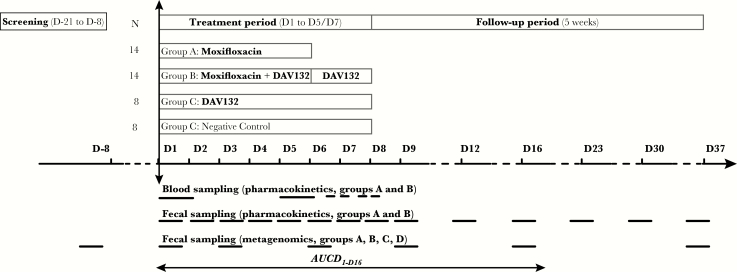
Study design. The various periods of the study (screening, treatment, follow-up) are shown in boxes at the top. The times of blood and fecal sampling for moxifloxacin pharmacokinetics and metagenomics analysis are shown by horizontal bars in the bottom section of the graph. Abbreviations: AUC, area under the time curve; MXF, moxifloxacin.
Figure 2.
Figure 2.
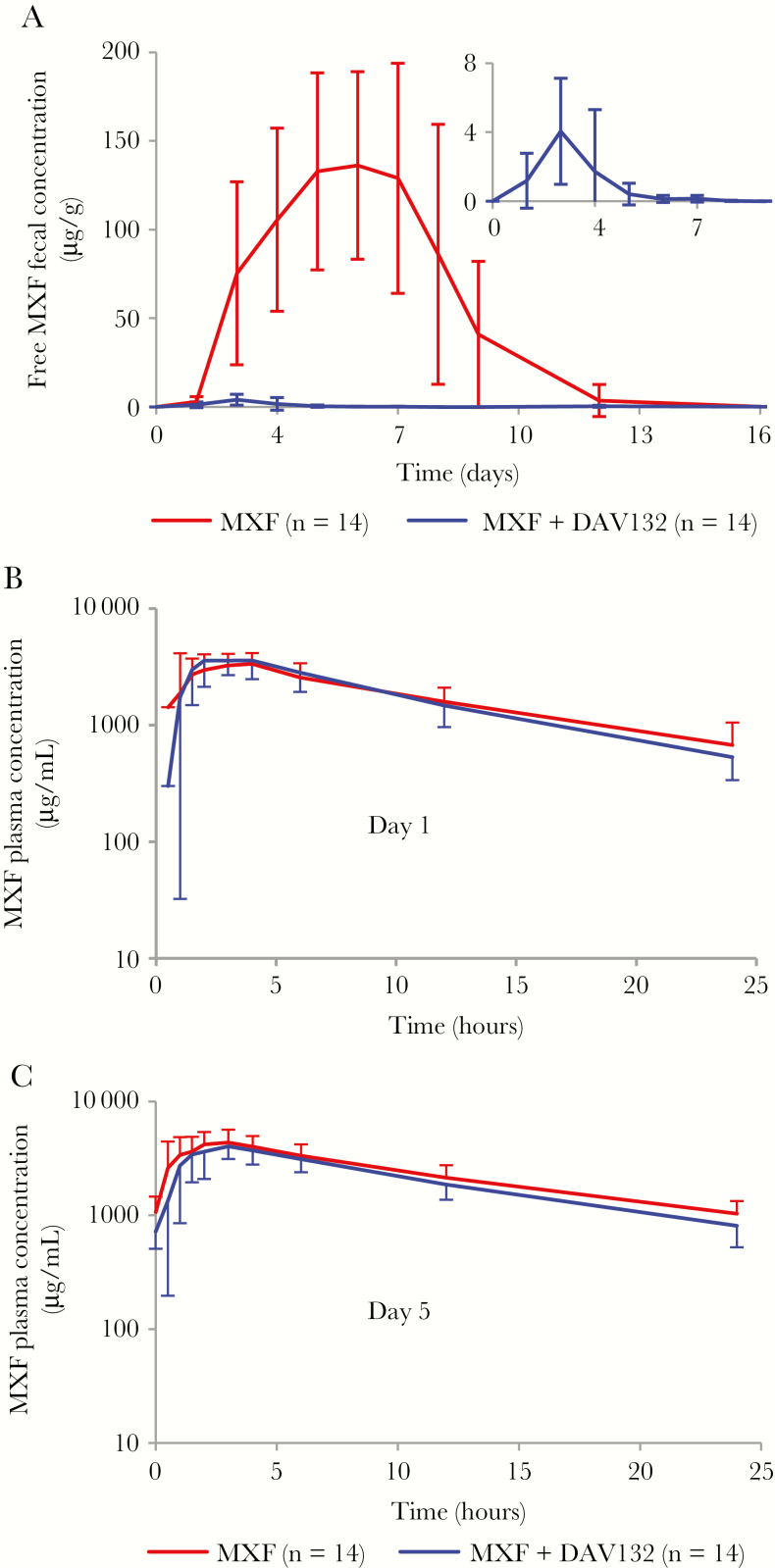
Effect of DAV132 on moxifloxacin (MXF) concentrations in feces and plasma of human volunteers. A, Free fecal MXF concentrations between day (D) 1 and D16 (P = 10–17 for the comparison of logAUCD1-D16). Inset: magnified scale for healthy volunteers (HVs) treated with MXF + DAV132. Plasma MXF concentrations on D1 (P = .8 for the comparison of logAUC0-24h) (B) and D5 (P = .1 for the comparison of logAUC0-24h) (C). HVs, 14 in each of these groups, were administered orally MXF 400 mg once daily from D1 to D5 (MXF), or MXF 400 mg once daily plus DAV132 7.5 g thrice daily from D1 to D5 and then DAV132 alone on D6–D7 (MXF + DAV132). Mean values ± standard deviation are shown.
Figure 3.
Figure 3.
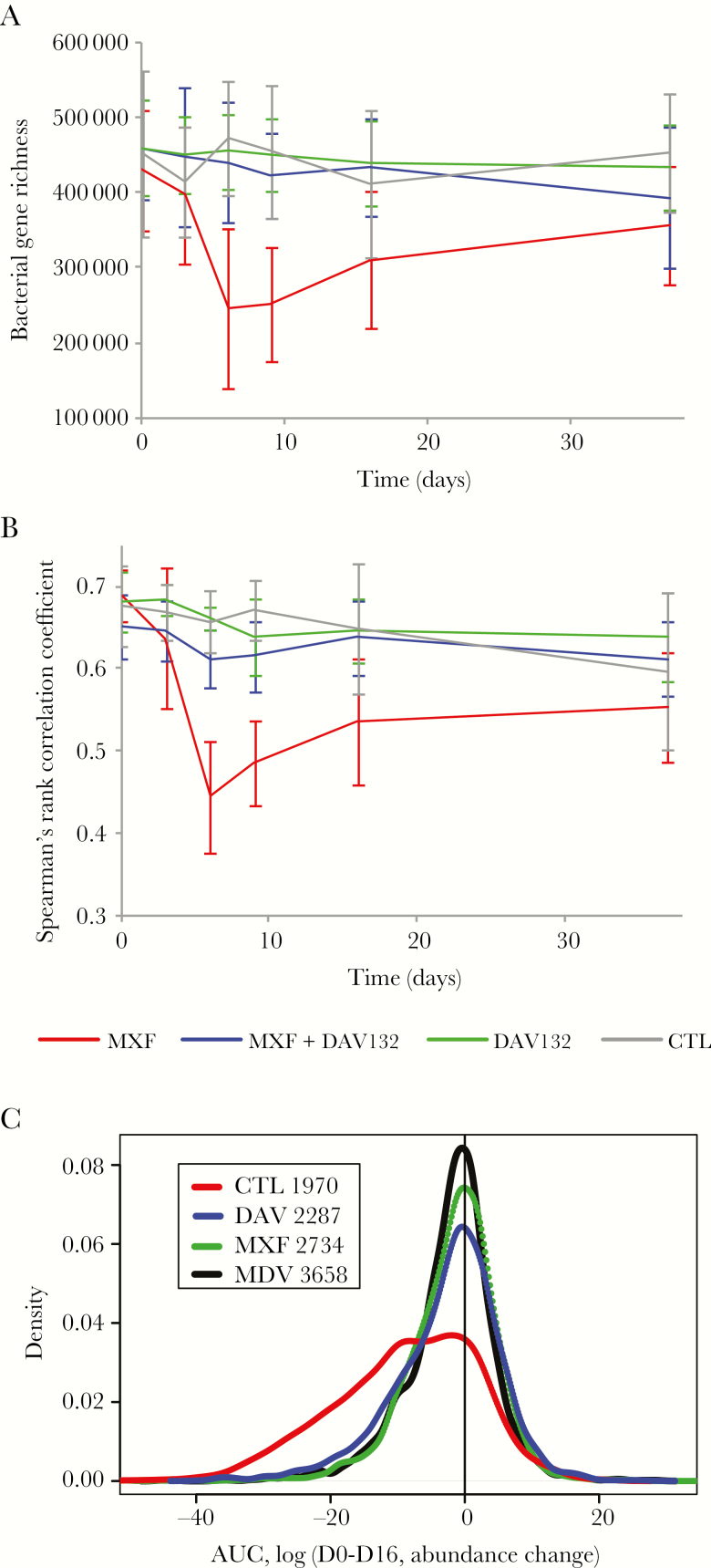
Effect of DAV132 on moxifloxacin (MXF)–induced alterations of the human gut microbiome of human volunteers. A, Gene richness: bacterial gene counts for each study group are displayed. B, Microbiome composition. Spearman rank correlation coefficients (ρ) computed from the abundance of all genes of the 3.9 M gene catalog carried by each individual between Dscreening and the indicated days are shown for each study group. C, Metagenomic species (MGSs). Distribution of areas under the time curve (AUC) values computed between D0 and D16 using log10 of abundance change from D0 of each MGS present in each individual is shown. The group sizes were: MXF, n = 14; MXF + DAV132, n = 13; DAV132, n = 8; negative control (CTL), n = 8. The number of available individual measures over all MGSs for each group is indicated in the inset. Red, blue, green, and black correspond to MXF, MXF + DAV132 (MDV), DAV132 (DAV), and CTL groups, respectively.
Figure 4.
Figure 4.
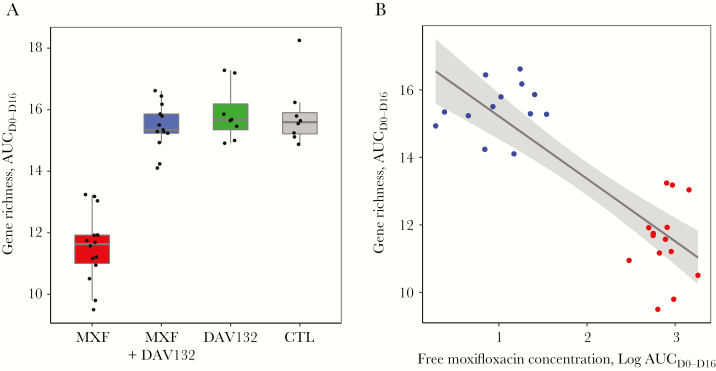
Impact of moxifloxacin (MXF) and DAV132 on gene richness. A, AUCD0-D16 of gene richness change from D0; see Methods for details. Medians [min, max] were 11.63 [9.50, 13.24] for MFX, 15.34 [14.10, 16.62] for MXF + DAV132, 15.66 [14.91, 17.28] for DAV132, and 15.59 [14.88, 18.25] for negative control (CTL). Of note, in absence of any change from D0 the value of AUCD0-D16 would be 16. Median values, quartiles, and 1.5 interquartile range are shown. The distribution of the AUCD0-D16 of gene richness was significantly different between the 4 groups (Kruskal–Wallis test p = 4.10–6). In the pairwise comparisons, it was significantly lower in healthy volunteers (HVs) receiving MXF alone than in those receiving MXF + DAV132 (q = 4.10–7) or negative control (q = 1.10–5), whereas the difference between HVs receiving MXF + DAV132 and negative control was not significant (q = 0.8) as assessed by the Wilcoxon rank-sum test with Benjamini–Hochberg correction for the 4 pairwise comparisons. No difference was observed between the group receiving DAV132 alone and CTL (q = 0.8). The number of individuals in different groups was MXF, n = 14; MXF + DAV132, n = 13; DAV, n = 8; CTL, n = 8. B, Relationship between AUCD0-D16 of gene richness change from D0 and AUCD1-D16 MXF fecal concentration (r2 = 0.71, p = 4.10–8). Red and blue dots correspond to groups exposed to MXF or MXF + DAV132, respectively.
Figure 5.
Figure 5.
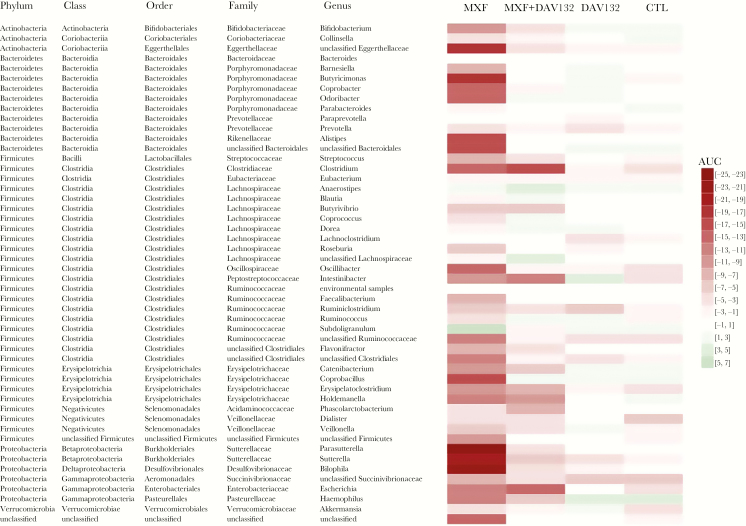
Heatmap depicting the changes induced by the various treatments at the genus level. The heatmap represents, for each treatment group and for each bacterial genus, the median AUC of log10 change from D0 of the metagenomic species that constitute this genus. Green and red colors, respectively, indicate genera that are decreased or increased (the intensity of the color represents the extent of the change), while white indicates very limited changes. Abbreviations: AUC, area under the time curve; CTL, negative control; MXF, moxifloxacin.

References

    1. Jernberg C, Löfmark S, Edlund C, Jansson JK. Long-term impacts of antibiotic exposure on the human intestinal microbiota. Microbiology 2010; 156:3216–23. - PubMed
    1. Dethlefsen L, Relman DA. Incomplete recovery and individualized responses of the human distal gut microbiota to repeated antibiotic perturbation. Proc Natl Acad Sci U S A 2011; 108(Suppl 1):4554–61. - PMC - PubMed
    1. Pérez-Cobas AE, Gosalbes MJ, Friedrichs A et al. Gut microbiota disturbance during antibiotic therapy: a multi-omic approach. Gut 2013; 62:1591–601. - PMC - PubMed
    1. Belkaid Y, Hand TW. Role of the microbiota in immunity and inflammation. Cell 2014; 157:121–41. - PMC - PubMed
    1. Cox LM, Blaser MJ. Antibiotics in early life and obesity. Nat Rev Endocrinol 2015; 11:182–90. - PMC - PubMed

Publication types

MeSH terms

Associated data