. 2018 Mar 1;35(3):719-733.
doi: 10.1093/molbev/msx304.

PHYLOSCANNER: Inferring Transmission from Within- and Between-Host Pathogen Genetic Diversity

Affiliations

PHYLOSCANNER: Inferring Transmission from Within- and Between-Host Pathogen Genetic Diversity

Chris Wymant et al. Mol Biol Evol. .

Abstract

A central feature of pathogen genomics is that different infectious particles (virions and bacterial cells) within an infected individual may be genetically distinct, with patterns of relatedness among infectious particles being the result of both within-host evolution and transmission from one host to the next. Here, we present a new software tool, phyloscanner, which analyses pathogen diversity from multiple infected hosts. phyloscanner provides unprecedented resolution into the transmission process, allowing inference of the direction of transmission from sequence data alone. Multiply infected individuals are also identified, as they harbor subpopulations of infectious particles that are not connected by within-host evolution, except where recombinant types emerge. Low-level contamination is flagged and removed. We illustrate phyloscanner on both viral and bacterial pathogens, namely HIV-1 sequenced on Illumina and Roche 454 platforms, HCV sequenced with the Oxford Nanopore MinION platform, and Streptococcus pneumoniae with sequences from multiple colonies per individual. phyloscanner is available from https://github.com/BDI-pathogens/phyloscanner.

Keywords: molecular epidemiology; multiple infection; pathogen diversity; pathogen genomics; pathogen transmission; phylogenetics.


Figures

<sc>Fig</sc>. 1.
Fig. 1.
Pathogen transmission direction via ancestral state reconstruction. In the left-hand phylogeny, tips are labeled red or blue according to their state: In our case, the state of interest is “in which individual was this pathogen found?”. This state is known for the tips, but can only be inferred for the internal nodes of the phylogeny: These represent coalescence events, ancestors of the pathogens we have sampled. A change in state corresponds to a change in the pathogen’s host, i.e. to transmission, be it direct or indirect. The central phylogeny shows one possible ancestral state reconstruction for which the root of the tree is blue, meaning blue is ancestral to red. This requires at least four changes of state (shown with black branches)—four sampled lineages transmitted from blue to red. The right-hand phylogeny shows one possible ancestral state reconstruction for which the root of the tree is red, meaning red is ancestral to blue. This requires only one change of state—one sampled lineage transmitted from red to blue. Based on parsimony, we would consider the right-hand scenario more likely.
<sc>Fig</sc>. 2.
Fig. 2.
phyloscanner schematic for whole-genome deep sequence data. In this schematic, pathogens are sampled from the population infecting three hosts. NGS deep sequencing produces reads, which are fragments of the genome sequence of one pathogen particle (after amplification if necessary). Mapping to a reference means aligning each read to the appropriate location in the genome; this must be done beforehand, as mapped reads are the inputs to phyloscanner. phyloscanner produces alignments of reads in sliding windows along the genome, automatically adjusting for the fact that the reference may be different for each sample. Phylogenies are inferred for each alignment. These phylogenies are analyzed separately using ancestral host-state reconstruction (i.e., assigning hosts to internal nodes), and their information is combined to give biologically and epidemiologically meaningful summaries. For example, here, we infer that the red individual infected the blue individual directly or indirectly, and the green individual has two distinct pathogen strains.
<sc>Fig</sc>. 3.
Fig. 3.
Subgraphs defined by a given ancestral state reconstruction. Here, we show again the two different ancestral state reconstructions on the same phylogeny from figure 1, this time illustrating the host subgraphs that these reconstructions define: connected regions of the phylogeny that have been assigned the same state (blue host or red host). Note that the set of tips in a subgraph may or may not form a clade. In both of the above reconstructions, the blue tips are contained in one subgraph and form a monophyletic group (one clade), whereas the red tips form a polyphyletic group. The minimum number of clades needed to encompass all and only the red tips is four, coinciding with the four red subgraphs in the left-hand reconstruction.
<sc>Fig</sc>. 4.
Fig. 4.
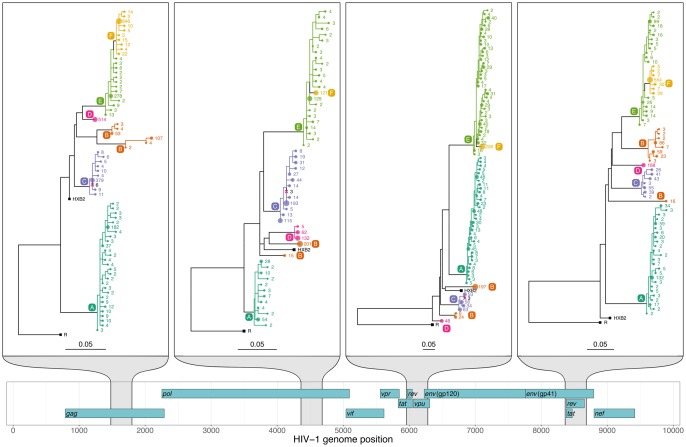
phyloscanner analysis of four illustrative windows of the HIV-1 genome. A map of the HIV-1 genome is shown at the bottom with the nine genes in the three reading frames. Phylogenies are shown for the four windows highlighted in gray, with scale bars measured in substitutions per site. Tip labels are colored by patient, as are all nodes assigned to that patient by ancestral reconstruction, and the branches connecting these tips and nodes; a solid block of color therefore defines a single subgraph for one patient (see main text). The number labeling each tip is the number of times that read was found in the sample, and the size of the circle at each tip is proportional to this count. The count is after merging all identical reads and reads differing by a single base pair (merging similar reads can be done for computational efficiency, or as here, for presentational clarity). External references included for comparison are shown with black squares. One is HXB2; the other, labeled R, is a subtype C reference used to root each phylogeny. The six patients are labeled A through F. Single infection: patient A is a singly infected—all reads from this patient form a single subgraph. Dual infection: patient B is inferred to be dually infected, as is apparent by the fact that ancestral reconstruction produces two subgraphs in each window. Contamination: patients C and D are both singly infected, but we infer that some contamination has occurred from C to D. Patient D’s sample has a small number of reads that are identical to reads from patient C, but much less numerous. Such reads are removed, but are shown here as crosses in the clade of patient C, for illustrative purposes. Transmission: in all four windows shown here, the reads of patient F are seen to be wholly descended from within the subgraph of reads of patient E. We infer that patient E infected patient F, either directly, or indirectly via an unsampled intermediate. Patient F having a single subgraph, which is linked to patient E by a single branch, suggests that the viral population was bottlenecked down to a single sampled ancestor during transmission (subject to adequate sampling of both hosts).
<sc>Fig</sc>. 5.
Fig. 5.
Summary statistics for six illustrative HIV-1 infected patients. Each column shows data from a single patient; each row is one or two statistics, plotted along the genome. Top row: number of reads, and number of unique reads (corresponding to tips in the phylogeny). Second row: the number of clades required to encompass all and only the reads from that patient, and the number of subgraphs (see fig. 3 for clarification of these quantities). In many windows, though not all, the reads of patient B form two subgraphs: evidence of dual infection. For patients C and E, we see a single subgraph but many clades. This is because of the presence of reads from other patients (D and F, respectively, as seen in fig. 4) inside what would otherwise be a single clade, turning a monophyletic group into polyphyletic group (which requires splitting in order to form clades). Third row: within-host divergence, quantified by mean root-to-tip distance. Defining a patient’s subtree as the tree obtained by removing all tips not from this patient, we calculate root-to-tip distances both in the whole subtree and in just the largest subgraph. For patient B, this distinction is substantial due to the very large distance (∼0.1 substitutions/site) between the two subgraphs of this dually infected patient. For singly infected patients, divergence may correlate with time since infection. Fourth row: for each window, a stacked histogram of the proportion of reads in each subgraph. For patient B, when two subgraphs are present, an appreciable proportion of reads are in the second one (mean 12%). The histogram is absent in the window that was excluded by choice. Bottom row: a score based on Hamming distance (between 0 and 1) of the extent of recombination in that window. The highest score across all six patients and all windows is indicated with an orange diamond; the reads giving rise to this score are shown in supplementary figure S6, Supplementary Material online.
<sc>Fig</sc>. 6.
Fig. 6.
Relationship graphs: visual representations of the relationship between two connected patients infected with HIV-1. The power of phyloscanner in studying transmission events comes from aggregating information over many within- and between-host phylogenies, in this case obtained from different windows of the whole HIV-1 genome. Part A, top diagram: the outcomes from all 54 windows are shown. The top blue arrow shows that in 41 windows, patient E was inferred to be ancestral to patient F, with a single bottleneck. The bottom blue arrow shows that in two windows the reverse was true—F was ancestral to E. The undirected red line shows that in two windows, the patients were linked by “complex” ancestry, with the direction unclear. The undirected green line shows that in nine windows the patient subgraphs were adjacent and close, but no ancestry was implied by the topology. In no window was transmission of more than one lineage inferred, and in no window were the patients distant and unlinked. (See supplementary section SI 1, Supplementary Material online, for more details on these categories.) A simplification of these relational data is shown in part B, with a single directed arrow. The first number indicates the proportion of windows supporting transmission in the direction of the arrow, and the second number indicates the proportion of windows supporting transmission in either direction.
<sc>Fig</sc>. 7.
Fig. 7.
The relationship between seven patients infected with HIV-1. The coloring and numbers on the arrows connecting patients are as in parts A and B of figure 6; in addition, part B here contains undirected green lines as well directed blue lines. These green lines suggest that the pair are close in the transmission network but with unknown transmission direction; the single number on the line indicates the proportion of windows supporting this. The known or estimated year of infection is shown in parentheses after each patient’s label.
<sc>Fig</sc>. 8.
Fig. 8.
phyloscanner analysis of two illustrative windows of the HCV genome. Sequence data from four individuals were obtained with the Oxford Nanopore MinION device. A continuous region of the phylogeny with the same color shows a subgraph for one patient (see main text). Black tips were flagged as contamination and excluded. Patient-derived sequences clustered with respective genotype 2 and genotype 3 references (G2R, G3R) as expected from the virus genotypes known from the clinical information available for participants. Two windows, 600 bp in length, are shown for the E2 and NS4B genes at positions given by the genome map (bottom panel).
<sc>Fig</sc>. 9.
Fig. 9.
Phylogeny and relationships between S. pneumoniae carriers. The phylogeny shown is the MrBayes consensus tree. Tip shapes are colored by carrier, with mother and infant pairs sharing the same color; diamonds represent infants and circles mothers. All nodes assigned to a carrier by ancestral reconstruction, and the branches connecting these tips and nodes, are given the same color as that carrier’s tips; a solid block of color therefore defines a single subgraph for one carrier (see main text). Regions of the phylogeny not in any carrier’s subgraph are gray. These regions connect carriers’ subgraphs to each other, and so each must contain one or more transmission events. The carrier relationship diagram (inset) displays the relationships between the carriers in 18 identified groups, in the same fashion as in figures 6 and 7, except that here the numbers represent the proportion of phylogenies from the posterior set, rather than the proportion of genomic windows in which both patients have sequence data. The clades representing these 18 groups are labeled in the phylogeny.

References

    1. Altschul SF, Gish W, Miller W, Myers EW, Lipman DJ.. 1990. Basic local alignment search tool. J Mol Biol. 215(3):403–410. - PubMed
    1. Bolger AM, Lohse M, Usadel B.. 2014. Trimmomatic: a flexible trimmer for Illumina sequence data. Bioinformatics 30(15):2114–2120.http://dx.doi.org/10.1093/bioinformatics/btu170 - DOI - PMC - PubMed
    1. Bonsall D, Ansari MA, Ip C, Trebes A, Brown A, Klenerman P, Buck D, null N, Piazza P, Barnes E, et al.2015. ve-SEQ: robust, unbiased enrichment for streamlined detection and whole-genome sequencing of HCV and other highly diverse pathogens [version 1; referees: 2 approved, 1 approved with reservations]. F1000Research 4: 1062. - PMC - PubMed
    1. Cornelissen M, Gall A, Vink M, Zorgdrager F, Binter Š, Edwards S, Jurriaans S, Bakker M, Ong SH, Gras L, et al.2016. From clinical sample to complete genome: comparing methods for the extraction of HIV-1 RNA for high-throughput deep sequencing. Virus Res. 239:10–16. - PubMed
    1. Cornelissen M, Pasternak AO, Grijsen ML, Zorgdrager F, Bakker M, Blom P, Prins JM, Jurriaans S, van der Kuyl AC.. 2012. HIV-1 dual infection is associated with faster CD4+ T-cell decline in a cohort of men with primary HIV infection. Clin Infect Dis. 54(4):539.. - PubMed