. 2017 Nov 15:8:1968.
doi: 10.3389/fpls.2017.01968. eCollection 2017.

Identification of Candidate Genes for Calcium and Magnesium Accumulation in Brassica napus L. by Association Genetics

Affiliations

Identification of Candidate Genes for Calcium and Magnesium Accumulation in Brassica napus L. by Association Genetics

Thomas D Alcock et al. Front Plant Sci. .

Abstract

Calcium (Ca) and magnesium (Mg) are essential plant nutrients and vital for human and animal nutrition. Biofortification of crops has previously been suggested to alleviate widespread human Ca and Mg deficiencies. In this study, new candidate genes influencing the leaf accumulation of Ca and Mg were identified in young Brassica napus plants using associative transcriptomics of ionomics datasets. A total of 247 and 166 SNP markers were associated with leaf Ca and Mg concentration, respectively, after false discovery rate correction and removal of SNPs with low second allele frequency. Gene expression markers at similar positions were also associated with leaf Ca and Mg concentration, including loci on chromosomes A10 and C2, within which lie previously identified transporter genes ACA8 and MGT7. Further candidate genes were selected from seven loci and the mineral composition of whole Arabidopsis thaliana shoots were characterized from lines mutated in orthologous genes. Four and two mutant lines had reduced shoot Ca and Mg concentration, respectively, compared to wild type plants. Three of these mutations were found to have tissue specific effects; notably reduced silique Ca in all three such mutant lines. This knowledge could be applied in targeted breeding, with the possibility of increasing Ca and Mg in plant tissue for improving human and livestock nutrition.

Keywords: Brassica napus; GWAS; associative transcriptomics; biofortification; calcium; magnesium; nutrient use efficiency.


Figures
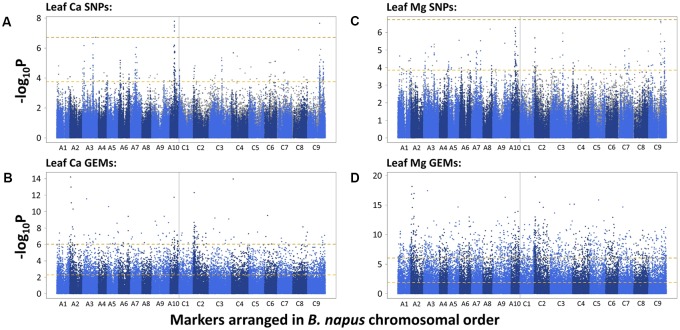
FIGURE 1
FIGURE 1
–log10P values of SNPs and GEMs associated with leaf Ca concentration (A,B, respectively) and leaf Mg concentration (C,D, respectively) in order of markers within the B. napus pan-transcriptome. Upper, gold, dashed line represents Bonferroni corrected significance threshold; lower, yellow, dashed line represents FDR corrected significance threshold (P = 0.05).
FIGURE 2
FIGURE 2
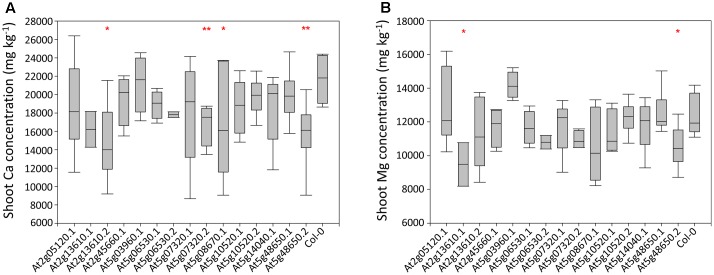
Shoot Ca (A) and Mg (B) concentrations across 15 mutant A. thaliana lines and wild type (Col-0) plants. Boxes represent the mid two quartiles with the median drawn; whiskers are the 95% confidence limits. Single and double stars above boxes represent significance at P < 0.05 and P < 0.01, respectively, compared to wild type (Col-0) plants.
FIGURE 3
FIGURE 3
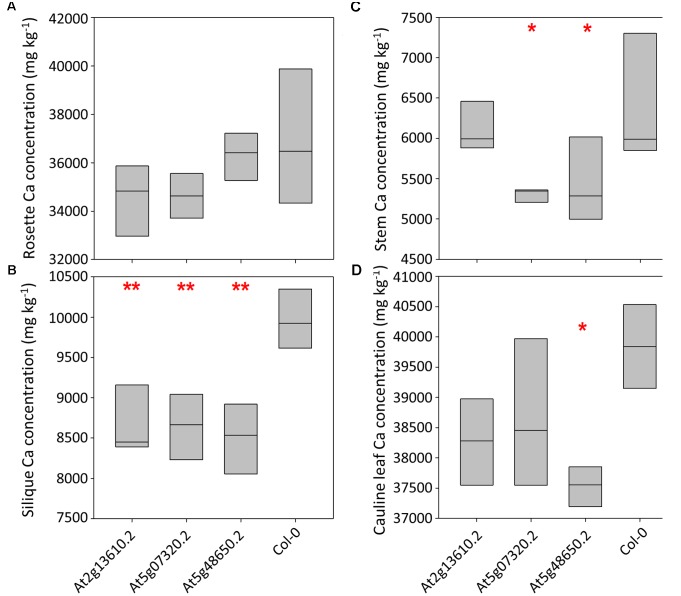
Rosette leaf (A), silique (B), stem (C) and cauline leaf (D) Ca concentrations across three mutant A. thaliana lines and wild type (Col-0) plants. Boxes represent full range of values with the median drawn. Single and double stars above boxes represent significance at P < 0.05 and P < 0.01, respectively, compared to wild type (Col-0) plants.
FIGURE 4
FIGURE 4
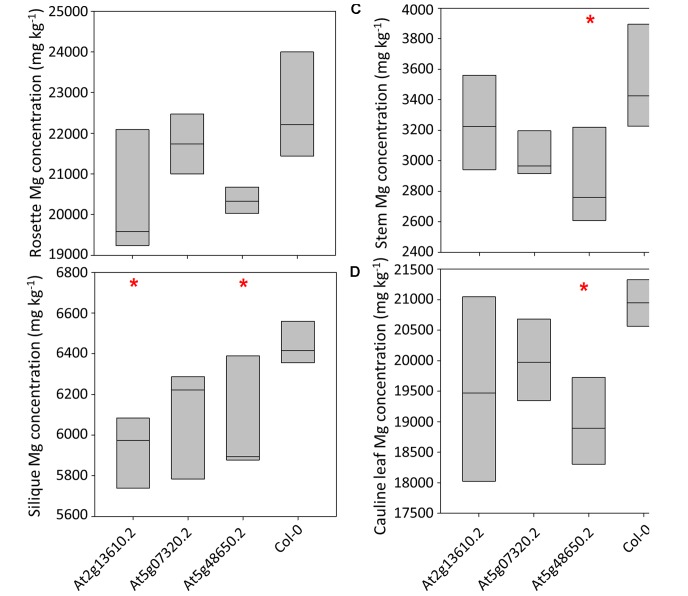
Rosette leaf (A), silique (B), stem (C) and cauline leaf (D) Mg concentrations across three mutant A. thaliana lines and wild type (Col-0) plants. Boxes represent full range of values with the median drawn. Single and double stars above boxes represent significance at P < 0.05 and P < 0.01, respectively, compared to wild type (Col-0) plants.

References

    1. Adams K. L., Cronn R., Percifield R., Wendel J. F. (2003). Genes duplicated by polyploidy show unequal contributions to the transcriptome and organ-specific reciprocal silencing. Proc. Natl. Acad. Sci. U.S.A. 100 4649–4654. 10.1073/pnas.0630618100 - DOI - PMC - PubMed
    1. Alonso J. M., Stepanova A. N., Leisse T. J., Kim C. J., Chen H., Shinn P., et al. (2003). Genome-wide insertional mutagenesis of Arabidopsis thaliana. Science 301 653–657. 10.1126/science.1086391 - DOI - PubMed
    1. Bancroft I., Morgan C., Fraser F., Higgins J., Wells R., Clissold L., et al. (2011). Dissecting the genome of the polyploid crop oilseed rape by transcriptome sequencing. Nat. Biotechnol. 29 762–766. 10.1038/nbt.1926 - DOI - PubMed
    1. Baxter I., Ouzzani M., Orcun S., Kennedy B., Jandhyla S. S., Salt D. E. (2007). Purdue ionomics information management system. An integrated functional genomics platform. Plant Physiol. 143 600–611. 10.1104/pp.106.092528 - DOI - PMC - PubMed
    1. Benjamini Y., Hochberg Y. (1995). Controlling the false discovery rate: a practical and powerful approach to multiple testing. J. R. Stat. Soc. B 57 289–300.

LinkOut - more resources