doi: 10.1001/jamapsychiatry.2017.3561.
Assessment of Symptom Network Density as a Prognostic Marker of Treatment Response in Adolescent Depression
Affiliations
- PMID: 29188277
- PMCID: PMC5833532
- DOI: 10.1001/jamapsychiatry.2017.3561
Item in Clipboard
Assessment of Symptom Network Density as a Prognostic Marker of Treatment Response in Adolescent Depression
JAMA Psychiatry.
.
Abstract
This cohort study uses the 33-item Mood and Feelings Questionnaire to examine whether symptom network density is associated with treatment response in adolescent depression.
Conflict of interest statement
Figures
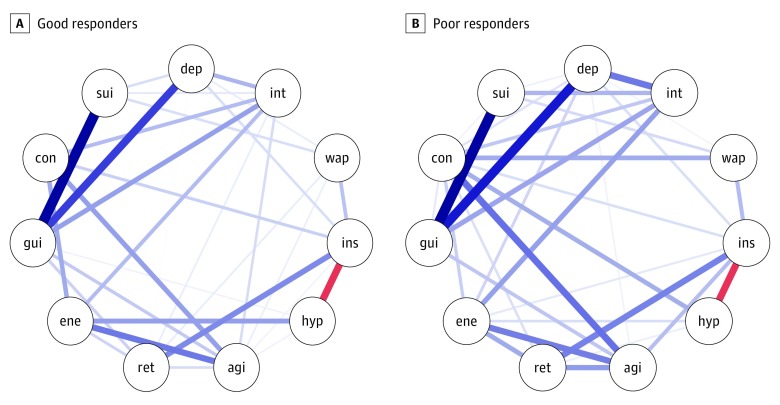
Blue lines represent positive connections; red lines, negative connections; and thicker lines, stronger connections. For the symptom (node) abbreviations, agi indicates psychomotor agitation; con, concentration problems; dep, feeling sad/depressed; ene, loss of energy; gui, guilt/worthlessness; hyp, hypersomnia; ins, insomnia; int, loss of interest/pleasure; ret, psychomotor retardation; sui, suicidal ideation; and wap, weight or appetite change.
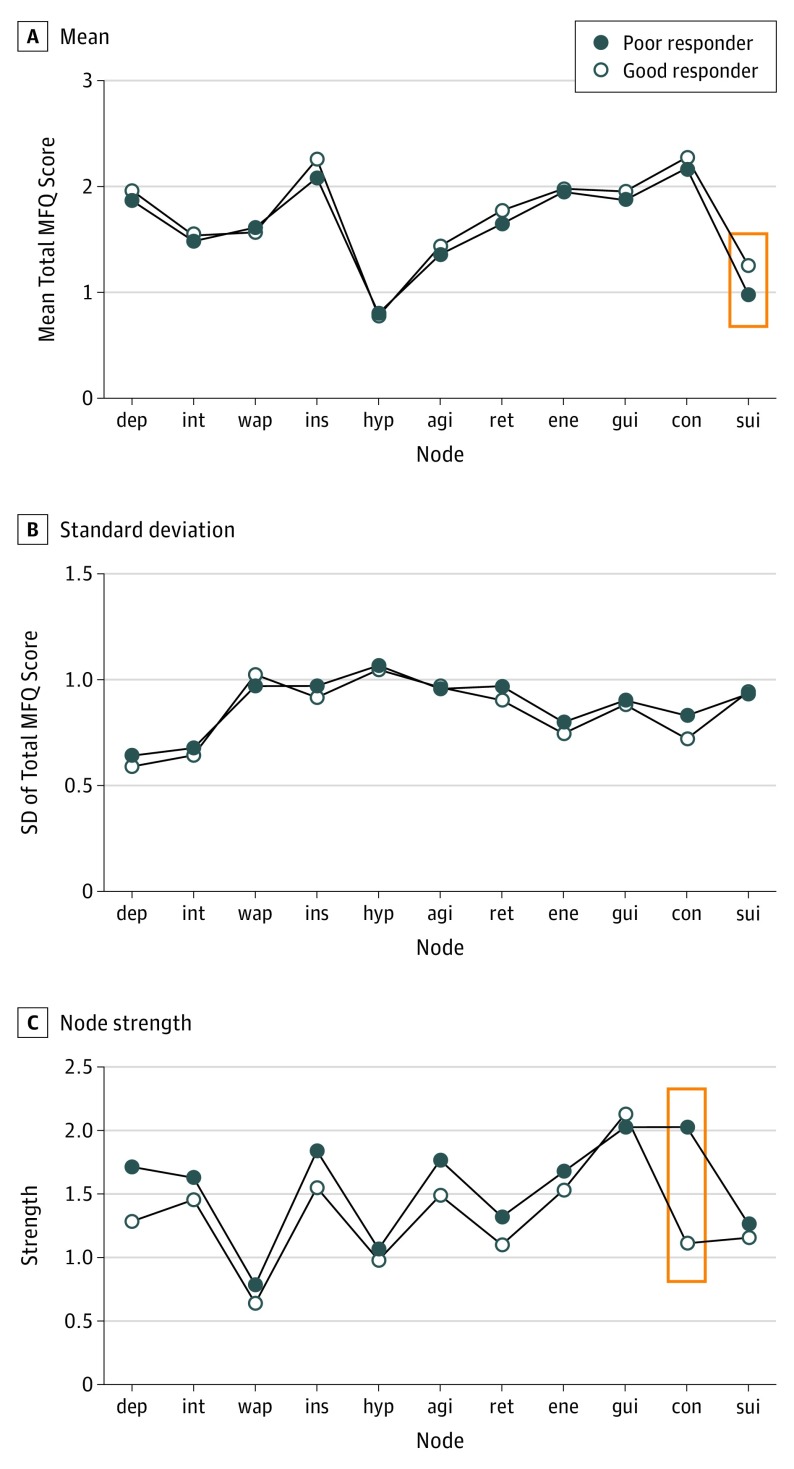
Red boxes outline statistically significant differences. Symptom (node) abbreviations are defined in the caption to Figure 1.
References
-
- Goodyer IM, Reynolds S, Barrett B, et al. . Cognitive behavioural therapy and short-term psychoanalytical psychotherapy versus a brief psychosocial intervention in adolescents with unipolar major depressive disorder (IMPACT): a multicentre, pragmatic, observer-blind, randomised controlled superiority trial. Lancet Psychiatry. 2017;4(2):109-119. - PMC - PubMed
-
- Nilsen TS, Eisemann M, Kvernmo S. Predictors and moderators of outcome in child and adolescent anxiety and depression: a systematic review of psychological treatment studies. Eur Child Adolesc Psychiatry. 2013;22(2):69-87. - PubMed
-
- van Borkulo C, Boschloo L, Borsboom D, Penninx BWJH, Waldorp LJ, Schoevers RA. Association of symptom network structure with the course of [corrected] depression. JAMA Psychiatry. 2015;72(12):1219-1226. - PubMed
-
- Daviss WB, Birmaher B, Melhem NA, Axelson DA, Michaels SM, Brent DA. Criterion validity of the Mood and Feelings Questionnaire for depressive episodes in clinic and non-clinic subjects. J Child Psychol Psychiatry. 2006;47(9):927-934. - PubMed
-
- Epskamp S, Cramer AOJ, Waldorp LJ, Schmittmann VD, Borsboom D. Qgraph: network visualizations of relationships in psychometric data. J Stat Soft. 2012;48(4):1-18.
Publication types
MeSH terms
Grants and funding
LinkOut - more resources
Full Text Sources
Other Literature Sources