


An Antarctic Extreme Halophile and Its Polyextremophilic Enzyme: Effects of Perchlorate Salts
- PMID: 29189043
- PMCID: PMC5910040
- DOI: 10.1089/ast.2017.1766
An Antarctic Extreme Halophile and Its Polyextremophilic Enzyme: Effects of Perchlorate Salts
Abstract
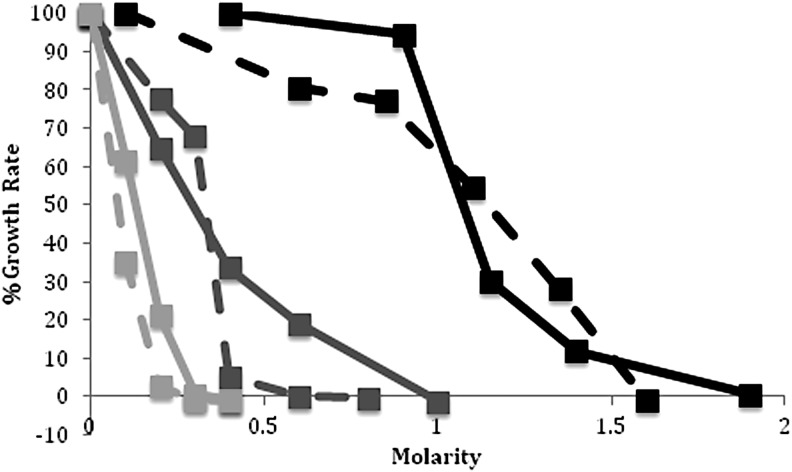
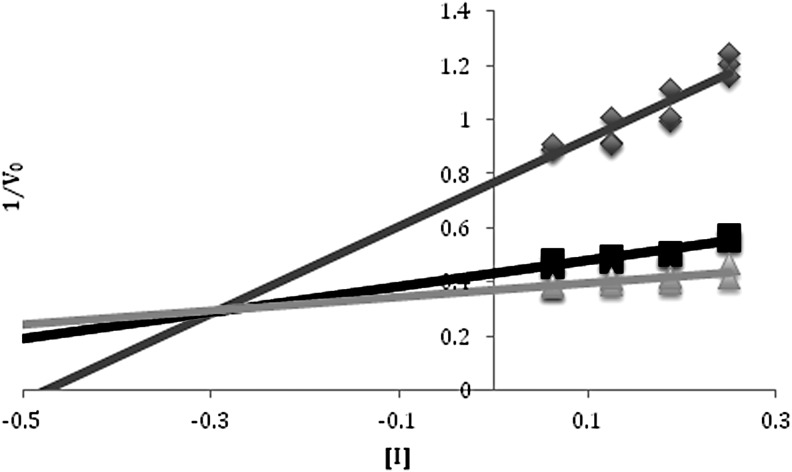
Effects of perchlorate salts prevalent on the surface of Mars are of significant interest to astrobiology from the perspective of potential life on the Red Planet. Halorubrum lacusprofundi, a cold-adapted halophilic Antarctic archaeon, was able to grow anaerobically on 0.04 M concentration of perchlorate. With increasing concentrations of perchlorate, growth was inhibited, with half-maximal growth rate in ca. 0.3 M NaClO4 and 0.1 M Mg(ClO4)2 under aerobic conditions. Magnesium ions were also inhibitory for growth, but at considerably higher concentrations, with half-maximal growth rate above 1 M. For a purified halophilic β-galactosidase enzyme of H. lacusprofundi expressed in Halobacterium sp. NRC-1, 50% inhibition of catalytic activity was observed at 0.88 M NaClO4 and 0.13 M Mg(ClO4)2. Magnesium ions were a more potent inhibitor of the enzyme than of cell growth. Steady-state kinetic analysis showed that Mg(ClO4)2 acts as a mixed inhibitor (KI = 0.04 M), with magnesium alone being a competitive inhibitor (KI = 0.3 M) and perchlorate alone acting as a very weak noncompetitive inhibitor (KI = 2 M). Based on the estimated concentrations of perchlorate salts on the surface of Mars, our results show that neither sodium nor magnesium perchlorates would significantly inhibit growth and enzyme activity of halophiles. This is the first study of perchlorate effects on a purified enzyme. Key Words: Halophilic archaea-Perchlorate-Enzyme inhibition-Magnesium. Astrobiology 18, 412-418.
Figures




References
-
- Anderson I.J., DasSarma P., Lucas S., Copeland A., Lapidus A., Del Rio T.G., Tice H., Dalin E., Bruce D.C., Goodwin L., Pitluck S., Sims D., Brettin T.S., Detter J.C., Han C.S., Larimer F., Hauser L., Land M., Ivanova N., Richardson P., Cavicchioli R., DasSarma S., Woese C.R., and Kyrpides N.C. (2016) Complete genome sequence of the Antarctic Halorubrum lacusprofundi type strain ACAM 34. Stand Genomic Sci 11, doi: 10.1186/s40793-016-0194-2 - DOI - PMC - PubMed
-
- Bauer W.R. (2002) Structure of DNA in denaturing solvents. II. Premelting unwinding of the deoxyribonucleic acid duplex by aqueous magnesium perchlorate. Biochemistry 11:2915–2920 - PubMed
-
- Capes M.D., Coker J.A., Gessler R., Grinblat-Huse V., DasSarma S.L., Jacob C.G., Kim J.-M., DasSarma P., and DasSarma S. (2011) The information transfer system of halophilic archaea. Plasmid 65:77–101 - PubMed
-
- DasSarma P., Laye V.J., Harvey J., Reid C., Shultz J., Yarborough A., Lamb A., Koske-Phillips A., Herbst A., Molina F., Grah O., Phillips T., and DasSarma S. (2017) Survival of halophilic archaea in Earth's cold stratosphere. International Journal of Astrobiology 16:321–327
Publication types
MeSH terms
Substances
LinkOut - more resources
Full Text Sources
Other Literature Sources
Molecular Biology Databases
Miscellaneous
