


Opioid Prescribing for the Treatment of Acute Pain in Children on Hospital Discharge
- PMID: 29189368
- PMCID: PMC5728167
- DOI: 10.1213/ANE.0000000000002586
Opioid Prescribing for the Treatment of Acute Pain in Children on Hospital Discharge
Abstract
Background: The epidemic of nonmedical use of prescription opioids has been fueled by the availability of legitimately prescribed unconsumed opioids. The aim of this study was to better understand the contribution of prescriptions written for pediatric patients to this problem by quantifying how much opioid is dispensed and consumed to manage pain after hospital discharge, and whether leftover opioid is appropriately disposed of. Our secondary aim was to explore the association of patient factors with opioid dispensing, consumption, and medication remaining on completion of therapy.
Methods: Using a scripted 10-minute interview, parents of 343 pediatric inpatients (98% postoperative) treated at a university children's hospital were questioned within 48 hours and 10 to 14 days after discharge to determine amount of opioid prescribed and consumed, duration of treatment, and disposition of unconsumed opioid. Multivariable linear regression was used to examine predictors of opioid prescribing, consumption, and doses remaining.
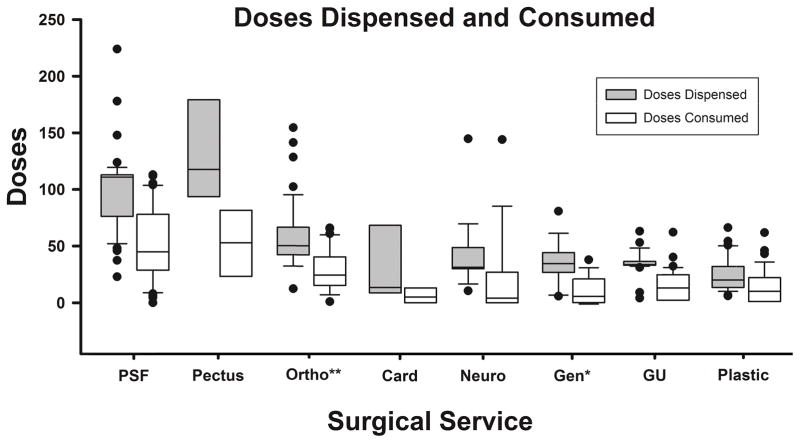
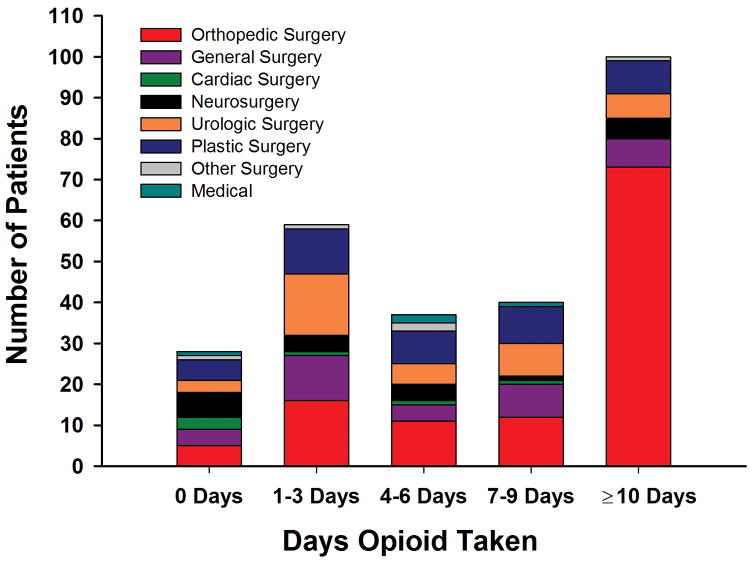
Results: Median number of opioid doses dispensed was 43 (interquartile range, 30-85 doses), and median duration of therapy was 4 days (interquartile range, 1-8 days). Children who underwent orthopedic or Nuss surgery consumed 25.42 (95% confidence interval, 19.16-31.68) more doses than those who underwent other types of surgery (P < .001), and number of doses consumed was positively associated with higher discharge pain scores (P = .032). Overall, 58% (95% confidence interval, 54%-63%) of doses dispensed were not consumed, and the strongest predictor of number of doses remaining was doses dispensed (P < .001). Nineteen percent of families were informed how to dispose of leftover opioid, but only 4% (8 of 211) did so.
Conclusions: Pediatric providers frequently prescribed more opioid than needed to treat pain. This unconsumed opioid may contribute to the epidemic of nonmedical use of prescription opioids. Our findings underscore the need for further research to develop evidence-based opioid prescribing guidelines for physicians treating acute pain in children.
Conflict of interest statement
Figures
References
-
- Apfelbaum JL, Chen C, Mehta SS, et al. Postoperative pain experience: results from a national survey suggest postoperative pain continues to be undermanaged. AnesthAnalg. 2003;97:534–540. - PubMed
-
- Sauber-Schatz EK, Mack KA, Diekman ST, et al. Associations between pain clinic density and distributions of opioid pain relievers, drug-related deaths, hospitalizations, emergency department visits, and neonatal abstinence syndrome in Florida. Drug Alcohol Depend. 2013;133:161–166. - PubMed
-
- Manchikanti L, Abdi S, Atluri S, et al. American Society of Interventional Pain Physicians (ASIPP) guidelines for responsible opioid prescribing in chronic non-cancer pain: Part I--evidence assessment. Pain Physician. 2012;15:S1–65. - PubMed
Publication types
MeSH terms
Substances
Grants and funding
LinkOut - more resources
Full Text Sources
Other Literature Sources
Medical
