. 2018 May/Jun;39(3):527-539.
doi: 10.1097/AUD.0000000000000504.

Psychosocial Outcomes in Long-Term Cochlear Implant Users

Affiliations

Psychosocial Outcomes in Long-Term Cochlear Implant Users

Irina Castellanos et al. Ear Hear. 2018 May/Jun.

Abstract

Objectives: The objectives of this study were to investigate psychosocial outcomes in a sample of prelingually deaf, early-implanted children, adolescents, and young adults who are long-term cochlear implant (CI) users and to examine the extent to which language and executive functioning predict psychosocial outcomes.

Design: Psychosocial outcomes were measured using two well-validated, parent-completed checklists: the Behavior Assessment System for Children and the Conduct Hyperactive Attention Problem Oppositional Symptom. Neurocognitive skills were measured using gold standard, performance-based assessments of language and executive functioning.

Results: CI users were at greater risk for clinically significant deficits in areas related to attention, oppositional behavior, hyperactivity-impulsivity, and social-adaptive skills compared with their normal-hearing peers, although the majority of CI users scored within average ranges relative to Behavior Assessment System for Children norms. Regression analyses revealed that language, visual-spatial working memory, and inhibition-concentration skills predicted psychosocial outcomes.

Conclusions: Findings suggest that underlying delays and deficits in language and executive functioning may place some CI users at a risk for difficulties in psychosocial adjustment.


Conflict of interest statement

The authors have no conflicts of interest to disclose.

Figures
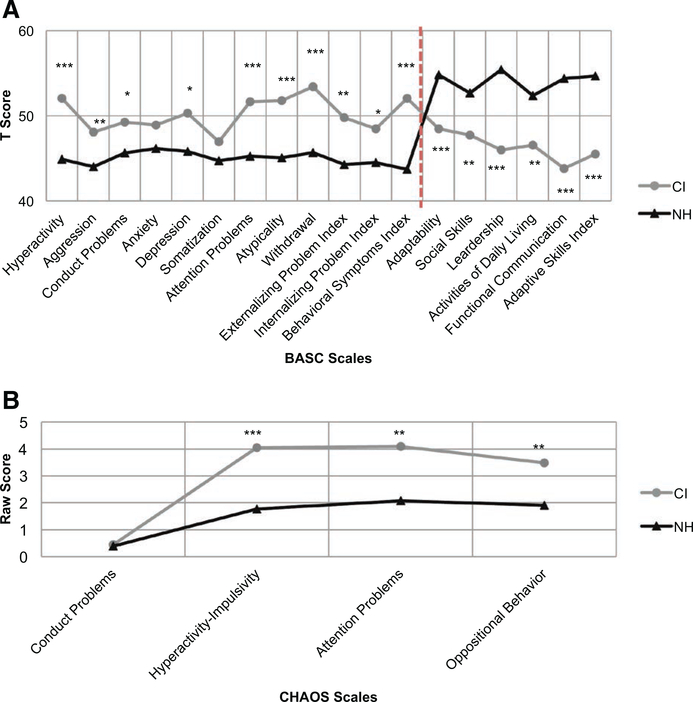
Figure 1.
Figure 1.
Group difference in psychosocial outcomes. A, BASC parent-reported scales that significantly differ between CI and NH participants (collapsed across age). N = 57 CI users and N = 53 NH peers. Higher t scores on scales constituting the externalizing problem index, the internalizing problem index, and the behavioral symptoms index indicate behavioral deficits (scales to the left of vertical dashed line). Lower t scores on scales constituting the adaptive skills index indicate maladaptive behaviors (scales to the right of vertical dashed line). ***p < 0.001; **p < 0.01; *p < 0.05. B, CHAOS parent-reported scales that significantly differ between CI and NH participants (collapsed across age). N = 57 CI users and N = 52 NH peers. Higher raw scores indicate greater behavioral problems. ***p < 0.001; **p < 0.01. BASC indicates Behavior Assessment System for Children; CHAOS, Conduct Hyperactive Attention Problem Oppositional Symptom; CI, cochlear implant; NH, normal hearing.
Figure 2.
Figure 2.
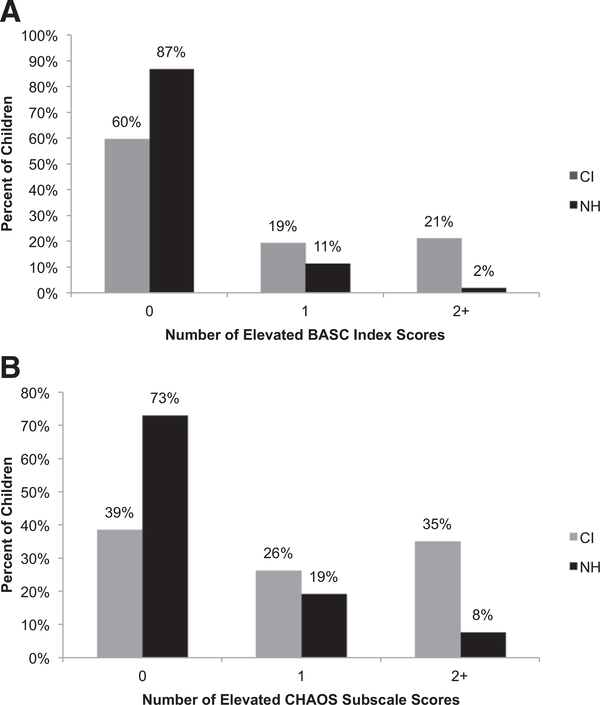
Number of elevated psychosocial scores. A, Number of elevated BASC index scores. The BASC contains 4 indices: externalizing problem, internalizing problem, behavioral symptoms, and adaptive skills. Percentages represent children with BASC t scores within the at-risk to clinically significant range. Externalizing problem index, internalizing problem index, and behavioral symptoms index (at-risk: t scores of 60–69; clinically significant: t scores ≥70); adaptive skills index (at-risk: t scores of 31–40; clinically significant: t scores ≤30). B, Number of elevated CHAOS subscale scores. The CHAOS contains 4 subscales: hyperactivity–impulsivity, oppositional behavior, conduct problems, and attention problems. Percentages represent children with CHAOS raw scores within the borderline problem (raw scores of 5–9) to problem (raw scores ≥10) range. BASC indicates Behavior Assessment System for Children; CHAOS, Conduct Hyperactive Attention Problem Oppositional Symptom.

References

    1. Achenbach TM (1991). Integrative Guide for the 1991 CBCL/4–18, YSR, and TRF Profiles. Burlington, VT: University of Vermont, Department of Psychiatry.
    1. AuBuchon AM, Pisoni DB, Kronenberger WG (2015). Verbal processing speed and executive functioning in long-term cochlear implant users. J Speech Lang Hear Res, 58, 151–162. - PMC - PubMed
    1. Barker DH, Quittner AL, Fink NE, et al. ; The CDaCI Investigative Team. (2009). Predicting behavior problems in deaf and hearing children: The influences of language, attention, and parent–child communication. Dev Psychopathol, 21, 373–321. - PMC - PubMed
    1. Barkley RA (2012). Executive Functions: What They Are, How They Work, and Why They Evolved. New York, NY: The Guildford Press.
    1. Baron RM, & Kenny DA (1986). The moderator-mediator variable distinction in social psychological research: Conceptual, strategic, and statistical considerations. J Pers Soc Psychol, 51, 1173–1182. - PubMed

Publication types