


Diffusion tractography reveals pervasive asymmetry of cerebral white matter tracts in the bottlenose dolphin (Tursiops truncatus)
- PMID: 29189908
- PMCID: PMC5884918
- DOI: 10.1007/s00429-017-1525-9
Diffusion tractography reveals pervasive asymmetry of cerebral white matter tracts in the bottlenose dolphin (Tursiops truncatus)
Abstract
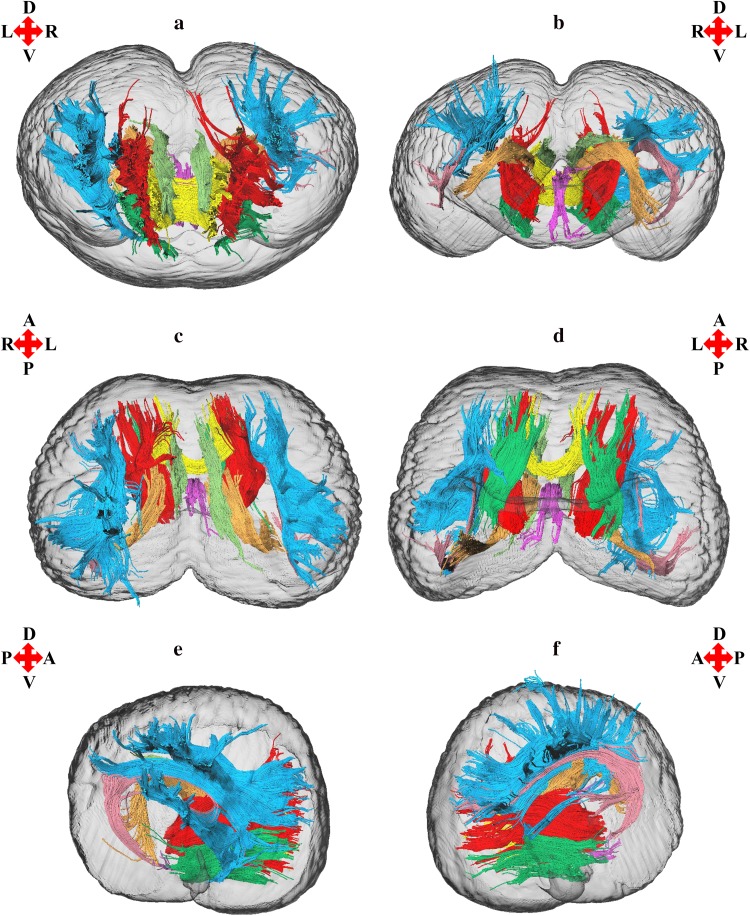
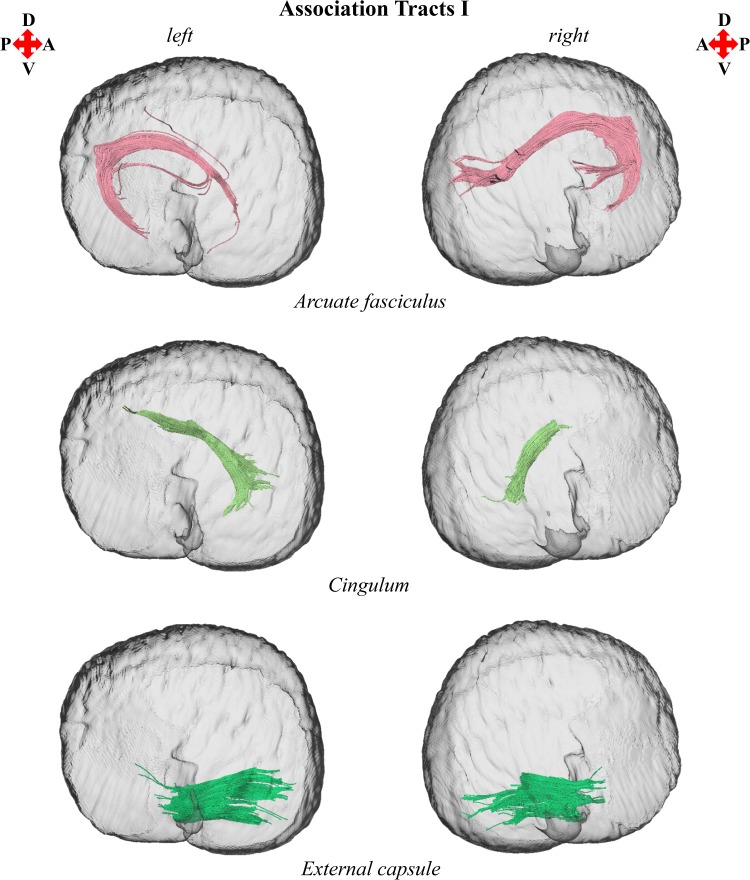
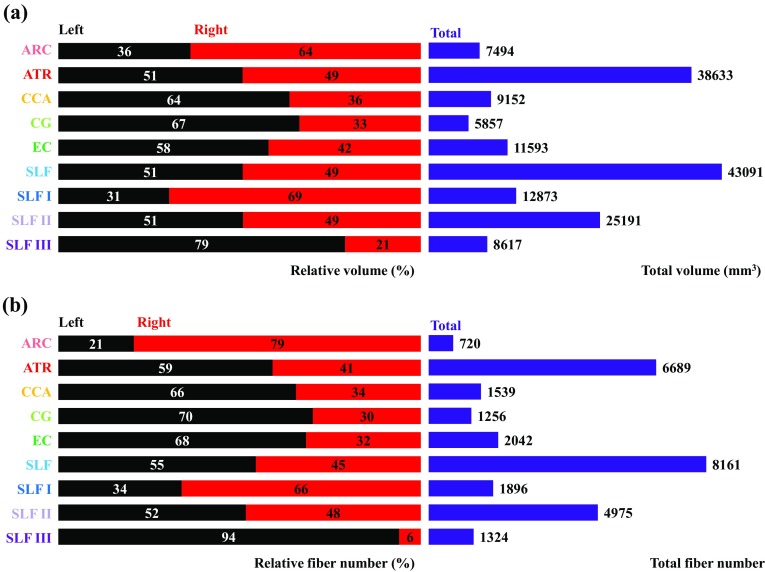
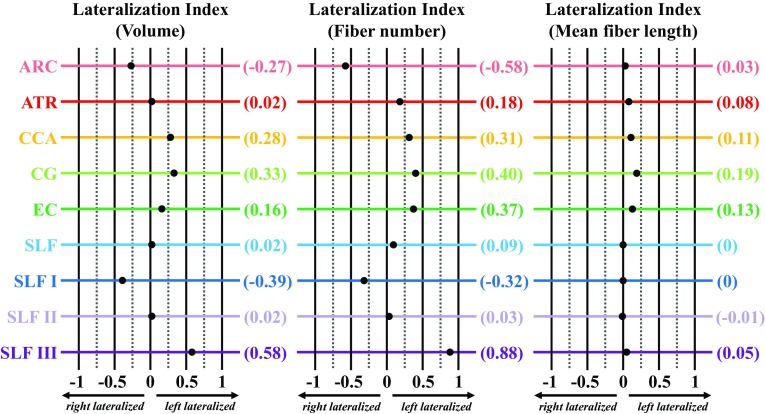
Brain enlargement is associated with concomitant growth of interneuronal distance, increased conduction time, and reduced neuronal interconnectivity. Recognition of these functional constraints led to the hypothesis that large-brained mammals should exhibit greater structural and functional brain lateralization. As a taxon with the largest brains in the animal kingdom, Cetacea provides a unique opportunity to examine asymmetries of brain structure and function. In the present study, diffusion tensor imaging and tractography were used to investigate cerebral white matter asymmetry in the bottlenose dolphin (Tursiops truncatus). Widespread white matter asymmetries were observed with the preponderance of tracts exhibiting leftward structural asymmetries. Leftward lateralization may reflect differential processing and execution of behaviorally variant sensory and motor functions by the cerebral hemispheres. The arcuate fasciculus, an association tract linked to human language evolution, was isolated and exhibited rightward asymmetry suggesting a right hemisphere bias for conspecific communication unlike that of most mammals. This study represents the first examination of cetacean white matter asymmetry and constitutes an important step toward understanding potential drivers of structural asymmetry and its role in underpinning functional and behavioral lateralization in cetaceans.
Keywords: Arcuate fasciculus; Asymmetry; Bottlenose dolphin (Tursiops truncatus); Diffusion tensor imaging (DTI); Tractography; White matter.
Conflict of interest statement
Conflict of interest
AKW, RJT, SHR, and MS declare no conflict of interest.
Funding
AKW was supported by the National Science Foundation Graduate Research Fellowship Program, Scripps Institution of Oceanography Graduate Department, and University of California-San Diego Graduate Division. SHR was partially supported by the Office of Naval Research (Project N0001417WX01558). The funders had no role in the study design, data collection, analysis, or interpretation, preparation of the manuscript, or decision to publish.
Ethics statement
No live animals were used for this study.
Figures

References
-
- Beaulieu C. The biological basis of diffusion anisotropy. In: Johansen-Berg H, Behrens TEJ, editors. Diffusion MRI: from quantitative measurement to in vivo neuroanatomy. 2. Amsterdam: Elsevier Academic Press; 2014. pp. 155–183.
MeSH terms
Grants and funding
LinkOut - more resources
Full Text Sources
Other Literature Sources
Research Materials
