


doi: 10.1021/jacs.7b10942.
Epub 2017 Nov 30.
DNA Damage Emanating From a Neutral Purine Radical Reveals the Sequence Dependent Convergence of the Direct and Indirect Effects of γ-Radiolysis
Affiliations
- PMID: 29190086
- PMCID: PMC5729073
- DOI: 10.1021/jacs.7b10942
Item in Clipboard
DNA Damage Emanating From a Neutral Purine Radical Reveals the Sequence Dependent Convergence of the Direct and Indirect Effects of γ-Radiolysis
J Am Chem Soc.
.
Abstract
Nucleobase radicals are the major intermediates generated by the direct (e.g., dA•+) and indirect (e.g., dA•) effects of γ-radiolysis. dA• was independently generated in DNA for the first time. The dA•+/dA• equilibrium, and consequently the reactivity in DNA, is significantly shifted toward the radical cation by a flanking dA. Tandem lesions emanating from dA• are the major products when the reactive intermediate is flanked by a 5'-dGT. In contrast, when dA• is flanked by dA, the increased dA•+ pKa results in DNA damage arising from hole transfer. This is the first demonstration that sequence effects lead to the intersection of the direct and indirect effects of ionizing radiation.
Figures

dA• induced strand damage in 5′-32P-2. (a.) Denaturing PAGE analysis (b.) Proposed mechanism for tandem lesion formation.

dA•+ induced hole transfer in 5′-32P-6. (a.) Denaturing PAGE analysis (b.) Proposed mechanism for sequence dependent dA•+ formation, and subsequent hole transfer.

Sequence and pH influence on strand damage. (a) pH 7.2 (b) pH 5.1. G5′, GM, and G3′ refer to the dGs in the dGGG triplet of each respective duplex. Values are the average ± std. dev. of 3 replicates.

pH Dependent strand damage in 5′-32P-11. (a.) Denaturing PAGE analysis. (b.) Proposed mechanism of pH dependent switching of strand damage induced by dA• and dA•+.

Reactive intermediate formation from dA by γ-radiolysis.

Proposed reaction pathways of dA• in DNA.
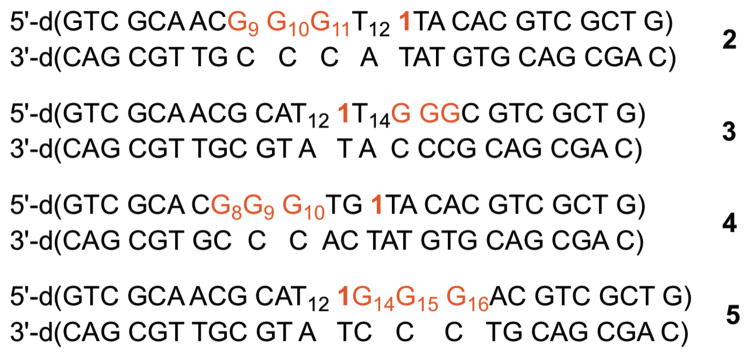
DNA duplexes lacking A-stacks.

DNA duplexes containing A-stacks.
References
-
- von Sonntag C. Free-Radical-Induced DNA Damage and Its Repair. Springer-Verlag; Berlin: 2006.
-
- Galm U, Hager MH, Van Lanen SG, Ju J, Thorson JS, Shen B. Chem Rev. 2005;105:739–758. - PubMed
-
- Bamatraf MMM, O’Neill P, Rao BSM. J Phys Chem B. 2000;104:636–642.
-
- Dizdaroglu M, Jaruga P. Free Rad Res. 2012;46:382–419. - PubMed
Publication types
MeSH terms
Substances
Grants and funding
LinkOut - more resources
Full Text Sources
Other Literature Sources
