


Drug delivery vectors based on filamentous bacteriophages and phage-mimetic nanoparticles
- PMID: 29191048
- PMCID: PMC8241185
- DOI: 10.1080/10717544.2017.1410259
Drug delivery vectors based on filamentous bacteriophages and phage-mimetic nanoparticles
Abstract
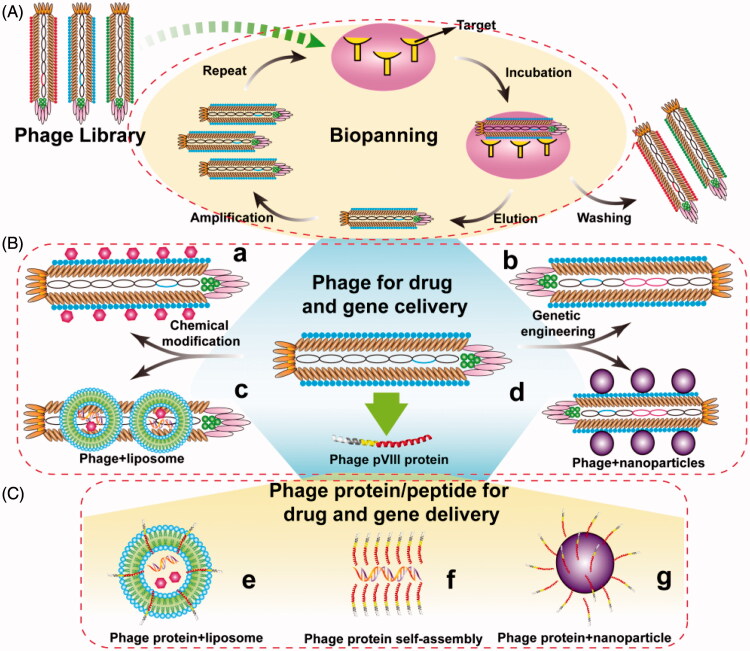
With the development of nanomedicine, a mass of nanocarriers have been exploited and utilized for targeted drug delivery, including liposomes, polymers, nanoparticles, viruses, and stem cells. Due to huge surface bearing capacity and flexible genetic engineering property, filamentous bacteriophage and phage-mimetic nanoparticles are attracting more and more attentions. As a rod-like bio-nanofiber without tropism to mammalian cells, filamentous phage can be easily loaded with drugs and directly delivered to the lesion location. In particular, chemical drugs can be conjugated on phage surface by chemical modification, and gene drugs can also be inserted into the genome of phage by recombinant DNA technology. Meanwhile, specific peptides/proteins displayed on the phage surface are able to conjugate with nanoparticles which will endow them specific-targeting and huge drug-loading capacity. Additionally, phage peptides/proteins can directly self-assemble into phage-mimetic nanoparticles which may be applied for self-navigating drug delivery nanovehicles. In this review, we summarize the production of phage particles, the identification of targeting peptides, and the recent applications of filamentous bacteriophages as well as their protein/peptide for targeting drug delivery in vitro and in vivo. The improvement of our understanding of filamentous bacteriophage and phage-mimetic nanoparticles will supply new tools for biotechnological approaches.
Keywords: Filamentous phage; drug delivery; nanoparticles; phage display; targeting.
Conflict of interest statement
The authors declare that there is no conflict of interests regarding the publication of this paper.
Figures
References
-
- Accardo A, Ringhieri P, Tesauro D, et al. (2013). Liposomes derivatized with tetrabranched neurotensin peptides via click chemistry reactions. New J Chem 37:3528–34.
-
- Arap W, Kolonin MG, Trepel M, et al. (2002). Steps toward mapping the human vasculature by phage display. Nat Med 8:121–7. - PubMed
-
- Arap W, Pasqualini R, Ruoslahti E. (1998). Cancer treatment by targeted drug delivery to tumor vasculature in a mouse model. Science 279:377–80. - PubMed
-
- Avvakumova S, Colombo M, Tortora P, et al. (2014). Biotechnological approaches toward nanoparticle biofunctionalization. Trends Biotechnol 32:11–20. - PubMed
Publication types
MeSH terms
Substances
LinkOut - more resources
Full Text Sources
Other Literature Sources
Medical
Research Materials
