


Mobile electronic versus paper case report forms in clinical trials: a randomized controlled trial
- PMID: 29191176
- PMCID: PMC5709849
- DOI: 10.1186/s12874-017-0429-y
Mobile electronic versus paper case report forms in clinical trials: a randomized controlled trial
Abstract
Background: Regulations, study design complexity and amounts of collected and shared data in clinical trials render efficient data handling procedures inevitable. Recent research suggests that electronic data capture can be key in this context but evidence is insufficient. This randomized controlled parallel group study tested the hypothesis that time efficiency is superior when electronic (eCRF) instead of paper case report forms (pCRF) are used for data collection. We additionally investigated predictors of time saving effects and data integrity.
Methods: This study was conducted on top of a clinical weight loss trial performed at a clinical research facility over six months. All study nurses and patients participating in the clinical trial were eligible to participate and randomly allocated to enter cross-sectional data obtained during routine visits either through pCRF or eCRF. A balanced randomization list was generated before enrolment commenced. 90 and 30 records were gathered for the time that 27 patients and 2 study nurses required to report 2025 and 2037 field values, respectively. The primary hypothesis, that eCRF use is faster than pCRF use, was tested by a two-tailed t-test. Analysis of variance and covariance were used to evaluate predictors of entry performance. Data integrity was evaluated by descriptive statistics.
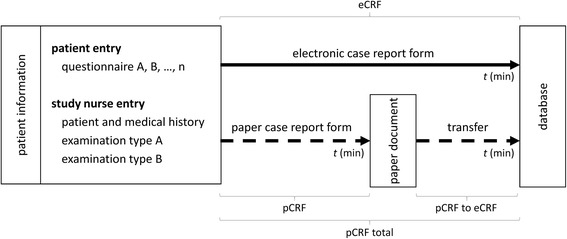
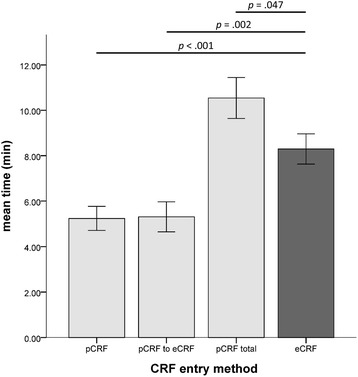
Results: All randomized patients were included in the study (eCRF group n = 13, pCRF group n = 14). eCRF, as compared to pCRF, data collection was associated with significant time savings across all conditions (8.29 ± 5.15 min vs. 10.54 ± 6.98 min, p = .047). This effect was not defined by participant type, i.e. patients or study nurses (F(1,112) = .15, p = .699), CRF length (F(2,112) = .49, p = .609) or patient age (Beta = .09, p = .534). Additional 5.16 ± 2.83 min per CRF were saved with eCRFs due to data transcription redundancy when patients answered questionnaires directly in eCRFs. Data integrity was superior in the eCRF condition (0 versus 3 data entry errors).
Conclusions: This is the first study to prove in direct comparison that using eCRFs instead of pCRFs increases time efficiency of data collection in clinical trials, irrespective of item quantity or patient age, and improves data quality.
Trial registration: Clinical Trials NCT02649907 .
Keywords: Data handling; Electronic case report form; REDCap; Time efficiency.
Conflict of interest statement
Authors’ information
Not applicable.
Ethics approval and consent to participate
This study was approved by the local ethics committee review board and complied with local data protection regulations Study nurses gave oral informed consent while patients had to provide written informed consent prior to data collection.
Consent for publication
Not applicable.
Competing interests
The authors declare that they have no competing interests.
Publisher’s Note
Springer Nature remains neutral with regard to jurisdictional claims in published maps and institutional affiliations.
Figures

References
-
- Number of Registered Studies Over Time. In: Trends, Charts, and Maps. 2016. https://clinicaltrials.gov/ct2/resources/trends#TypesOfRegisteredStudies. Accessed 11 Dec 2016.
-
- Jones CE, Munoz FM, Kochhar S, Vergnano S, Cutland CL, Steinhoff M, Black S, Heininger U, Bonhoeffer J, Heath PT. Guidance for the collection of case report form variables to assess safety in clinical trials of vaccines in pregnancy. Vaccine. 2016;34(49):6007–6014. doi: 10.1016/j.vaccine.2016.07.007. - DOI - PMC - PubMed
-
- Jha AK, Burke MF, DesRoches C, Joshi MS, Kralovec PD, Campbell EG, Buntin MB. Progress toward meaningful use: hospitals’ adoption of electronic health records. Am J Manag Care. 2011;17(12 Spec No.):SP117–SP124. - PubMed
Publication types
MeSH terms
Associated data
LinkOut - more resources
Full Text Sources
Other Literature Sources
Medical
Miscellaneous
