NudE regulates dynein at kinetochores but is dispensable for other dynein functions in the C. elegans early embryo
- PMID: 29192061
- PMCID: PMC5818066
- DOI: 10.1242/jcs.212159
NudE regulates dynein at kinetochores but is dispensable for other dynein functions in the C. elegans early embryo
Abstract
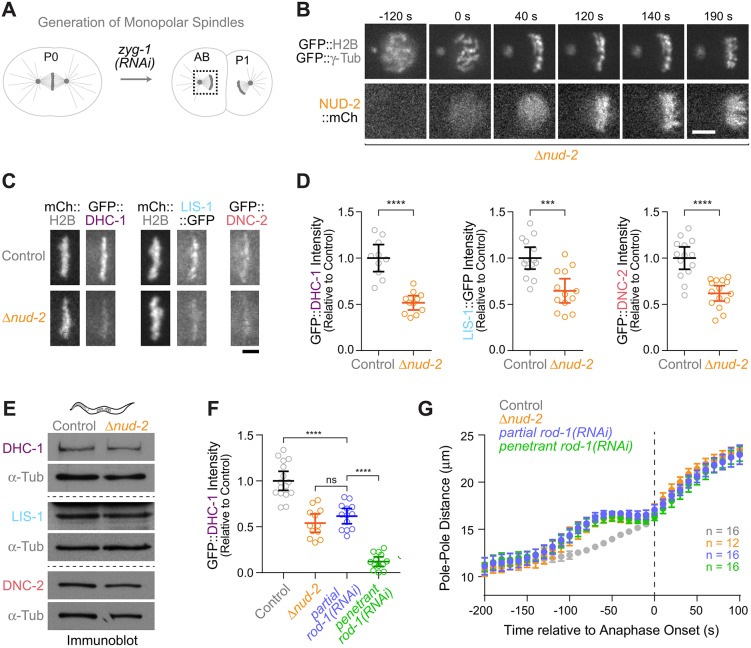
In mitosis, the molecular motor dynein is recruited to kinetochores by the Rod-Zw10-Zwilch complex (RZZ) and Spindly to control spindle assembly checkpoint (SAC) signaling and microtubule attachment. How the ubiquitous dynein co-factors Lis1 and NudE contribute to these functions remains poorly understood. Here, we show that the C. elegans NudE homolog NUD-2 is dispensable for dynein- and LIS-1-dependent mitotic spindle assembly in the zygote. This facilitates functional characterization of kinetochore-localized NUD-2, which is recruited by the CENP-F-like proteins HCP-1 and HCP-2 independently of RZZ-Spindly and dynein-LIS-1. Kinetochore dynein levels are reduced in Δnud-2 embryos, and, as occurs upon RZZ inhibition, loss of NUD-2 delays the formation of load-bearing kinetochore-microtubule attachments and causes chromatin bridges in anaphase. Survival of Δnud-2 embryos requires a functional SAC, and kinetochores without NUD-2 recruit an excess of SAC proteins. Consistent with this, SAC signaling in early Δnud-2 embryos extends mitotic duration and prevents high rates of chromosome mis-segregation. Our results reveal that both NUD-2 and RZZ-Spindly are essential for dynein function at kinetochores, and that the gain in SAC strength during early embryonic development is relevant under conditions that mildly perturb mitosis.
Keywords: Dynein; Kinetochore; Lis1; NDE1; NudE; PAFAH1B1; RZZ; Spindle assembly checkpoint.
© 2018. Published by The Company of Biologists Ltd.
Conflict of interest statement
Competing interestsThe authors declare no competing or financial interests.
Figures




References
-
- Barbosa D. J., Duro J., Prevo B., Cheerambathur D. K., Carvalho A. X. and Gassmann R. (2017). Dynactin binding to tyrosinated microtubules promotes centrosome centration in C. elegans by enhancing dynein-mediated organelle transport. PLoS Genet. 13, e1006941 10.1371/journal.pgen.1006941 - DOI - PMC - PubMed
Publication types
MeSH terms
Substances
Grants and funding
LinkOut - more resources
Full Text Sources
Other Literature Sources
Miscellaneous