. 2017 Nov 30;8(1):1870.
doi: 10.1038/s41467-017-01610-4.

Multi-scale magnetic mapping of serpentinite carbonation

Affiliations

Multi-scale magnetic mapping of serpentinite carbonation

Masako Tominaga et al. Nat Commun. .

Abstract

Peridotite carbonation represents a critical step within the long-term carbon cycle by sequestering volatile CO2 in solid carbonate. This has been proposed as one potential pathway to mitigate the effects of greenhouse gas release. Most of our current understanding of reaction mechanisms is based on hand specimen and laboratory-scale analyses. Linking laboratory-scale observations to field scale processes remains challenging. Here we present the first geophysical characterization of serpentinite carbonation across scales ranging from km to sub-mm by combining aeromagnetic observations, outcrop- and thin section-scale magnetic mapping. At all scales, magnetic anomalies coherently change across reaction fronts separating assemblages indicative of incipient, intermittent, and final reaction progress. The abundance of magnetic minerals correlates with reaction progress, causing amplitude and wavelength variations in associated magnetic anomalies. This correlation represents a foundation for characterizing the extent and degree of in situ ultramafic rock carbonation in space and time.


Conflict of interest statement

The authors declare no competing financial interests.

Figures

Fig. 1
Fig. 1
Aeromagnetic anomaly and geology of the Linnajavri area. a Magnetic anomaly map from the DRAGON aeromagnetic survey of the Linnajavri area showing the location of pristine and altered serpentinite bodies. b, c Geological maps of the Linnajavri Ultramafic Complex (LUC) northern b and southern parts c , . The location of outcrop-scale magnetic survey lines (Fig. 6) is indicated in b, c. Geological and geophysical data do not exist for the blank area
Fig. 2
Fig. 2
Field and microtextural relationships of carbonated serpentinite. a Field image of a sharp soapstone reaction front locally following fractures in the serpentinite. b Typical appearance of listvenite in the field with abundant quartz veinlets in front of massive soapstone (person for scale). ce Representative micrographs of serpentinite, soapstone, and listvenite mineral assemblages in cross-polarized transmitted light. fh Reflected light micrographs of oxide and sulfide phases in serpentinite, soapstone, and listvenite. Magnetite in serpentinite and soapstone is present as large grains and as fine grained matrix constituent with grain-sizes between ~10 µm and ~500 µm. Listvenite contains in most cases only relict amounts of magnetite and sometime additional pyrite and chalcopyrite together with minor pyrrhotite. Mineral abbreviations follow Whitney and Evans
Fig. 3
Fig. 3
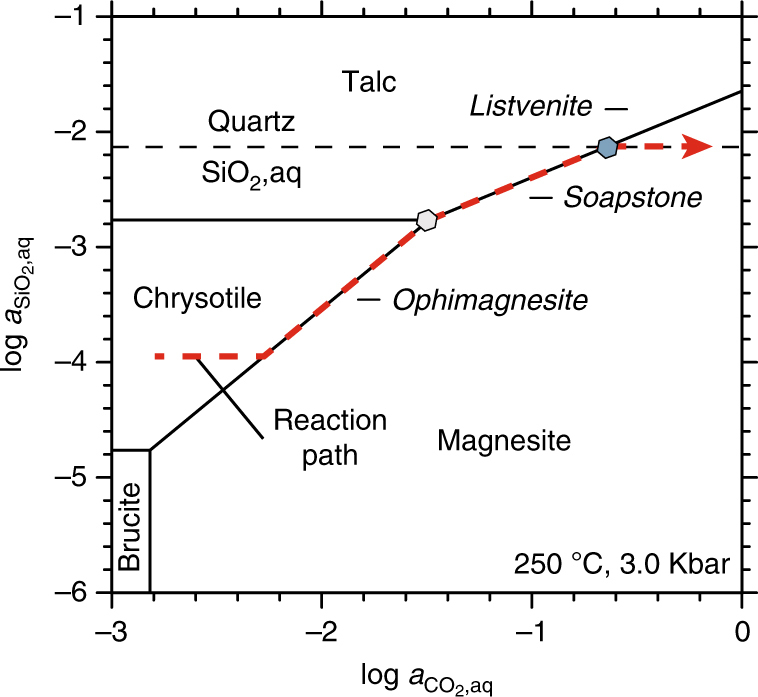
Reaction path of serpentinite carbonation. CO2–SiO2 activity diagram in the system MgO–SiO2–H2O–CO2 showing the reaction path of progressive serpentinite carbonation resulting in ophimagnesite (serpentine + magnesite), soapstone (talc + magnesite), and listvenite (quartz + magnesite) formation at constant pressure and temperature. Hexagon symbols mark CO2 activity values used in Fig. 9. Mineral stability fields are calculated using the computer program Supcrt and thermodynamic database dprons96.dat, quartz saturation is based on the thermodynamic data of Rimstidt. The estimated pressure of 3 kbar is based on a normal thermobaric gradient in a slightly thickened crust (12 bar/°C). The same diagram calculated for alteration temperatures of 180 °C and 300 °C is included in the supplement (Supplementary Fig. 1)
Fig. 4
Fig. 4
Magnesite growth textures. Back-scattered electron (BSE) images showing magnesite textures in soapstone ac and listvenite df. Anhedral to subhedral magnesite in the soapstone frequently contains magnetite inclusions, whereas euhedral magnesite rims related to listvenite formation are in most cases devoid of magnetite. The zonation of listvenite-magnesite is caused by elevated Fe/Mg in the euhedral rim
Fig. 5
Fig. 5
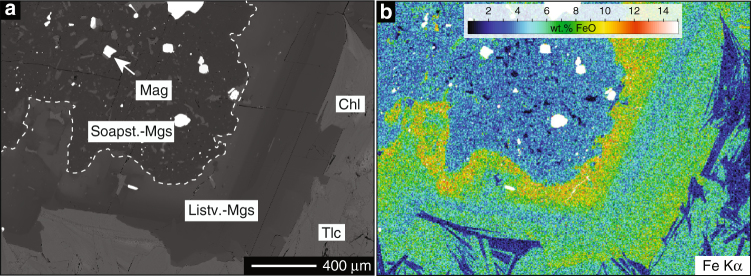
Compositional zoning in listvenite magnesite BSE image. a and quantitative element map of zoned magnesite b in the listvenite showing the increase in FeO in the euhedral magnesite rim overgrowing a low FeO, magnetite inclusion rich, anhedral magnesite core related to earlier soapstone formation
Fig. 6
Fig. 6
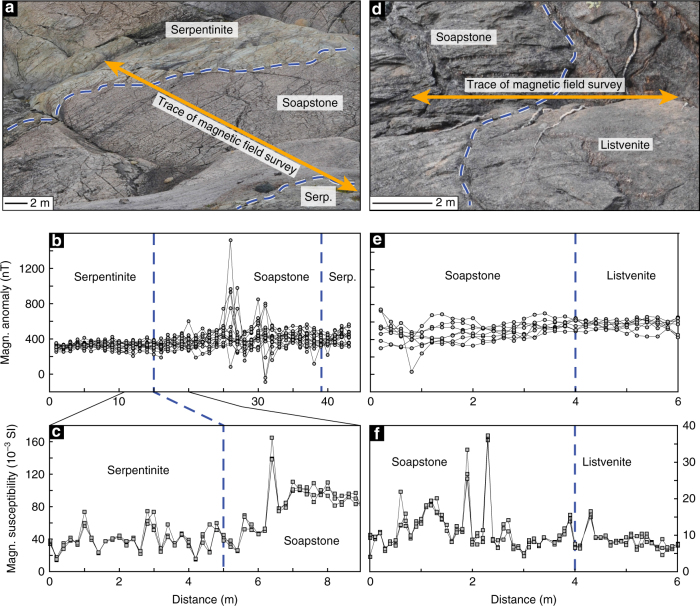
Outcrop magnetic anomaly measurements. Outcrop scale total field and magnetic susceptibility mapping across the serpentinite-soapstone interface a and the soapstone-listvenite interface d. Total magnetic field values across the serpentinite-soapstone interface were acquired along 16 transects (along the orange line in a) with a sampling interval and line spacing of 0.6 m and 0.2 m, respectively b. A total of three magnetic susceptibility measurement profiles were acquired along a portion of the same transect c. Total magnetic field values across the soapstone-listvenite interface were acquired along 8 transects (along the orange line in d) with a sampling interval and line spacing of 0.2 m e. A total of three magnetic susceptibility measurement profiles were acquired along the same transect f
Fig. 7
Fig. 7
Thin section magnetic anomaly measurements. a NRM and ARM (with the peak alternating field of 260 mT and the DC bias field of 100 μΤ) in 30 µm-thickness thin sections of serpentinite, soapstone and two listvenite samples acquired by SQUID microscopy. The samples are mounted on 1-inch discs. Shown is the total magnetic field at a height of 170 µm above the samples. For comparison, the SQUID images are presented with the color scale of 0–2 µT (Note the grains in the serpentinite and soapstone samples are mostly >2 µT). Listvenite samples show significantly weaker magnetic signal strength compared to serpentinite and particularly soapstone. Relict magnetite grains in the listvenite are mostly present as inclusions in magnesite cores and hence passivated from reaction during listvenite formation. b Schematic of changes in magnetite abundance and predicted magnetic field strength changes versus reaction progress of ultramafic rock serpentinization and carbonation. Magnetic susceptibility values are based on Maffione et al. and may differ in other alteration settings depending on rock composition and alteration temperature. Diamond symbols show the calculated bulk rock content of magnetite in the different alteration zones assuming bulk rock Fe3+ is exclusively present in magnetite (Supplementary Table 1). Error bars denote the 1σ standard deviation of averaged bulk Fe3+ weight fractions
Fig. 8
Fig. 8
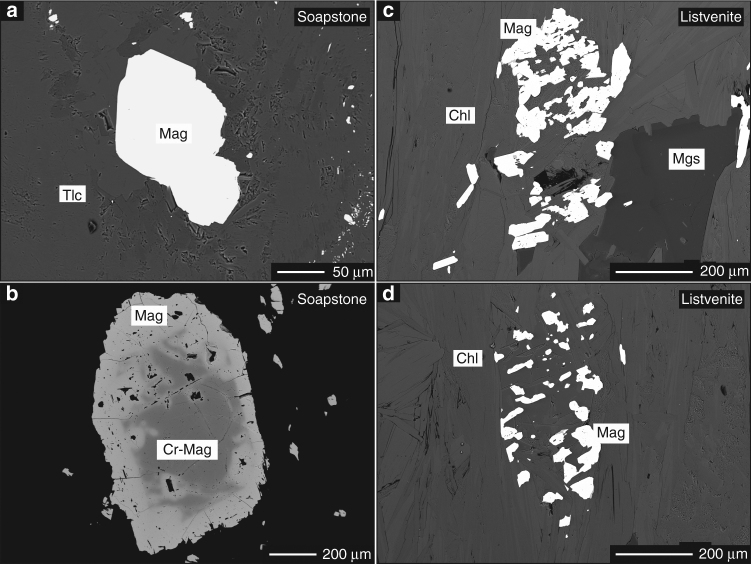
Reaction textures of magnetic carrier minerals. BSE images showing a comparison of magnetite textures between soapstone a and b and listvenite c and d. Magnetite in the soapstone is coarse grained and exhibits a subhedral crystal shape. In contrast, magnetite in the listvenite is usually fine grained with individual grains forming clusters that outline the size and shape of magnetite in the soapstone. Soapstone magnetite typically contains a chromium–bearing magnetite (Cr–Mag) core b
Fig. 9
Fig. 9
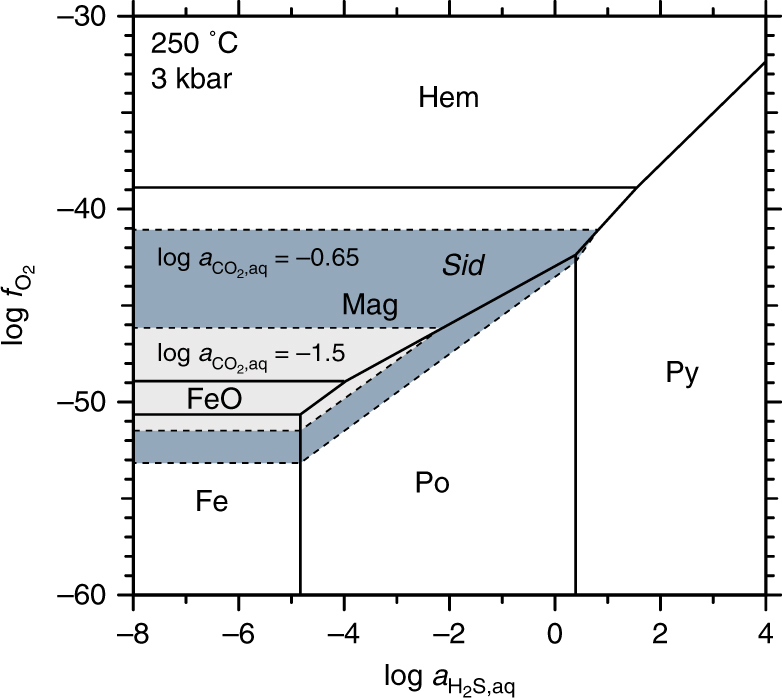
Thermodynamic stability of magnetic signal carrier minerals. H2S–O2 activity diagram in the system Fe–O2–H2S showing the stability of native iron, iron oxide and iron sulfide phases as a function of fluid H2S activity and oxygen fugacity. The shaded areas indicate stability of siderite over native iron, iron oxide and iron sulfide phases at fluid CO2 activities corresponding to soapstone (gray field) and listvenite (dark gray field) formation (hexagon symbols in Fig. 3). The magnetite stability field is significantly reduced relative to siderite at a fluid CO2 activity that stabilizes the listvenite assemblage. The diagram was calculated using the computer program Supcrt and thermodynamic database dprons96.dat. The same diagram calculated for alteration temperatures of 180 °C and 300 °C is included in the supplement (Supplementary Fig. 2)

References

    1. Hacker, B. R. H2O subduction beyond arcs. Geochem. Geophys. Geosyst. 9, Q03001, doi:10.1029/2007GC001707 (2008).
    1. Dasgupta R, Hirschmann MM. The deep carbon cycle and melting in Earth’s interior. Earth Planet Sci. Lett. 2010;298:1–13. doi: 10.1016/j.epsl.2010.06.039. - DOI
    1. Kelemen PB, Matter J. In situ carbonation of peridotite for CO2 storage. Proc. Natl Acad. Sci. USA. 2008;105:17295–17300. doi: 10.1073/pnas.0805794105. - DOI
    1. Kelemen PB, et al. Rates and mechanisms of mineral carbonation in peridotite: natural processes and recipes for enhanced, in situ CO2 capture and storage. Annu. Rev. Earth Planet Sci. 2011;39:545–576. doi: 10.1146/annurev-earth-092010-152509. - DOI
    1. Lackner KS, Wendt CH, Butt DP, Joyce EL, Sharp DH. Carbon dioxide disposal in carbonate minerals. Energy. 1995;20:1153–1170. doi: 10.1016/0360-5442(95)00071-N. - DOI

Publication types

LinkOut - more resources