Review
. 2018 Jan;25(1):169-179.
doi: 10.1038/cdd.2017.187. Epub 2017 Dec 1.

Relevance of the p53-MDM2 axis to aging

Affiliations
Review

Relevance of the p53-MDM2 axis to aging

Danyi Wu et al. Cell Death Differ. 2018 Jan.

Abstract

In response to varying stress signals, the p53 tumor suppressor is able to promote repair, survival, or elimination of damaged cells - processes that have great relevance to organismal aging. Although the link between p53 and cancer is well established, the contribution of p53 to the aging process is less clear. Delineating how p53 regulates distinct aging hallmarks such as cellular senescence, genomic instability, mitochondrial dysfunction, and altered metabolic pathways will be critical. Mouse models have further revealed the centrality and complexity of the p53 network in aging processes. While naturally aged mice have linked longevity with declining p53 function, some accelerated aging mice present with chronic p53 activation, whose phenotypes can be rescued upon p53 deficiency. Further, direct modulation of the p53-MDM2 axis has correlated elevated p53 activity with either early aging or with delayed-onset aging. We speculate that p53-mediated aging phenotypes in these mice must have (1) stably active p53 due to MDM2 dysregulation or chronic stress or (2) shifted p53 outcomes. Pinpointing which p53 stressors, modifications, and outcomes drive aging processes will provide further insights into our understanding of the human aging process and could have implications for both cancer and aging therapeutics.


Conflict of interest statement

The authors declare no conflict of interest.

Figures
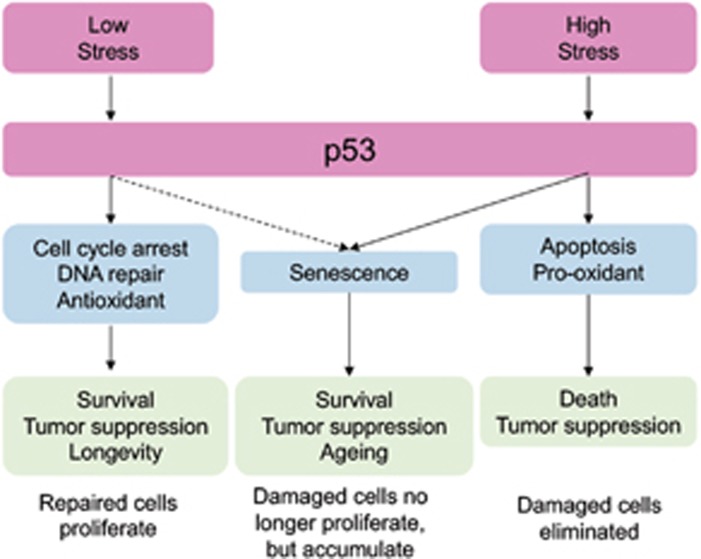
Figure 1
Figure 1
Stress levels regulate alternate p53 responses. The tumor suppressor p53 mediates both survival and killer cellular outcomes in response to stressors. Under low stress conditions, p53 will initiate repair and cell cycle arrest mechanisms that will promote cell survival. Under acute stress conditions, p53 will eliminate the damaged cells from the proliferative pool through apoptosis, senescence, and more
Figure 2
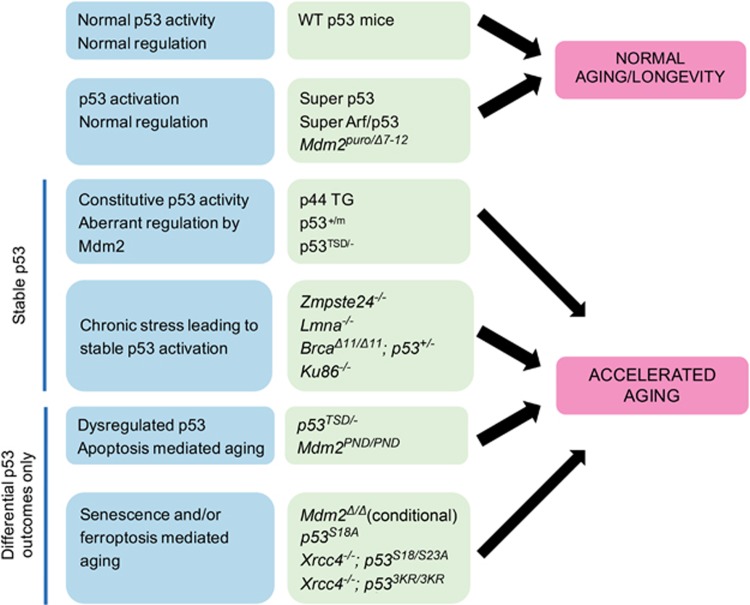
Figure 2
p53-mediated accelerated aging requires stable p53 or differential p53 outcomes. Speculation as to how p53 regulation is linked to aging in mouse models. When p53 is properly regulated, it leads to normal aging phenotypes in mice. However, constitutive p53 activity due to aberrant regulation through deletion or modifications of the N terminus of p53 (the primary interaction site with Mdm2) leads to accelerated aging phenotypes. Mice with defects in double-strand break repair and HGPS mouse models that display chronic nuclear structural stress lead to chronic p53 activation and accelerated aging phenotypes. Engineered mice that lack the entire spectrum of p53 outcomes but can promote differential outcomes (apoptosis, ferroptosis, and senescence) also display accelerated aging phenotypes. This figure is adapted from Serrano and Blasco
Figure 3
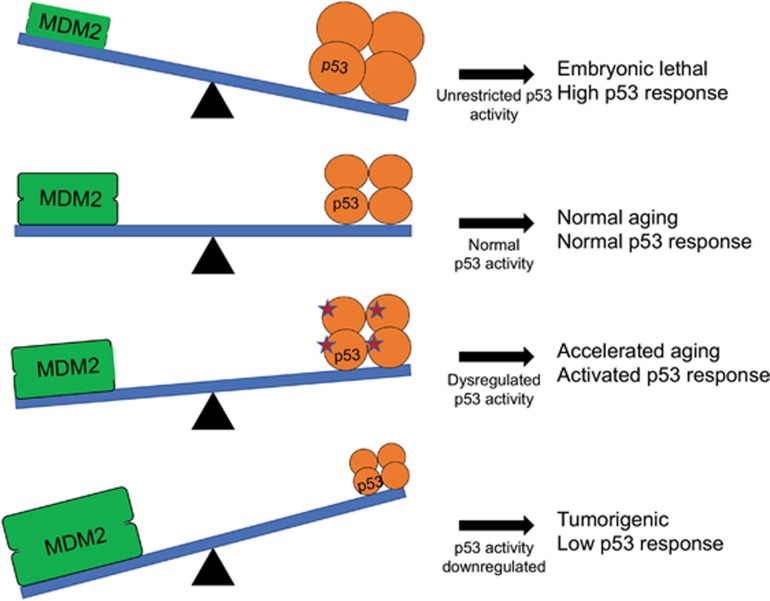
Figure 3
Mdm2–p53 balance is required for normal development. Proper regulation (balance) of p53 by MDM2 is needed for normal aging. Aberrant regulation can lead to tumorigenic, accelerated aging, or lethal phenotypes. Figure is taken and adapted from Poyurovsky and Prives
Figure 4
Figure 4
Lifespan and cancer resistance are related to p53 stability. Model for proposed relationship between lifespan and cancer resistance and their links to p53 protein stability. Mice with low p53 or no p53 due to deletion of one or two TP53 alleles are tumor prone and have shortened lifespans due to cancer. Mice with normal p53 levels or stability have normal lifespans, while super-p53/super-ARF mice have delayed-onset aging. Mice with increased p53 stability can lead to hyper-activation and accelerated aging phenotypes (dip in lifespan), but greater cancer resistance. Finally, mice with likely super-stable p53 due to Mdm2 or MdmX deletion leads to embryonic lethal phenotypes. Dotted line refers to inability to assess cancer resistance due to embryonic lethality. Lifespan and cancer resistance curves are diagrammatic rather than quantitative in terms of actual lifespan and resistance of mice.

References

    1. Kaeberlein M, Rabinovitch PS, Martin GM. Healthy aging: the ultimate preventative medicine. Science 2015; 350: 1191–1193. - PMC - PubMed
    1. Passarino G, Montesanto A, De Rango F, Garasto S, Berardelli M, Domma F et al. A cluster analysis to define human aging phenotypes. Biogerontology 2007; 8: 283–290. - PubMed
    1. Campisi J. Aging, cellular senescence, and cancer. Annu Rev Physiol 2013; 75: 685–705. - PMC - PubMed
    1. Balaban RS, Nemoto S, Finkel T. Mitochondria, oxidants, and aging. Cell 2005; 120: 483–495. - PubMed
    1. Vousden KH, Prives C. Blinded by the light: the growing complexity of p53. Cell 2009; 137: 413–431. - PubMed