Review
. 2017 Dec 1;18(12):2574.
doi: 10.3390/ijms18122574.

Drug Resistance Driven by Cancer Stem Cells and Their Niche

Affiliations
Review

Drug Resistance Driven by Cancer Stem Cells and Their Niche

Marta Prieto-Vila et al. Int J Mol Sci. .

Abstract

Drug resistance represents one of the greatest challenges in cancer treatment. Cancer stem cells (CSCs), a subset of cells within the tumor with the potential for self-renewal, differentiation and tumorigenicity, are thought to be the major cause of cancer therapy failure due to their considerable chemo- and radioresistance, resulting in tumor recurrence and eventually metastasis. CSCs are situated in a specialized microenvironment termed the niche, mainly composed of fibroblasts and endothelial, mesenchymal and immune cells, which also play pivotal roles in drug resistance. These neighboring cells promote the molecular signaling pathways required for CSC maintenance and survival and also trigger endogenous drug resistance in CSCs. In addition, tumor niche components such as the extracellular matrix also physically shelter CSCs from therapeutic agents. Interestingly, CSCs contribute directly to the niche in a bilateral feedback loop manner. Here, we review the recent advances in the study of CSCs, the niche and especially their collective contribution to resistance, since increasingly studies suggest that this interaction should be considered as a target for therapeutic strategies.

Keywords: cancer niche; cancer stem cells; drug resistance.


Conflict of interest statement

The authors declare no conflict of interest.

Figures
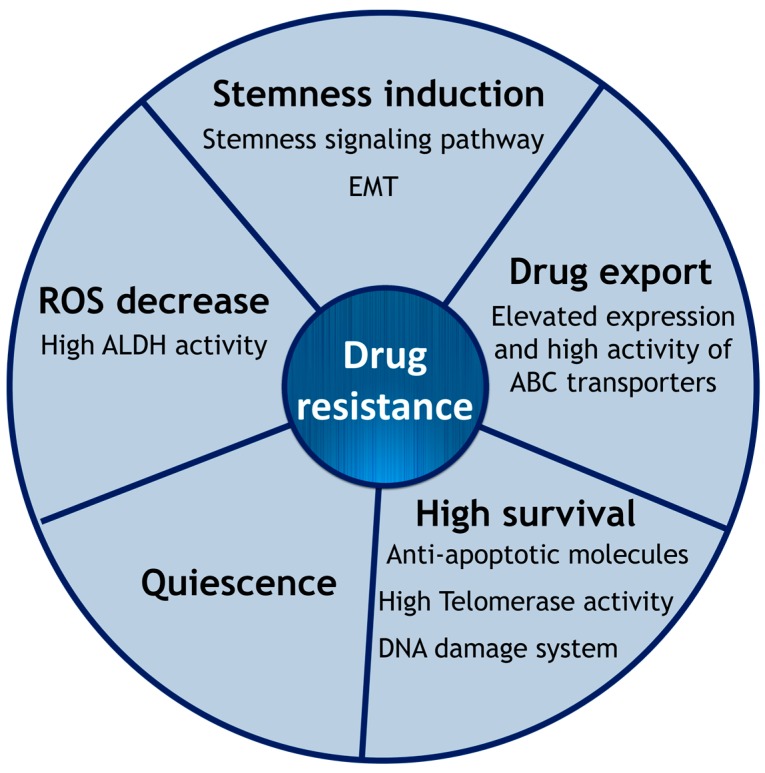
Figure 1
Figure 1
Radio- and chemotherapy resistance that CSCs intrinsically possess.
Figure 2
Figure 2
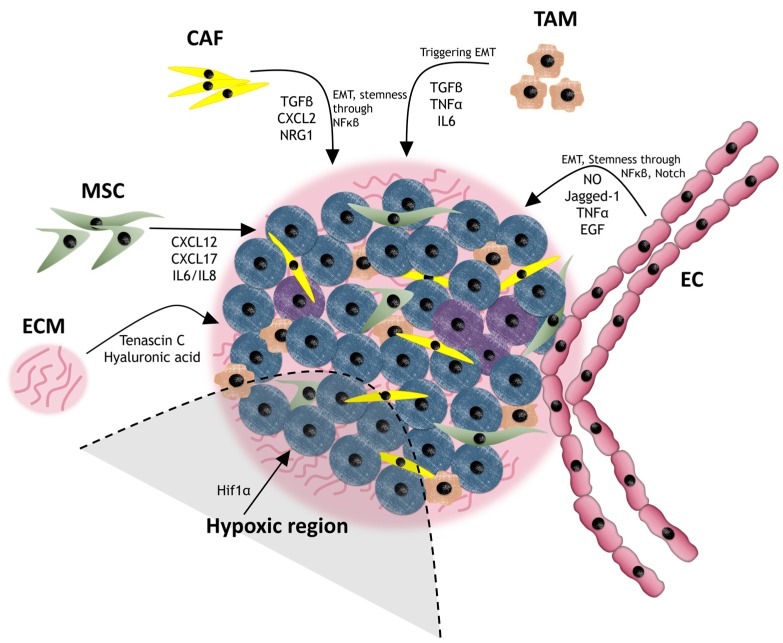
CSCs (represented as purple cells) within the cancer niche, surrounded by CAFs, TAMs, ECs, MSCs and ECM. The CSCs are situated in a hypoxic region and are receiving stimuli from neighboring cells that increase drug resistance.
Figure 3
Figure 3
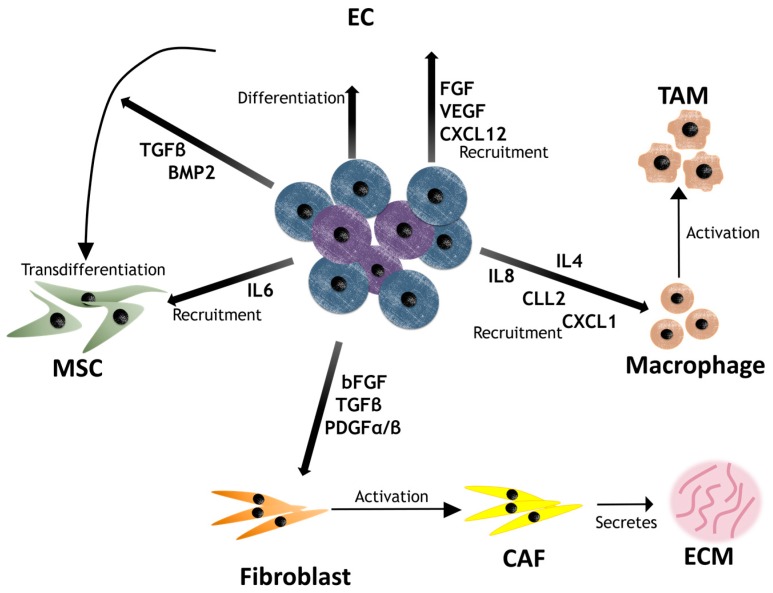
Factors secreted by CSCs (represented as purple cells) promote the recruitment and activation of niche components, indicating that the relation of CSC-niche is not unidirectional.

References

    1. Siegel R.L., Miller K.D., Jemal A. Cancer statistics. CA Cancer J. Clin. 2016;66:7–30. doi: 10.3322/caac.21332. - DOI - PubMed
    1. Lawson D.A., Bhakta N.R., Kessenbrock K., Prummel K.D., Takai K., Zhou A., Eyob H., Balakrishnan S., Wang C., Yaswen P., et al. Single-cell analysis reveals a stem-cell program in human metastatic breast cancer cells. Nature. 2015;526:131–135. doi: 10.1038/nature15260. - DOI - PMC - PubMed
    1. Al-Hajj M., Wicha M.S., Benito-Hernandez A., Morrison S.J., Clarke M.F. Prospective identification of tumorigenic breast cancer cells. Proc. Natl. Acad. Sci. USA. 2003;100:3983–3988. doi: 10.1073/pnas.0530291100. - DOI - PMC - PubMed
    1. Lobo N.A., Shimono Y., Qian D., Clarke M.F. The biology of cancer stem cells. Annu. Rev. Cell Dev. Biol. 2007;23:675–699. doi: 10.1146/annurev.cellbio.22.010305.104154. - DOI - PubMed
    1. Lapidot T., Sirard C., Vormoor J., Murdoch B., Hoang T., Caceres-Cortes J., Minden M., Paterson B., Caligiuri M.A., Dick J.E. A cell initiating human acute myeloid leukaemia after transplantation into SCID mice. Nature. 1994;367:645–648. doi: 10.1038/367645a0. - DOI - PubMed

LinkOut - more resources