


Resetting the Yeast Epigenome with Human Nucleosomes
- PMID: 29198523
- PMCID: PMC5732057
- DOI: 10.1016/j.cell.2017.10.043
Resetting the Yeast Epigenome with Human Nucleosomes
Abstract
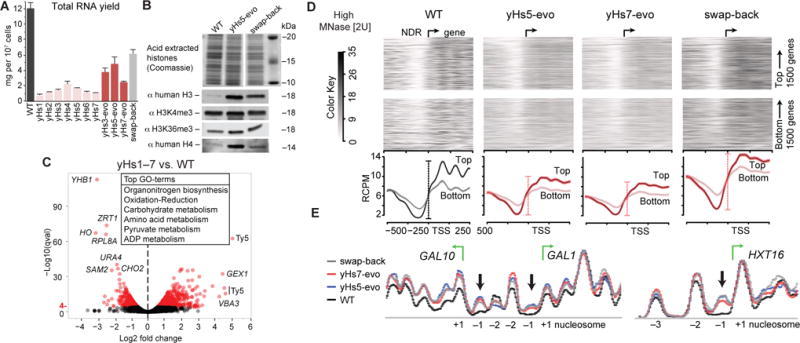
Humans and yeast are separated by a billion years of evolution, yet their conserved histones retain central roles in gene regulation. Here, we "reset" yeast to use core human nucleosomes in lieu of their own (a rare event taking 20 days), which initially only worked with variant H3.1. The cells adapt by acquiring suppressor mutations in cell-division genes or by acquiring certain aneuploid states. Converting five histone residues to their yeast counterparts restored robust growth. We reveal that humanized nucleosomes are positioned according to endogenous yeast DNA sequence and chromatin-remodeling network, as judged by a yeast-like nucleosome repeat length. However, human nucleosomes have higher DNA occupancy, globally reduce RNA content, and slow adaptation to new conditions by delaying chromatin remodeling. These humanized yeasts (including H3.3) pose fundamental new questions about how chromatin is linked to many cell processes and provide a platform to study histone variants via yeast epigenome reprogramming.
Keywords: chromatin; genomics; histone; histones; humanized; synthetic biology; systems biology.
Copyright © 2017 Elsevier Inc. All rights reserved.
Figures




References
-
- Acker J, Conesa C, Lefebvre O. Yeast RNA polymerase III transcription factors and effectors. Biochim Biophys Acta. 2013;1829:283–295. - PubMed
-
- Ahmad K, Henikoff S. The histone variant H3.3 marks active chromatin by replication-independent nucleosome assembly. Mol Cell. 2002;9:1191–1200. - PubMed
-
- Annunziato AT. Split decision: what happens to nucleosomes during DNA replication? J Biol Chem. 2005;280:12065–12068. - PubMed
-
- Bernstein E, Hake SB. The nucleosome: a little variation goes a long way. Biochem Cell Biol. 2006;84:505–517. - PubMed
-
- Boeke JD, Trueheart J, Natsoulis G, Fink GR. 5-Fluoroorotic acid as a selective agent in yeast molecular genetics. Methods Enzymol. 1987;154:164–175. - PubMed
MeSH terms
Substances
Grants and funding
LinkOut - more resources
Full Text Sources
Other Literature Sources
Molecular Biology Databases
