


Age Stratification and Impact of Eicosapentaenoic Acid and Docosahexaenoic Acid to Arachidonic Acid Ratios in Ischemic Stroke Patients
- PMID: 29199200
- PMCID: PMC6055034
- DOI: 10.5551/jat.40691
Age Stratification and Impact of Eicosapentaenoic Acid and Docosahexaenoic Acid to Arachidonic Acid Ratios in Ischemic Stroke Patients
Abstract
Aim: We focused on the ratios of eicosapentaenoic acid (EPA) and docosahexaenoic acid (DHA) to arachidonic acid (AA) and explored the significance of these ratios relative to clinical characteristics by age in ischemic stroke patients.
Methods: We enrolled patients with acute ischemic stroke who underwent radiological investigations and laboratory examinations, including measurement of serum EPA, DHA, and AA levels, and controls. Patients were classified according to age (<65, 65-74, and ≥ 75 years) and the tertile of EPA/AA and DHA/AA ratios, and clinical aspects were compared with these factors.
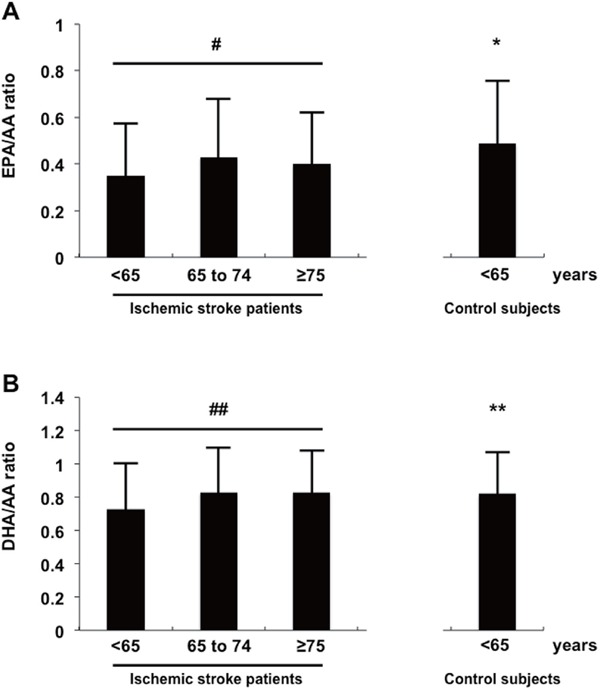
Results: We analyzed 373 patients (age 70.2±13.4 years; 245 males) and 105 controls. Among stroke patients, patients aged <65 years had the lowest EPA/AA (0.35±0.23, p=0.006) and DHA/AA (0.73±0.27, p<0.001) ratios. Compared with controls, patients aged <65 years showed lower EPA/AA (vs. 0.49±0.25, p<0.001) and DHA/AA (vs. 0.82±0.26, p=0.009) ratios. From logistic regression analysis, the EPA/AA (odds ratio 0.18, 95% confidence interval 0.04-0.81, p=0.026) and DHA/AA (odds ratio 0.09, 95% confidence interval 0.02-0.33, p<0.001) ratios were inversely related to patients aged <65 years. According to age-stratified analyses, we found an association of aortic arch calcification with a lower EPA/AA ratio for patients aged ≥ 75 years and an association of multiple infarctions and cerebral white matter lesions with a lower EPA/AA ratio for patients aged 65-74 years (p<0.05).
Conclusions: The ratios of EPA/AA and DHA/AA could be specific markers for younger stroke patients. The EPA/AA ratio may be related to aortic arch calcification for elderly stroke patients and to multiple infarctions and cerebral white matter disease for middle-aged stroke patients.
Keywords: Aortic arch calcification; Docosahexaenoic acid; Eicosapentaenoic acid; Ischemic stroke; White matter lesions.
Conflict of interest statement
R.T. received research funds from Bayer Pharmaceutical Co., Ltd., Pfizer Japan Inc., Takeda Pharmaceutical Co., Ltd.
T.U. received lecture fees from Boehringer Ingelheim, Bristol-Myers Squibb, AstraZeneca K.K., Bayer Pharmaceutical Co., Ltd., Otsuka Pharmaceutical Co., Ltd., Takeda Pharmaceutical Co., Ltd., Mitsubishi-Tanabe Pharma Co., Ltd., Sanofi K.K., Shionogi & Co., Ltd., Novartis Pharmaceuticals, UCB Japan Co., Ltd., Kowa Shinyaku Co., Ltd., Sumitomo Dainippon Pharma Co., Ltd., ONO Pharmaceutical Co., Ltd., Pfizer Japan Inc., Merck Sharp and Dohme (MSD) K.K., Astellas Pharma Inc., GlaxoSmithkline K.K., and research funds from Pfizer Japan Inc., Boehringer Ingelheim, AstraZeneca K.K., Otsuka Pharmaceutical Co., Ltd., Astellas Pharma Inc., Eisai Co., Ltd.
K.S. received lecture fees from Mochida Pharmaceutical Company Ltd. and Takeda Pharmaceutical Company Ltd.
H.D. received scholarship funds and lecture fees from Mochida Pharmaceutical Company Ltd. and Takeda Pharmaceutical Company Ltd.
N.H. was an advisory member of Hisamitsu Pharmaceutical, Dai-Nippon Sumitomo Pharma, Otsuka Pharmaceutical, Novartis Pharma, Takeda Pharmaceutical, Abbie, received lecture fees from GSK, Nippon Boehringer Ingelheim, FP Pharmaceutical, Dai-Nippon Sumitomo Pharma, Eisai, Kissei Pharmaceutical, Nihon Medi-physics, Kyowa Hakko-Kirin, Novartis Pharma, Biogen, Otsuka Pharmaceutical, Medtronic, Abbie, research funds from Kyowa Hakko-Kirin, Nihon Medi-physics, FP Pharmaceutical, Takeda Pharmaceutical, and scholarship funds from Astellas Pharma, Daiichi-Sankyo, Pfizer Japan Inc.
The remaining authors report no conflicts of interest.
Figures
References
-
- Donnan GA, Fisher M, Macleod M, Davis SM: Stroke. Lancet, 2008; 371: 1612-1623 - PubMed
-
- Bevan H, Sharma K, Bradley W: Stroke in young adults. Stroke, 1990; 21: 382-386 - PubMed
-
- Ji R, Schwamm LH, Pervez MA, Singhal AB: Ischemic stroke and transient ischemic attack in young adults: risk factors, diagnostic yield, neuroimaging, and thrombolysis. JAMA Neurol, 2013; 70: 51-57 - PubMed
-
- Park TH, Ko Y, Lee SJ, Lee KB, Lee J, Han MK, Park JM, Kim DE, Cho YJ, Hong KS, Kim JT, Cho KH, Kim DH, Cha JK, Yu KH, Lee BC, Yoon BW, Lee JS, Lee J, Gorelick PB, Bae HJ: Gender differences in the age-stratified prevalence of risk factors in Korean ischemic stroke patients: a nationwide stroke registry-based cross-sectional study. Int J Stroke, 2014; 9: 759-765 - PubMed
-
- Zeiler K, Siostrzonek P, Lang W, Gossinger H, Oder W, Ciciyasvilli H, Kollegger H, Mosslacher H, Deecke L: Different risk factor profiles in young and elderly stroke patients with special reference to cardiac disorders. J Clin Epidemiol, 1992; 45: 1383-1389 - PubMed
MeSH terms
Substances
LinkOut - more resources
Full Text Sources
Other Literature Sources
Research Materials
