


Efficacy and safety of stress ulcer prophylaxis in critically ill patients: a network meta-analysis of randomized trials
- PMID: 29199388
- PMCID: PMC5770505
- DOI: 10.1007/s00134-017-5005-8
Efficacy and safety of stress ulcer prophylaxis in critically ill patients: a network meta-analysis of randomized trials
Erratum in
-
Correction to: Efficacy and safety of stress ulcer prophylaxis in critically ill patients: a network meta-analysis of randomized trials.Intensive Care Med. 2018 Feb;44(2):277-278. doi: 10.1007/s00134-017-5023-6. Intensive Care Med. 2018. PMID: 29230521 Free PMC article.
Abstract
Purpose: Stress ulcer prophylaxis (SUP) is commonly prescribed in the intensive care unit. However, data from systematic reviews and conventional meta-analyses are limited by imprecision and restricted to direct comparisons. We conducted a network meta-analysis of randomized clinical trials (RCTs) to examine the safety and efficacy of drugs available for SUP in critically ill patients.
Methods: We searched MEDLINE, EMBASE, and the Cochrane Library Central Register of Controlled Trials through April 2017 for randomized controlled trials that examined the efficacy and safety of proton pump inhibitors (PPIs), histamine-2 receptor antagonists (H2RAs), and sucralfate for SUP in critically ill patients. No date or language restrictions were applied. Data on study characteristics, methods, outcomes, and risk of bias were abstracted by two reviewers.
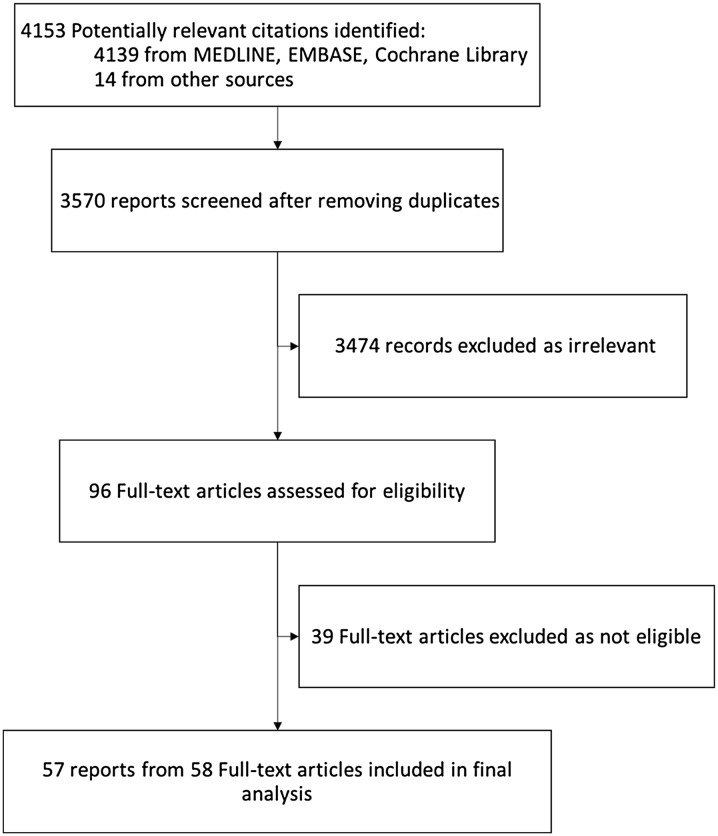
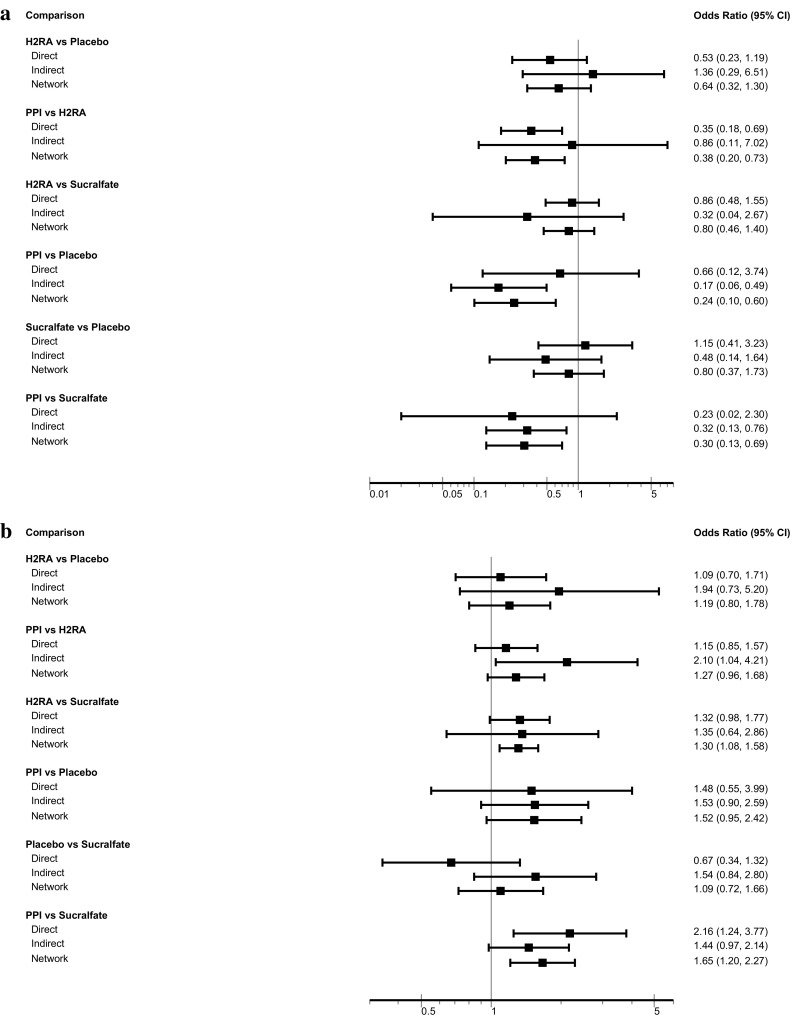
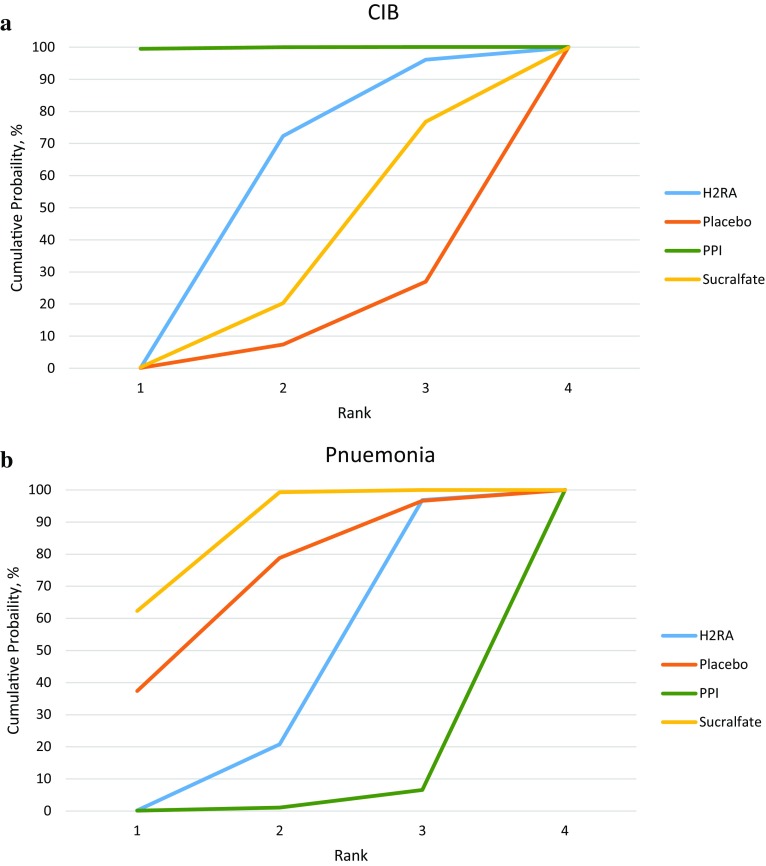
Results: Of 96 potentially eligible studies, we included 57 trials enrolling 7293 patients. The results showed that PPIs are probably more effective for preventing clinically important gastrointestinal bleeding (CIB) than H2RAs [odds ratio (OR) 0.38; 95% confidence interval (95% CI) 0.20, 0.73], sucralfate (OR 0.30; 95% CI 0.13, 0.69), and placebo (OR 0.24; 95% CI 0.10, 0.60) (all moderate quality evidence). There were no convincing differences among H2RA, sucralfate, and placebo. PPIs probably increase the risk of developing pneumonia compared with H2RAs (OR 1.27; 95% CI 0.96, 1.68), sucralfate (OR 1.65; 95% CI 1.20, 2.27), and placebo (OR 1.52; 95% CI 0.95, 2.42) (all moderate quality). Mortality is probably similar across interventions (moderate quality). Estimates of baseline risks of bleeding varied significantly across studies, and only one study reported on Clostridium difficile infection. Definitions of pneumonia varied considerably. Most studies on sucralfate predate pneumonia prevention strategies.
Conclusions: Our results provide moderate quality evidence that PPIs are the most effective agents in preventing CIB, but they may increase the risk of pneumonia. The balance of benefits and harms leaves the routine use of SUP open to question.
Keywords: Critical illness; Histamine-2 receptor antagonists; Network meta-analysis; Pneumonia; Proton pump inhibitors; Stress ulcers; Sucralfate.
Conflict of interest statement
Conflicts of interest
On behalf of all authors, the corresponding author states that there is no conflict of interest.
Funding
This study was funded by the Hamilton Chapter of the Canadian Intensive Care Foundation, the Critical Care Medicine Residency Program, and the Critical Care Division Alternate Funding Plan at McMaster University. Waleed Alhazzani holds a McMaster University Department of Medicine Internal Career Research Award. Deborah Cook is a Canada Research Chair of the Canadian Institutes for Health Research.
Figures
References
-
- Krag M, Perner A, Wetterslev J, Wise MP, Borthwick M, Bendel S, McArthur C, Cook D, Nielsen N, Pelosi P, Keus F, Guttormsen AB, Moller AD, Moller MH, Co-authors S-I. Prevalence and outcome of gastrointestinal bleeding and use of acid suppressants in acutely ill adult intensive care patients. Intensive Care Med. 2015;41:833–845. doi: 10.1007/s00134-015-3725-1. - DOI - PubMed
-
- Krag M, Perner A, Wetterslev J, Wise MP, Borthwick M, Bendel S, McArthur C, Cook D, Nielsen N, Pelosi P, Keus F, Guttormsen AB, Moller AD, Moller MH, Collaborators S-I. Stress ulcer prophylaxis in the intensive care unit: an international survey of 97 units in 11 countries. Acta Anaesthesiol Scand. 2015;59:576–585. doi: 10.1111/aas.12508. - DOI - PubMed
-
- Dellinger RP, Levy MM, Rhodes A, Annane D, Gerlach H, Opal SM, Sevransky JE, Sprung CL, Douglas IS, Jaeschke R, Osborn TM, Nunnally ME, Townsend SR, Reinhart K, Kleinpell RM, Angus DC, Deutschman CS, Machado FR, Rubenfeld GD, Webb S, Beale RJ, Vincent JL, Moreno R, Surviving Sepsis Campaign Guidelines Committee including The Pediatric S Surviving Sepsis Campaign: international guidelines for management of severe sepsis and septic shock, 2012. Intensive Care Med. 2013;39:165–228. doi: 10.1007/s00134-012-2769-8. - DOI - PMC - PubMed
-
- Rhodes A, Evans LE, Alhazzani W, Levy MM, Antonelli M, Ferrer R, Kumar A, Sevransky JE, Sprung CL, Nunnally ME, Rochwerg B, Rubenfeld GD, Angus DC, Annane D, Beale RJ, Bellinghan GJ, Bernard GR, Chiche J-D, Coopersmith C, De Backer DP, French CJ, Fujishima S, Gerlach H, Hidalgo JL, Hollenberg SM, Jones AE, Karnad DR, Kleinpell RM, Koh Y, Lisboa TC, Machado FR, Marini JJ, Marshall JC, Mazuski JE, McIntyre LA, McLean AS, Mehta S, Moreno RP, Myburgh J, Navalesi P, Nishida O, Osborn TM, Perner A, Plunkett CM, Ranieri M, Schorr CA, Seckel MA, Seymour CW, Shieh L, Shukri KA, Simpson SQ, Singer M, Thompson BT, Townsend SR, Van der Poll T, Vincent J-L, Wiersinga WJ, Zimmerman JL, Dellinger RP. Surviving Sepsis Campaign: International Guidelines for Management of sepsis and septic shock: 2016. Intensive Care Med. 2017;43:304–377. doi: 10.1007/s00134-017-4683-6. - DOI - PubMed
Publication types
MeSH terms
Substances
LinkOut - more resources
Full Text Sources
Other Literature Sources
Miscellaneous
