Comment
. 2018 Jan 2;128(1):113-115.
doi: 10.1172/JCI98619. Epub 2017 Dec 4.

Rare mutations provide unique insight into oncogenic potential of STAT transcription factors

Comment

Rare mutations provide unique insight into oncogenic potential of STAT transcription factors

Lisa N Heppler et al. J Clin Invest. .

Abstract

The inappropriate activation of transcription factors, including STATs, is known to promote tumor initiation and progression. The most common mechanisms of misregulation lead to constitutive activation of WT STATs. However, the recent discovery of rare STAT mutations in hematopoietic malignancies suggests that STAT mutants may be oncogenic. In this issue of the JCI, Pham et al. use a transgenic mouse model to demonstrate that STAT5BN642H is sufficient for the development of T cell neoplasia. This study, along with other studies of constitutively active STAT mutants, provides insight into the pathogenesis and treatment of STAT5-driven cancer.


Conflict of interest statement

Conflict of interest: D.A. Frank receives research support from Gilead Sciences and is the inventor on US Patent 8,445,517 “Stat modulators.” The spouse of D.A. Frank is employed by and owns shares in Biogen.

Figures

Figure 1
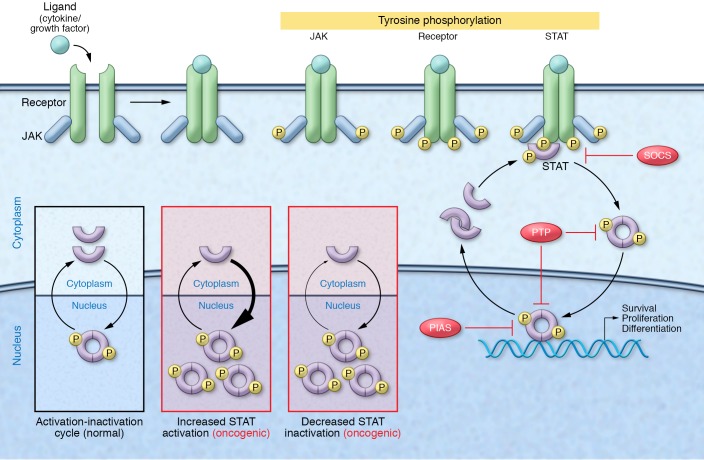
Figure 1. STAT-mediated oncogenesis.
Under physiologic conditions, STAT signaling is stimulus dependent and tightly regulated by endogenous inhibitors, including SOCS proteins, protein inhibitor of activated STAT (PIAS) proteins, and protein tyrosine phosphatases (PTPs). Cytokine or growth factor stimulation triggers receptor oligomerization and sequential tyrosine phosphorylation of receptor-associated JAKs, intracellular receptor domains, and newly recruited STAT proteins. Phosphorylated STAT dimers then translocate to the nucleus, where they bind DNA and control the expression of genes regulating proliferation, survival, and differentiation. Following dephosphorylation, STATs are shuttled back out of the nucleus, completing the activation-inactivation cycle. Cancer-associated events can lead to constitutive STAT activity and STAT-dependent oncogenesis. This can occur through increased STAT activation due to elevated cytokine levels, loss of endogenous inhibitors, or hyperactivation of upstream signaling machinery, or via decreased STAT inactivation, such as that occurring through loss of endogenous inhibitors and dephosphorylation-resistant STAT mutants. The STAT5 mutant STAT5BN642H analyzed by Pham et al. (18) appears to drive the malignant transformation of hematopoietic cells through this latter mechanism.

Comment on

  • STAT5BN642H is a driver mutation for T cell neoplasia.
    Pham HTT, Maurer B, Prchal-Murphy M, Grausenburger R, Grundschober E, Javaheri T, Nivarthi H, Boersma A, Kolbe T, Elabd M, Halbritter F, Pencik J, Kazemi Z, Grebien F, Hengstschläger M, Kenner L, Kubicek S, Farlik M, Bock C, Valent P, Müller M, Rülicke T, Sexl V, Moriggl R. Pham HTT, et al. J Clin Invest. 2018 Jan 2;128(1):387-401. doi: 10.1172/JCI94509. Epub 2017 Dec 4. J Clin Invest. 2018. PMID: 29200404 Free PMC article.

References

    1. Lee TI, Young RA. Transcriptional regulation and its misregulation in disease. Cell. 2013;152(6):1237–1251. doi: 10.1016/j.cell.2013.02.014. - DOI - PMC - PubMed
    1. Yeh JE, Toniolo PA, Frank DA. Targeting transcription factors: promising new strategies for cancer therapy. Curr Opin Oncol. 2013;25(6):652–658. doi: 10.1097/01.cco.0000432528.88101.1a. - DOI - PubMed
    1. Darnell JE., Jr Transcription factors as targets for cancer therapy. Nat Rev Cancer. 2002;2(10):740–749. doi: 10.1038/nrc906. - DOI - PubMed
    1. Bhagwat AS, Vakoc CR. Targeting transcription factors in cancer. Trends Cancer. 2015;1(1):53–65. doi: 10.1016/j.trecan.2015.07.001. - DOI - PMC - PubMed
    1. Levy DE, Darnell JE., Jr Stats: transcriptional control and biological impact. Nat Rev Mol Cell Biol. 2002;3(9):651–662. doi: 10.1038/nrm909. - DOI - PubMed

Substances