


Amelioration of Intestinal Barrier Dysfunction by Berberine in the Treatment of Nonalcoholic Fatty Liver Disease in Rats
- PMID: 29200733
- PMCID: PMC5701411
- DOI: 10.4103/pm.pm_584_16
Amelioration of Intestinal Barrier Dysfunction by Berberine in the Treatment of Nonalcoholic Fatty Liver Disease in Rats
Abstract
Objective: To investigate the effect of berberine (BBR) on intestinal barrier function in nonalcoholic fat liver disease (NAFLD) in rats.
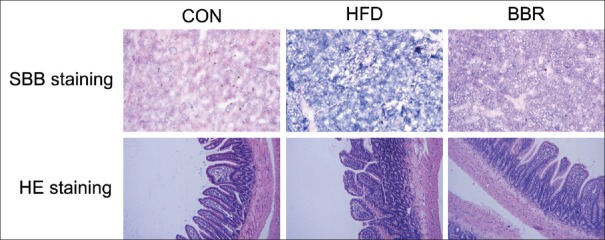
Materials and methods: Rats were divided into three groups: normal diet group (control group [CON group]), high-fat diet feeding group (HFD group), and HFD with BBR group. After 8 weeks of HFD feeding, rats in the BBR group were given BBR intragastrically at a dose of 150 mg/kg daily for 4 weeks. The same volume of normal saline was given to the CON and HFD groups. Liver index was detected, and Sudan black B staining was used to study fatty degeneration, also the expression level of occluding and intestinal flora was analyzed.
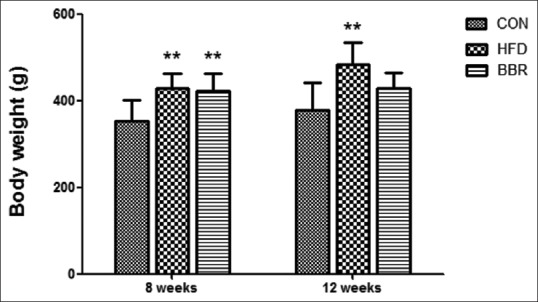
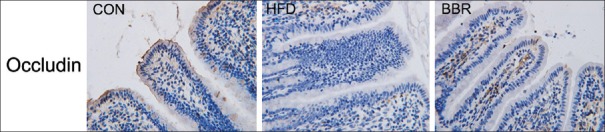
Results: BBR administration significantly reduced HFD-induced increase in body weight (CON group: 379.83 ± 61.51 g, HFD group: 485.24 ± 50.15 g, and BBR group: 428.60 ± 37.37 g). It obviously alleviated the HFD-induced liver fatty degeneration and histopathological changes of intestinal mucosa according to liver index low-density lipoprotein-cholesterol, high-density lipoprotein-cholesterol, and total cholesterol (P < 0.05). The triglyceride, alanine transaminase, and aspartate aminotransferase levels were greatly elevated after BBR treatment (P < 0.05); while endotoxin, intestinal fatty acid-binding protein, and tumor necrosis factor-α were significantly reduced (P < 0.05). Moreover, we found that BBR could obviously elevate the level of occludin and decrease the level of Faecalibacterium prausnitzii and upregulate the level of bacteroides.
Conclusion: BBR provides significant protection in NAFLD through ameliorating intestinal barrier function.
Summary: Berberine (BBR), an alkaloid that can be isolated from many plants, has been medically used for its wide range of antimicrobial and anti-inflammatory effectsThis is a study of BBR on liver function and intestinal barrier function in nonalcoholic fat liver disease (NAFLD)BBR treatment for NAFLD could significantly restore the liver function and provide significant protection in NAFLD through ameliorating intestinal barrier function. Abbreviations used: BBR: Berberine, NAFLD: Nonalcoholic fat liver disease, ALT: Alanine transaminase, AST: Aspartate aminotransferase, TG: Triglyceride, I-FABP: Intestinal-fatty acid-binding protein, IBD: Inflammatory bowel disease.
Keywords: Bacteroides; Faecalibacterium prausnitzii; berberine hydrochloride; liver function test.
Conflict of interest statement
There are no conflicts of interest.
Figures
References
-
- Bellentani S, Scaglioni F, Marino M, Bedogni G. Epidemiology of non-alcoholic fatty liver disease. Dig Dis. 2010;28:155–61. - PubMed
-
- Fan JG, Saibara T, Chitturi S, Kim BI, Sung JJ, Chutaputti A, et al. What are the risk factors and settings for non-alcoholic fatty liver disease in Asia-Pacific? J Gastroenterol Hepatol. 2007;22:794–800. - PubMed
-
- Torres DM, Harrison SA. Diagnosis and therapy of nonalcoholic steatohepatitis. Gastroenterology. 2008;134:1682–98. - PubMed
-
- Dixon JB, Bhathal PS, Hughes NR, O’Brien PE. Nonalcoholic fatty liver disease: Improvement in liver histological analysis with weight loss. Hepatology. 2004;39:1647–54. - PubMed
-
- Gueugnon C, Mougin F, Simon-Rigaud ML, Regnard J, Nègre V, Dumoulin G, et al. Effects of an in-patient treatment program based on regular exercise and a balanced diet on high molecular weight adiponectin, resistin levels, and insulin resistance in adolescents with severe obesity. Appl Physiol Nutr Metab. 2012;37:672–9. - PubMed
LinkOut - more resources
Full Text Sources
Other Literature Sources
Research Materials
Miscellaneous