


Physiological and training characteristics of recreational marathon runners
- PMID: 29200895
- PMCID: PMC5703178
- DOI: 10.2147/OAJSM.S141657
Physiological and training characteristics of recreational marathon runners
Abstract
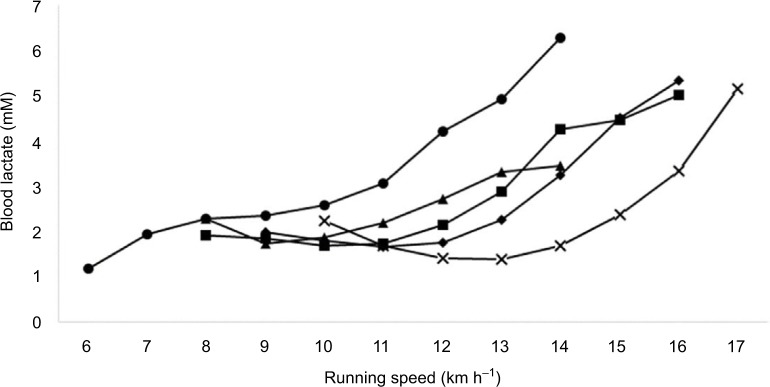
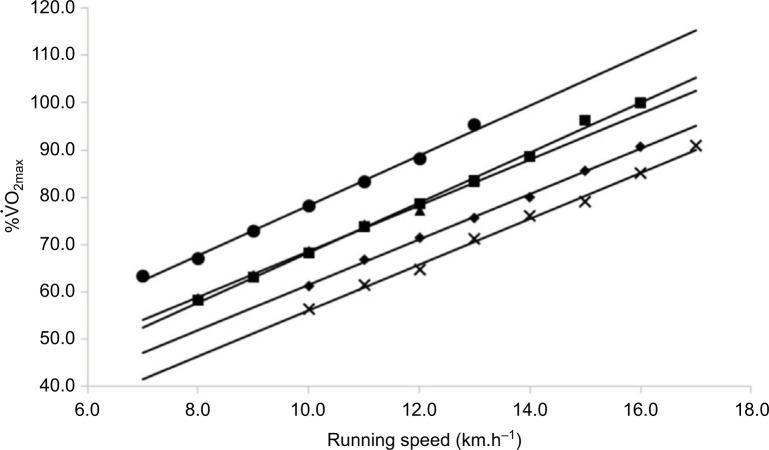
Purpose: The aim of this study was to examine the physical and training characteristics of recreational marathon runners within finish time bandings (2.5-3 h, 3-3.5 h, 3.5-4 h, 4-4.5 h and >4.5 h).
Materials and methods: A total of 97 recreational marathon runners (age 42.4 ± 9.9 years; mass 69.2 ± 11.3 kg; stature 172.8 ± 9.1 cm), with a marathon finish time of 229.1 ± 48.7 min, of whom n = 34 were female and n = 63 were male, completed an incremental treadmill test for the determination of lactate threshold (LT1), lactate turn point (LT2) and running economy (RE). Following a 7-min recovery, they completed a test to volitional exhaustion starting at LT2 for the assessment of [Formula: see text]. In addition, all participants completed a questionnaire gathering information on their current training regimes exploring weekly distances, training frequencies, types of sessions, longest run in a week, with estimations of training speed, and load and volume derived from these data.
Results: Training frequency was shown to be significantly greater for the 2.5-3 h group compared to the 3.5-4 h runners (P < 0.001) and >4.5 h group (P = 0.004), while distance per session (km·session-1) was significantly greater for the 2.5-3 h group (16.1 ± 4.2) compared to the 3.5-4 h group (15.5 ± 5.2; P = 0.01) and >4.5 h group (10.3 ± 2.6; P = 0.001). Race speed correlated with LT1 (r = 0.791), LT2 (r = 0.721) and distance per session (r = 0.563).
Conclusion: The data highlight profound differences for key components of marathon running ([Formula: see text], LT1, LT2, RE and % [Formula: see text]) within a group of recreational runners with the discriminating training variables being training frequency and the absolute training speed.
Keywords: aerobic capacity; endurance running; maximal oxygen uptake; nonelite; running economy; workout structures.
Conflict of interest statement
Disclosure The results of this study are presented in a clear, honest manner, with no falsification, fabrication or inappropriate data manipulation. There are no personal relationships to disclose with this study. The authors report no other conflicts of interest in this work.
Figures
References
-
- Coyle EF. Physiological regulation of marathon performance. Sports Med. 2007;37(4):306–311. - PubMed
-
- Jones AM. The physiology of the world record holder for the women’s marathon. Int J Sports Sci Coach. 2006;1(2):101–116.
-
- Weston AR, Mbambo Z, Myburgh KH. Running economy of African and Caucasian distance runners. Med Sci Sports Exerc. 2000;32(6):1130–1134. - PubMed
LinkOut - more resources
Full Text Sources
Other Literature Sources
