


A Qualitative Study with Healthcare Staff Exploring the Facilitators and Barriers to Engaging in a Self-Help Mindfulness-Based Intervention
- PMID: 29201248
- PMCID: PMC5693971
- DOI: 10.1007/s12671-017-0740-z
A Qualitative Study with Healthcare Staff Exploring the Facilitators and Barriers to Engaging in a Self-Help Mindfulness-Based Intervention
Abstract
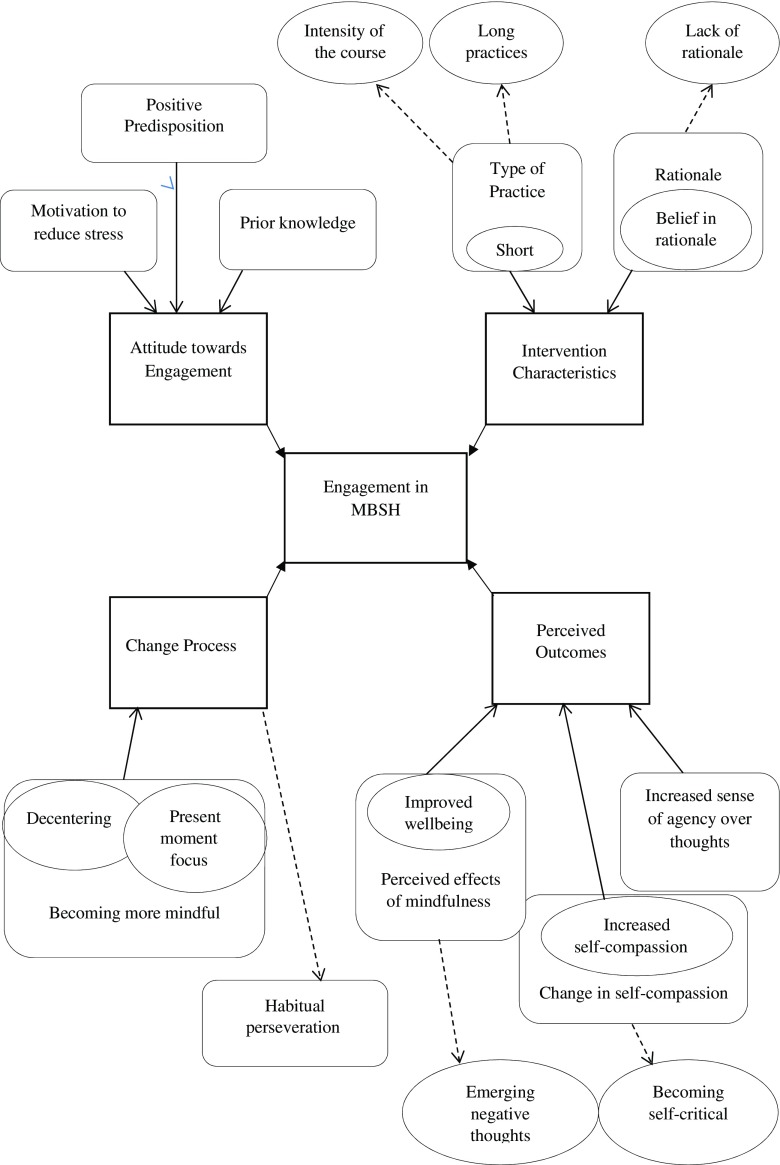
In order to increase the cost-efficiency, availability and ease of accessing and delivering mindfulness-based interventions (MBIs), clinical and research interest in mindfulness-based self-help (MBSH) interventions has increased in recent years. Several studies have shown promising results of effectiveness of MBSH. However, like all self-help interventions, dropout rates and disengagement from MBSH are high. The current study explored the facilitators and barriers of engaging in a MBSH intervention. Semi-structured interviews with members of healthcare staff who took part in an MBSH intervention (n = 16) were conducted. A thematic analysis approach was used to derive central themes around engagement from the interviews. Analyses resulted in four overarching themes characterising facilitation and hindrance to engagement in MBSH. These are "attitude towards engagement", "intervention characteristics", "process of change" and "perceived consequences". Long practices, emerging negative thoughts and becoming self-critical were identified as the key hindrances, whilst need for stress reduction techniques, shorter practices and increased sense of agency over thoughts were identified as the key facilitators. Clinical and research implications are discussed.
Keywords: Attrition; Dropout; Engagement; MBCT; MBSR; Mindfulness; Self-guided; Self-help; Thematic analysis.
Conflict of interest statement
Ethical Approval
All procedures performed in studies involving human participants were in accordance with the ethical standards of the institutional research committee and with the 1964 Helsinki Declaration and its later amendments or comparable ethical standards.
Informed Consent
Informed consent was obtained from all individual participants included in the study. Prior to obtaining consent, the participant information sheet informed potential participants that difficult thoughts and feelings may arise during mindfulness practice. Participants were also provided with contact details of organisations that could provide help and support in the event that significant difficulties emerged, and it was made clear that participants could drop out of the study at any point.
Conflict of Interest
The authors declare that they have no conflicts of interest.
Figures
References
-
- Ajzen I. From intentions to actions: a theory of planned behavior. Action control. Berlin Heidelberg: Springer; 1985. pp. 11–39.
-
- Birnie K, Speca M, Carlson LE. Exploring self-compassion and empathy in the context of mindfulness-based stress reduction (MBSR) Stress and Health. 2010;26(5):359–371. doi: 10.1002/smi.1305. - DOI
-
- Boggs, J.M., Beck, A., Felder, J.N., Dimidjian, S., Metcalf, C.A., & Segal, Z.V. (2014). Web-based intervention in mindfulness meditation for reducing residual depressive symptoms and relapse prophylaxis: a qualitative study. Journal of Medical Internet Research, 16(3). doi:10.2196/jmir.3129. - PMC - PubMed
LinkOut - more resources
Full Text Sources
Other Literature Sources