


Association between contraceptive implant knowledge and intent with implant uptake among postpartum Malawian women: a prospective cohort study
- PMID: 29201402
- PMCID: PMC5693581
- DOI: 10.1186/s40834-016-0026-1
Association between contraceptive implant knowledge and intent with implant uptake among postpartum Malawian women: a prospective cohort study
Abstract
Background: Long-acting reversible contraception (LARC) can assist women with birth spacing and reduce unintended pregnancies. Sub-Saharan Africa has low uptake of the two available methods of LARC, the subdermal implant and intrauterine contraception (IUC). Our primary objectives were to: 1) calculate the incidence of LARC use among postpartum Malawian women, and 2) assess if LARC knowledge and intent to use LARC were associated with LARC uptake.
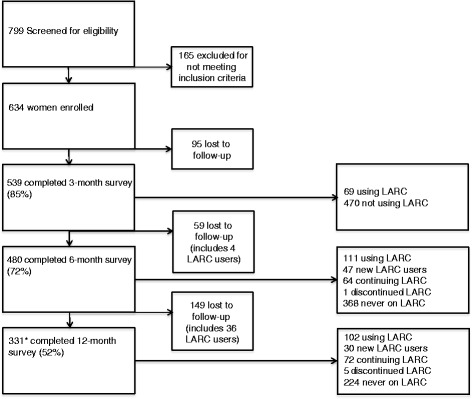
Methods: This study was a prospective cohort study of 634 postpartum women who were recruited from the postpartum ward of Bwaila Hospital in Lilongwe, Malawi. Study participants completed a baseline survey in the postpartum ward. Follow-up telephone surveys about contraceptive use were conducted at 3, 6, and 12 months postpartum. Cox proportional hazards regression analysis was performed to evaluate if implant knowledge and intent to use implant were associated with implant uptake.
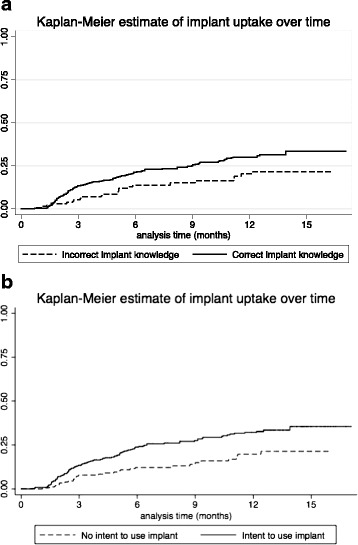
Results: One hundred thirty-seven implant and 10 IUC placements were reported over 12 months of follow-up; given the low rate of IUC uptake, further analysis was only done for implant uptake. The incidence rate for implant uptake was 35.6 per 100 person-years (95 % CI 30.0, 42.2). Correct implant knowledge (adjusted HR = 1.69; 95 % CI 1.06, 2.68) and intent to use implant (adjusted HR 1.95; 95 % CI 1.28, 2.98) were both associated with implant uptake.
Conclusions: More women reported implant use than IUC use in our study. Correct implant knowledge and intent to use implant were both associated with implant uptake, with a stronger association for intent. Interventions to increase LARC uptake should focus on improving LARC knowledge and removing barriers to LARC.
Trial registration: Clinical Trial Registration #: NCT01893021.
Keywords: Africa; Family planning; Intrauterine contraception; Long-acting reversible contraception; Postpartum; Subdermal implants.
Figures
Similar articles
-
Effect of HIV status on fertility desire and knowledge of long-acting reversible contraception of postpartum Malawian women.AIDS Care. 2015;27(4):489-98. doi: 10.1080/09540121.2014.972323. Epub 2014 Nov 4. AIDS Care. 2015. PMID: 25367269 Free PMC article.
-
Counseling increases immediate postpartum Long-Acting Reversible Contraception (LARC) acceptability in Hispanic women.J Gynecol Obstet Hum Reprod. 2022 Nov;51(9):102457. doi: 10.1016/j.jogoh.2022.102457. Epub 2022 Aug 8. J Gynecol Obstet Hum Reprod. 2022. PMID: 35952927
-
Prenatal intent and postpartum receipt of long-acting reversible contraception among women receiving medication-assisted treatment for opioid use disorder.Contraception. 2019 Jan;99(1):36-41. doi: 10.1016/j.contraception.2018.08.008. Epub 2018 Aug 13. Contraception. 2019. PMID: 30114393 Free PMC article.
-
Immediate Postpartum Contraception: A Survey Needs Assessment of a National Sample of Midwives.J Midwifery Womens Health. 2017 Sep;62(5):538-544. doi: 10.1111/jmwh.12653. Epub 2017 Sep 7. J Midwifery Womens Health. 2017. PMID: 28881464 Free PMC article.
-
Acceptability of immediate postpartum and post-abortion long-acting reversible contraception provision to adolescents: A systematic review.Acta Obstet Gynecol Scand. 2021 Apr;100(4):629-640. doi: 10.1111/aogs.14129. Epub 2021 Mar 9. Acta Obstet Gynecol Scand. 2021. PMID: 33608901
Cited by
-
Toward person-centred measures of contraceptive demand: a systematic review of the relationship between intentions to use and actual use of contraception.Gates Open Res. 2025 Feb 28;8:1. doi: 10.12688/gatesopenres.15078.3. eCollection 2024. Gates Open Res. 2025. PMID: 39669095 Free PMC article.
-
Mapping evidence on postpartum modern family planning service uptake among women in Ethiopia: A scoping review.Front Glob Womens Health. 2022 Dec 23;3:1043034. doi: 10.3389/fgwh.2022.1043034. eCollection 2022. Front Glob Womens Health. 2022. PMID: 36619592 Free PMC article.
-
A Comparison of Breastfeeding Exclusivity and Duration Rates Between Immediate Postpartum Levonorgestrel Versus Etonogestrel Implant Users: A Prospective Cohort Study.Breastfeed Med. 2019 Jan/Feb;14(1):69-76. doi: 10.1089/bfm.2018.0165. Epub 2018 Dec 14. Breastfeed Med. 2019. PMID: 30508390 Free PMC article.
-
Knowledge, attitude and acceptability for long-acting reversible contraceptive (LARC) methods among women attending contraception counselling sessions: A cross-sectional study.J Family Med Prim Care. 2025 Jan;14(1):160-166. doi: 10.4103/jfmpc.jfmpc_780_24. Epub 2025 Jan 13. J Family Med Prim Care. 2025. PMID: 39989562 Free PMC article.
-
Getting Intentional about Intention to Use: A Scoping Review of Person-Centered Measures of Demand.Stud Fam Plann. 2022 Mar;53(1):61-132. doi: 10.1111/sifp.12182. Epub 2022 Feb 3. Stud Fam Plann. 2022. PMID: 35119110 Free PMC article.
References
Associated data
Grants and funding
LinkOut - more resources
Full Text Sources
Other Literature Sources
Medical
