Factors Affecting Optimal Time of Cranioplasty: Brain Sunken Ratio
- PMID: 29201844
- PMCID: PMC5702745
- DOI: 10.13004/kjnt.2017.13.2.113
Factors Affecting Optimal Time of Cranioplasty: Brain Sunken Ratio
Abstract
Objective: After a rigorous management of increased intracranial pressure by decompressive craniectomy (DC), cranioplasty (CP) is usually carried out for functional and cosmetic purposes. However, the optimal timing of CP remains controversial. Our study aims to analyze the relationship between the optimal timing of CP and the post-operative complications.
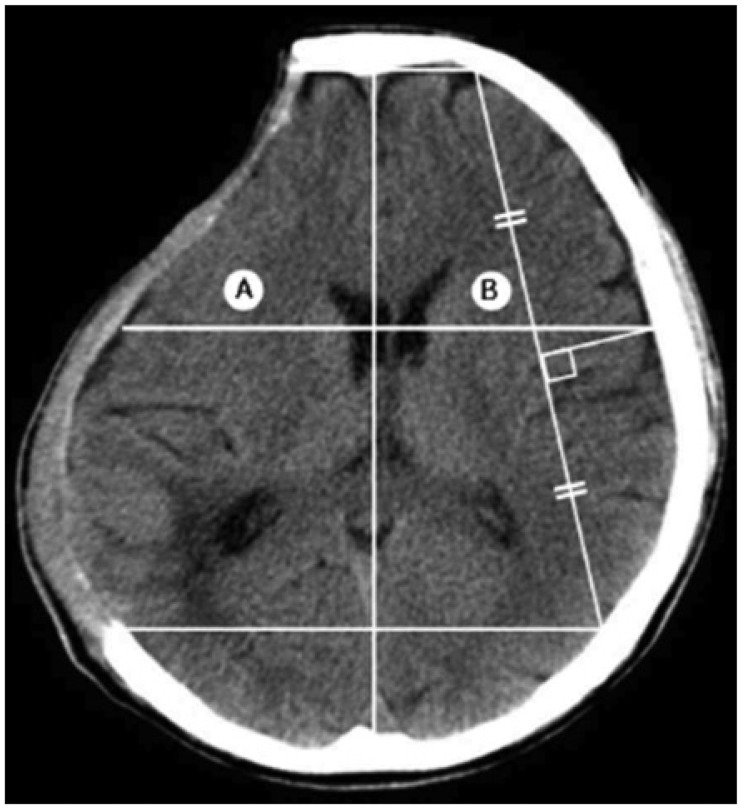
Methods: From January 2013 to December 2015, ninety patients who underwent CP in a single institution were analyzed. We set the independent variables as follows: 1) patient characteristics; 2) the time interval between the DC and CP; 3) operation time; 4) anesthesia time; and 5) pre-operative computed tomography (CT) findings such as a degree of sunken brain by ratio of A (the median length from scalp to midline) to B (the length from midline to inner table of skull at this level). The dependent variables of this study are the event of post-operative complications.
Results: The overall complication rate was 33.3%. There was no statistical significance in the time interval between the DC and CP in the groups with and without complications of CP (p=0.632). However, there was a significant statistical difference in the degree of sunken brain by ratio (A/B) between the two groups (p<0.001).
Conclusion: From this study, we conclude that it is better to determine the optimal timing of CP by the pre-operative CT finding than by the time interval between the DC and CP. Hereby, we suggest a potentially useful determinant of optimal timing of CP.
Keywords: Complication; Cranioplasty; Decompressive craniectomy.
Conflict of interest statement
The authors have no financial conflicts of interest.
Figures
References
-
- Abbott KH. Use of frozen cranial bone flaps for autogenous and homologous grafts in cranioplasty and spinal interbody fusion. J Neurosurg. 1953;10:380–388. - PubMed
-
- Andrzejak S, Fortuniak J, Wróbel-Wiśniewska G, Zawirski M. Clinical evaluation of the polypropylene-polyester knit used as a cranioplasty material. Acta Neurochir (Wien) 2005;147:973–976. - PubMed
-
- Beauchamp KM, Kashuk J, Moore EE, Bolles G, Rabb C, Seinfeld J, et al. Cranioplasty after postinjury decompressive craniectomy: is timing of the essence? J Trauma. 2010;69:270–274. - PubMed
-
- Bender A, Heulin S, Rohrer S, Mehrkens JH, Heidecke V, Straube A, et al. Early cranioplasty may improve outcome in neurological patients with decompressive craniectomy. Brain Inj. 2013;27:1073–1079. - PubMed
-
- Bullock MR, Chesnut R, Ghajar J, Gordon D, Hartl R, Newell DW, et al. Surgical management of acute subdural hematomas. Neurosurgery. 2006;58:S16–S24. - PubMed
LinkOut - more resources
Full Text Sources
Other Literature Sources
Miscellaneous