Proper Management of Posttraumatic Tension Pneumocephalus
- PMID: 29201853
- PMCID: PMC5702754
- DOI: 10.13004/kjnt.2017.13.2.158
Proper Management of Posttraumatic Tension Pneumocephalus
Abstract
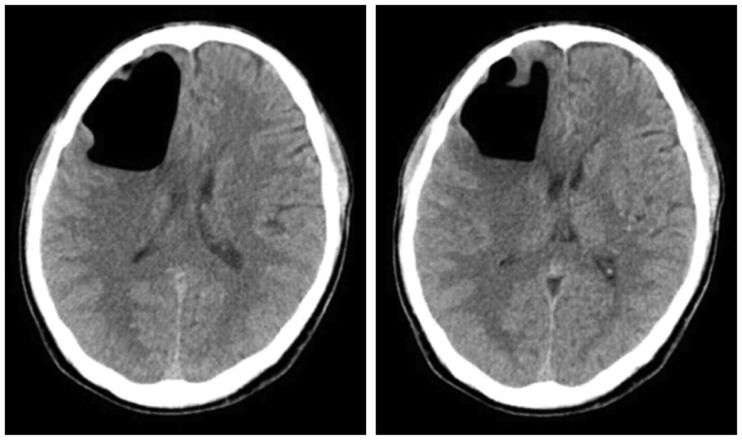
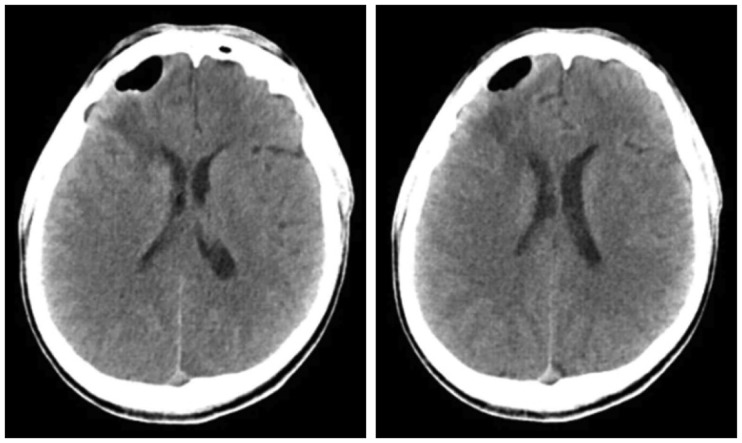
Pneumocephalus is commonly seen after craniofacial injury. The pathogenesis of pneumocephalus has been debated as to whether it was caused by ball valve effect or combined episodic increased pressure within the nasopharynx on coughing. Discontinuous exchange of air and cerebrospinal fluid due to "inverted bottle" effect is assumed to be the cause of it. Delayed tension pneumocephalus is not common, but it requires an active management in order to prevent serious complication. We represent a clinical case of a 57-year-old male patient who fell down from 3 m height, complicated by tension pneumocephalus on 5 months after trauma. We recommend a surgical intervention, but the patient did not want that so we observe the patient. The patient was underwent seizure and meningitis after 7 months after trauma, he came on emergency room on stupor mentality. Tension pneumocephalus may result in a neurologic disturbance due to continued air entrainment and it significantly the likelihood of intracranial infection caused by continued open channel. Tension pneumocephalus threat a life, so need a neurosurgical emergency surgical intervention.
Keywords: Cerebrospinal fluid leak; Head injury; Tension pneumocephalus.
Conflict of interest statement
The authors have no financial conflicts of interest.
Figures



References
-
- Bakay L, Glasauer FE. Head injury. Boston, MA: Little, Brown; 1980.
-
- Dandy WE. Pneumocephalus (intracranial pneumatocele or aerocele) Arch Surg. 1926;12:949–982.
-
- Eljamel MS, Foy PM. Post-traumatic CSF fistulae, the case for surgical repair. Br J Neurosurg. 1990;4:479–483. - PubMed
Publication types
LinkOut - more resources
Full Text Sources
Other Literature Sources