. 2017 Nov 22;2(6):e00446-17.
doi: 10.1128/mSphere.00446-17. eCollection 2017 Nov-Dec.

A Simple and Universal System for Gene Manipulation in Aspergillus fumigatus: In Vitro-Assembled Cas9-Guide RNA Ribonucleoproteins Coupled with Microhomology Repair Templates

Affiliations

A Simple and Universal System for Gene Manipulation in Aspergillus fumigatus: In Vitro-Assembled Cas9-Guide RNA Ribonucleoproteins Coupled with Microhomology Repair Templates

Qusai Al Abdallah et al. mSphere. .

Abstract

CRISPR (clustered regularly interspaced short palindromic repeat)-Cas9 is a novel genome-editing system that has been successfully established in Aspergillus fumigatus. However, the current state of the technology relies heavily on DNA-based expression cassettes for delivering Cas9 and the guide RNA (gRNA) to the cell. Therefore, the power of the technology is limited to strains that are engineered to express Cas9 and gRNA. To overcome such limitations, we developed a simple and universal CRISPR-Cas9 system for gene deletion that works across different genetic backgrounds of A. fumigatus. The system employs in vitro assembly of dual Cas9 ribonucleoproteins (RNPs) for targeted gene deletion. Additionally, our CRISPR-Cas9 system utilizes 35 to 50 bp of flanking regions for mediating homologous recombination at Cas9 double-strand breaks (DSBs). As a proof of concept, we first tested our system in the ΔakuBakuBku80 ) laboratory strain and generated high rates (97%) of gene deletion using 2 µg of the repair template flanked by homology regions as short as 35 bp. Next, we inspected the portability of our system across other genetic backgrounds of A. fumigatus, namely, the wild-type strain Af293 and a clinical isolate, A. fumigatus DI15-102. In the Af293 strain, 2 µg of the repair template flanked by 35 and 50 bp of homology resulted in highly efficient gene deletion (46% and 74%, respectively) in comparison to classical gene replacement systems. Similar deletion efficiencies were also obtained in the clinical isolate DI15-102. Taken together, our data show that in vitro-assembled Cas9 RNPs coupled with microhomology repair templates are an efficient and universal system for gene manipulation in A. fumigatus. IMPORTANCE Tackling the multifactorial nature of virulence and antifungal drug resistance in A. fumigatus requires the mechanistic interrogation of a multitude of genes, sometimes across multiple genetic backgrounds. Classical fungal gene replacement systems can be laborious and time-consuming and, in wild-type isolates, are impeded by low rates of homologous recombination. Our simple and universal CRISPR-Cas9 system for gene manipulation generates efficient gene targeting across different genetic backgrounds of A. fumigatus. We anticipate that our system will simplify genome editing in A. fumigatus, allowing for the generation of single- and multigene knockout libraries. In addition, our system will facilitate the delineation of virulence factors and antifungal drug resistance genes in different genetic backgrounds of A. fumigatus.

Keywords: Aspergillus fumigatus; CRISPR-Cas9; gene deletion; genome editing; in vitro assembly; pksP gene.


Figures
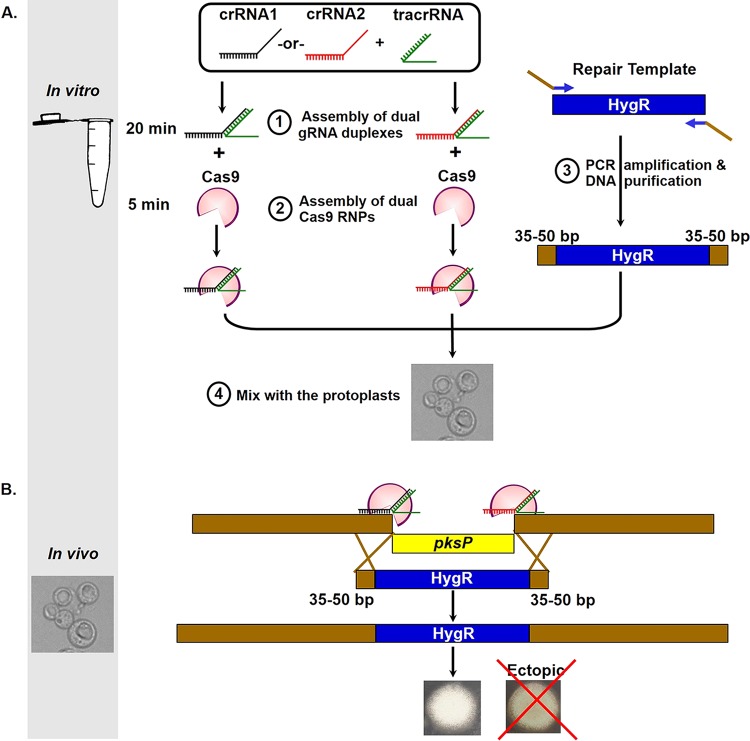
FIG 1
FIG 1
Overview of microhomology-mediated gene deletion coupled with in vitro-assembled dual Cas9 RNP cleavage. (A) (1) Cas9, tracrRNA, and dual crRNAs that cleave upstream and downstream of the pksP gene were purchased from a commercial vendor. The assembly of dual gRNA duplexes was performed by separately mixing each crRNA with equimolar amounts of tracrRNA to a final concentration of 33 μM. The two mixtures were boiled at 95°C for 5 min and then cooled to room temperature (20 to 25°C) for 10 to 15 min to allow hybridization of the crRNA to the tracrRNA. (2) For generation of dual Cas9 RNPs, each gRNA duplex was separately mixed with Cas9 (1 µg/µl) and incubated at room temperature for 5 min to allow for the formation of RNP complexes. (3) For generation of the repair template, the HygR cassette was PCR amplified using primer sets that insert 35 bp or 50 bp of flanking microhomology regions for targeting the pksP gene locus. The resulting PCR fragments were purified and utilized as repair templates. (4) The two RNP reaction mixtures were mixed with the HygR repair template and then added to A. fumigatus protoplast suspension (5 × 10⁷ conidia/ml). The protoplasts were then transformed according to a standard protocol. (B) Inside the protoplasts, the dual Cas9 RNPs cleave upstream and downstream of pksP, resulting in complete removal of the pksP coding sequence. In the presence of the HygR repair template, the cleaved pksP gene is replaced by the HygR repair template mediated by 35 to 50 bp of microhomology regions. Deletion mutants of the pksP gene exhibit white conidia, which allow for simple assessment of gene deletion based on the conidial color of the colonies.
FIG 2
FIG 2
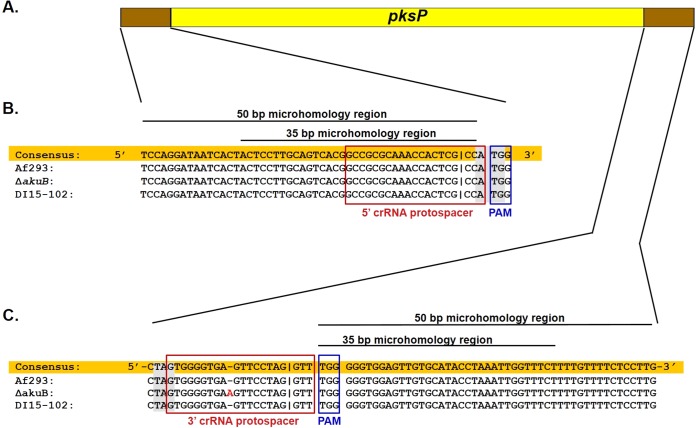
Selection of dual crRNA protospacer sequences. (A) Schematic diagram of pksP coding sequence and the flanking regions that are targeted by dual in vitro-assembled Cas9 RNPs. Designing the protospacers is described in Results. (B and C) Sequence alignment of pksP upstream (B) and downstream (C) regions of three distinct genetic backgrounds of A. fumigatus. The consensus sequence (highlighted in orange) was manually generated based on sequence alignment. The 5′ crRNA and 3′ crRNA protospacer sequences are marked by red open boxes. The protospacer-adjacent motif (PAM) sequences are marked by blue open boxes. Start and stop codons are highlighted in gray. The additional adenine in the pksP downstream region of the ΔakuB strain and the clinical isolate DI15-102 is shown in red font. Cas9 DSB sites (i.e., 3 nucleotides upstream of the PAM site [1, 9, 57]) are marked by a vertical line in the sequence. The sequences of the 35-bp and 50-bp regions that are used for microhomology-mediated integration are marked by a line above the sequence.
FIG 3
FIG 3
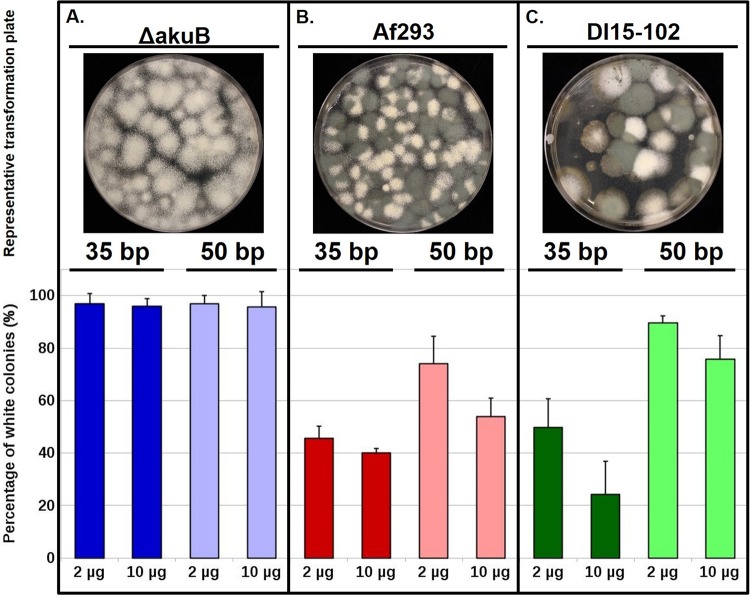
High efficiency of gene deletion in all tested genetic backgrounds of A. fumigatus. In vitro-assembled Cas9 RNPs coupled with microhomology-mediated integration of the HygR cassette were tested in ΔakuB (A), Af293 (B), and DI15-102 (C) strains. (Above) Representative transformation plates are shown for each strain using 2 µg of the HygR repair template that is flanked by 35-bp microhomology arms. (Below) The assessment of pksP deletion efficiency across different strains is plotted as the number of ΔpksP mutants out of the total number of transformation colonies. Deletion efficiencies were assessed based on the color of conidia. The ΔpksP mutant produces white colonies, while ectopic integrations result in green colonies. Deletion efficiencies represent the average from at least three independent transformations. Error bars represent the standard deviation calculated for each combination of strain, the size of HygR microhomology arms, and concentration of the HygR repair template for all experimental replicates.
FIG 4
FIG 4
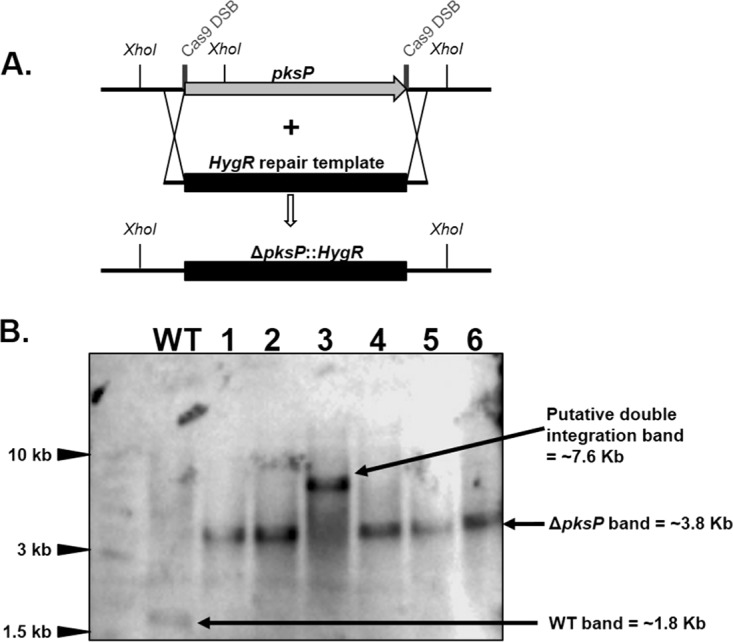
Southern blot analysis of ΔpksP mutant generated in the Af293 background. (A) Schematic representation of the genomic locus of the Af293 and ΔpksP strains. Deletion of the pksP gene was carried out using the HygR cassette. The cleavage sites of the dual in vitro-assembled Cas9 RNPs are marked by thick vertical lines. XhoI cutting sites are indicated in the pksP locus of the wild-type and ΔpksP strains. (B) Southern blot analysis of 6 arbitrarily selected colonies after digesting genomic DNA with the XhoI restriction enzyme. The wild type (WT) produced a 1.8-kb band that matches the expected wild-type banding pattern. Lanes 1, 2, 4, 5, and 6 displayed a 3.8-kb band which matches the expected pksP deletion banding pattern. The colony in lane 3 displayed a 7.6-kb band, likely containing a tandem integration of the HygR repair template at the pksP locus.
FIG 5
FIG 5
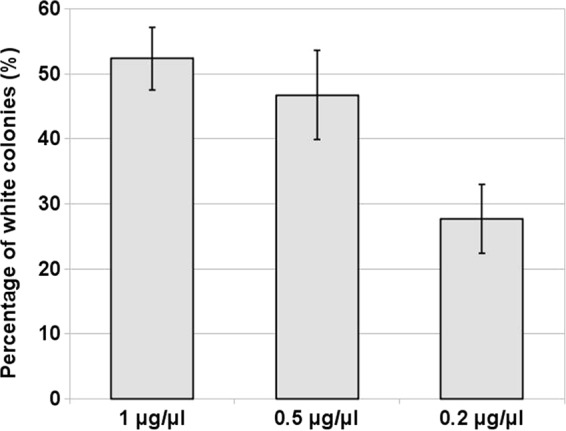
The concentration of Cas9 directly correlates with the efficiency of gene deletion. The analysis was carried out in the Af293 strain using 2 µg of the HygR repair template flanked by 35 bp of microhomology regions. Dilution of Cas9 is described in Materials and Methods. The effect of Cas9 concentration on pksP deletion rates was assessed based on the color of conidia. Deletion efficiencies represent the average from at least three independent transformations. Error bars represent the standard deviation calculated for each concentration of Cas9.

References

    1. Ran FA, Hsu PD, Wright J, Agarwala V, Scott DA, Zhang F. 2013. Genome engineering using the CRISPR-Cas9 system. Nat Protoc 8:2281–2308. doi:10.1038/nprot.2013.143. - DOI - PMC - PubMed
    1. Sander JD, Joung JK. 2014. CRISPR-Cas systems for editing, regulating and targeting genomes. Nat Biotechnol 32:347–355. doi:10.1038/nbt.2842. - DOI - PMC - PubMed
    1. Horvath P, Barrangou R. 2010. CRISPR/Cas, the immune system of bacteria and archaea. Science 327:167–170. doi:10.1126/science.1179555. - DOI - PubMed
    1. Barrangou R, Fremaux C, Deveau H, Richards M, Boyaval P, Moineau S, Romero DA, Horvath P. 2007. CRISPR provides acquired resistance against viruses in prokaryotes. Science 315:1709–1712. doi:10.1126/science.1138140. - DOI - PubMed
    1. Hsu PD, Lander ES, Zhang F. 2014. Development and applications of CRISPR-Cas9 for genome engineering. Cell 157:1262–1278. doi:10.1016/j.cell.2014.05.010. - DOI - PMC - PubMed