


Objectively-assessed physical activity and weight change in young adults: a randomized controlled trial
- PMID: 29202850
- PMCID: PMC5715643
- DOI: 10.1186/s12966-017-0620-x
Objectively-assessed physical activity and weight change in young adults: a randomized controlled trial
Abstract
Background: Reductions in physical activity (PA) are common throughout young adulthood and low PA is associated with weight gain. The SNAP Trial previously reported that two self-regulation approaches to weight gain prevention reduced weight gain over a 2-year period in 18-35 year olds. Presented here are secondary analyses examining changes in PA and the relationship between PA and weight change over 2 years.
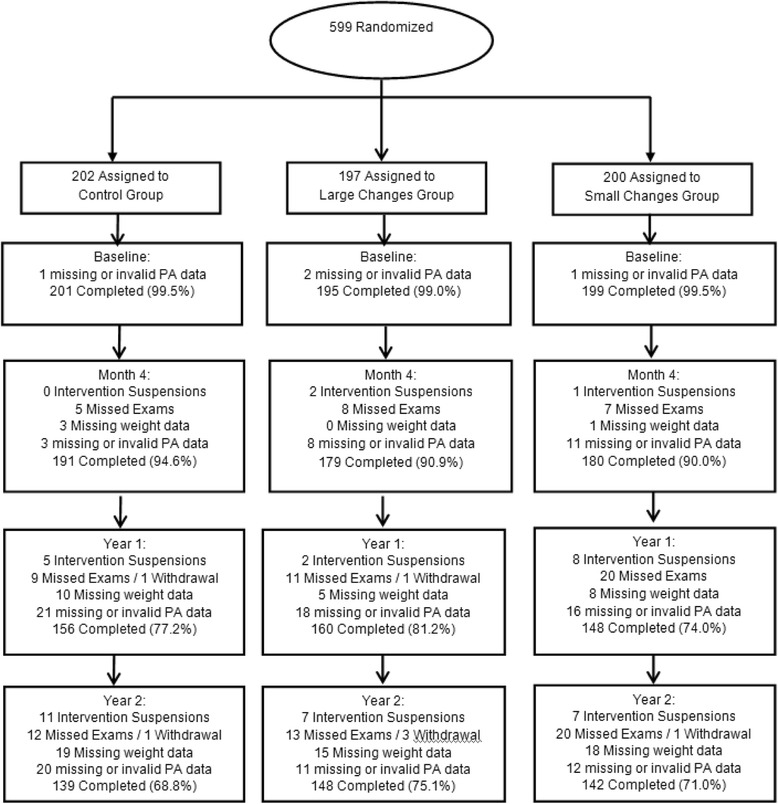
Methods: 599 young adults (age: 27.4 ± 4.4 yrs.; BMI: 25.4 ± 2.6 kg/m2) were randomly assigned to 1 of 3 treatment arms: Small Changes (reduce calorie intake by 100 kcals/day & add 2000 steps/day), Large Changes (lose 2.3-4.5 kg initially & increase PA to ≥250 min/wk), or Self-guided (control condition). Small and Large Changes received 10, face-to-face group sessions (months 1-4), and two 4-week refresher courses each subsequent year. Body weight and PA were objectively-measured at baseline, 4 months, 1 and 2 years. Daily steps and bout-related moderate-to-vigorous intensity PA (MVPA: ≥3 METs, ≥10-min bouts) was calculated.
Results: Changes in bout-related MVPA and daily steps did not differ among treatment groups over the 2-year period (p's > 0.16). Collapsed across groups, participants gaining >1 lb. (n = 187; 39.6%) had smaller changes in bout-related MVPA at 4 months, 1 and 2 years relative to those maintaining or losing weight (≤1 lb. weight gain; n = 282, 60.4%, p's < 0.05). Averaged across time points, this difference equated to 47.8 min/week. Those gaining and not gaining >1 lb. did not differ on daily steps (p's > 0.10). Among participants engaging in ≥250 min/wk. of MVPA at 2 years (n = 181), 30% gained >1 lb. from baseline to 2 years, which was not different from those engaging in 150-250 min/wk. (n = 87; 36%; p = 0.40), but this percentage was significantly lower when compared to those engaging in <150 min/wk. (n = 176; 49%; p < 0.001).
Conclusions: On average, PA differences were not observed between young adults assigned to small or large changes self-regulation interventions to prevent weight gain. Regardless of group assignment, higher levels of MVPA were associated with better weight gain prevention over 2 years. Our data suggest that achieving >150 min/week of MVPA is needed for weight gain prevention and that increasing MVPA, rather than steps, should be targeted.
Trial registration: www.clinicaltrials.gov (NCT01183689). Registered Aug 13, 2010.
Keywords: Body weight; Exercise; Physical activity; Weight gain; Young adulthood.
Conflict of interest statement
Ethics approval and consent to participate
Informed consent was obtained from all participants, and procedures were performed in accordance with The Miriam Hospital’s (Providence, RI) and University of North Carolina (Chapel Hill, NC) Institutional Review Boards.
Consent for publication
Not applicable.
Competing interests
Dr. Tate is on the Weight Watchers Scientific Advisory Board and received a research grant from Weight Watchers International. The remaining authors have no conflicts of interest to declare. Further, this study was sponsored by NHLBI and the study sponsor did not have any role in the study design; collection, analysis, and interpretation of data; writing the report; and the decision to submit the report for publication.
Publisher’s Note
Springer Nature remains neutral with regard to jurisdictional claims in published maps and institutional affiliations.
Figures
References
-
- Truesdale KP, Stevens J, Lewis CE, Schreiner PJ, Loria CM, Cai J. Changes in risk factors for cardiovascular disease by baseline weight status in young adults who maintain or gain weight over 15 years: the CARDIA study. Int J Obes. 2006;30(9):1397–1407. doi: 10.1038/sj.ijo.0803307. - DOI - PMC - PubMed
Publication types
MeSH terms
Associated data
Grants and funding
LinkOut - more resources
Full Text Sources
Other Literature Sources
Medical
