


Personalized Prediction of Glaucoma Progression Under Different Target Intraocular Pressure Levels Using Filtered Forecasting Methods
- PMID: 29203067
- PMCID: PMC5866175
- DOI: 10.1016/j.ophtha.2017.10.033
Personalized Prediction of Glaucoma Progression Under Different Target Intraocular Pressure Levels Using Filtered Forecasting Methods
Abstract
Purpose: To generate personalized forecasts of how patients with open-angle glaucoma (OAG) experience disease progression at different intraocular pressure (IOP) levels to aid clinicians with setting personalized target IOPs.
Design: Secondary analyses using longitudinal data from 2 randomized controlled trials.
Participants: Participants with moderate or advanced OAG from the Collaborative Initial Glaucoma Treatment Study (CIGTS) or the Advanced Glaucoma Intervention Study (AGIS).
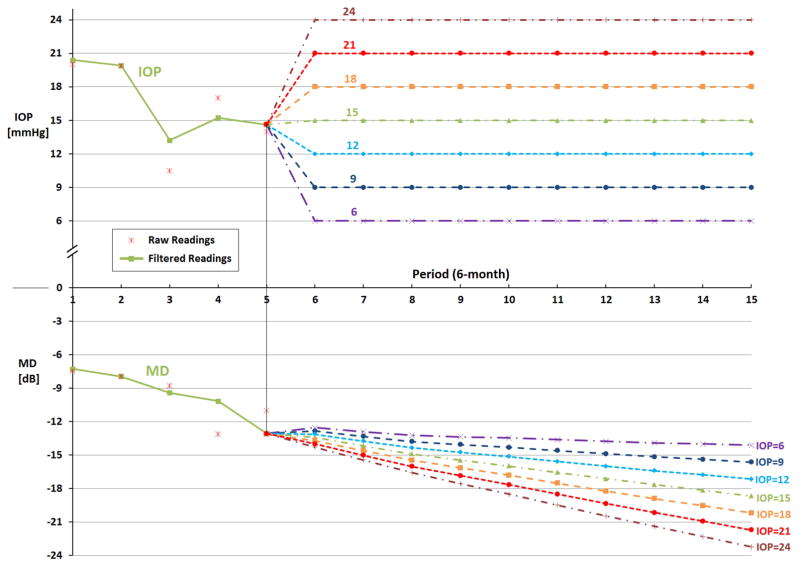
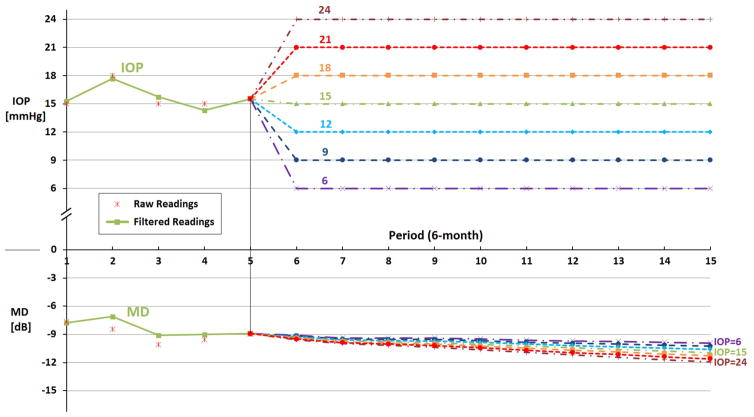
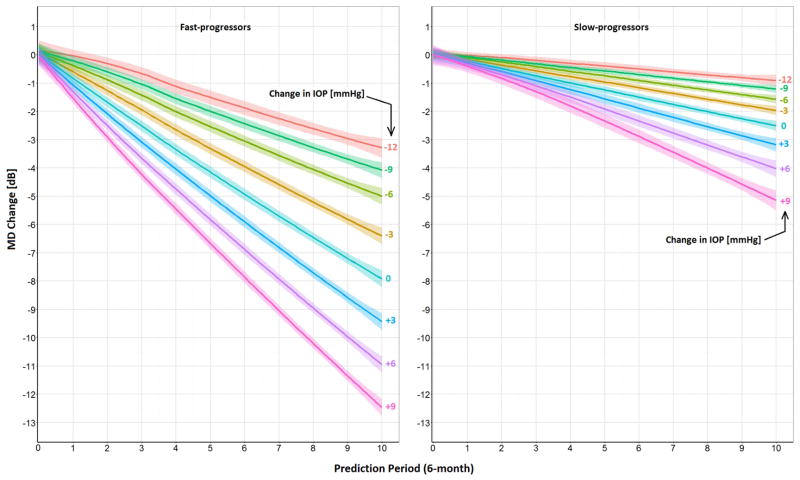
Methods: By using perimetric and tonometric data from trial participants, we developed and validated Kalman Filter (KF) models for fast-, slow-, and nonprogressing patients with OAG. The KF can generate personalized and dynamically updated forecasts of OAG progression under different target IOP levels. For each participant, we determined how mean deviation (MD) would change if the patient maintains his/her IOP at 1 of 7 levels (6, 9, 12, 15, 18, 21, or 24 mmHg) over the next 5 years. We also model and predict changes to MD over the same time horizon if IOP is increased or decreased by 3, 6, and 9 mmHg from the level attained in the trials.
Main outcome measures: Personalized estimates of the change in MD under different target IOP levels.
Results: A total of 571 participants (mean age, 64.2 years; standard deviation, 10.9) were followed for a mean of 6.5 years (standard deviation, 2.8). Our models predicted that, on average, fast progressors would lose 2.1, 6.7, and 11.2 decibels (dB) MD under target IOPs of 6, 15, and 24 mmHg, respectively, over 5 years. In contrast, on average, slow progressors would lose 0.8, 2.1, and 4.1 dB MD under the same target IOPs and time frame. When using our tool to quantify the OAG progression dynamics for all 571 patients, we found no statistically significant differences over 5 years between progression for black versus white, male versus female, and CIGTS versus AGIS participants under different target IOPs (P > 0.05 for all).
Conclusions: To our knowledge, this is the first clinical decision-making tool that generates personalized forecasts of the trajectory of OAG progression at different target IOP levels. This approach can help clinicians determine appropriate, personalized target IOPs for patients with OAG.
Copyright © 2017 American Academy of Ophthalmology. Published by Elsevier Inc. All rights reserved.
Figures
References
-
- Lefferts EJ, Markley FL, Shuster MD. Kalman filtering for spacecraft attitude estimation. Journal of Guidance, Control, and Dynamics. 1982;5(5):417–29.
-
- Eberle C, Ament C. The unscented Kalman filter estimates the plasma insulin from glucose measurement. Biosystems. 2011;103(1):67–72. - PubMed
-
- Lavieri MS, Puterman ML, Tyldesley S, Morris WJ. When to treat prostate cancer patients based on their PSA dynamics. IIE Transactions on Healthcare Systems Engineering. 2012;2(1):62–77.
-
- Musch DC, Lichter PR, Guire KE, et al. The Collaborative Initial Glaucoma Treatment Study: study design, methods, and baseline characteristics of enrolled patients. Ophthalmology. 1999;106(4):653–62. - PubMed
Publication types
MeSH terms
Substances
Grants and funding
LinkOut - more resources
Full Text Sources
Other Literature Sources
Miscellaneous
