Profile and Outcome of Pediatric Brain Tumors - Experience from a Tertiary Care Pediatric Oncology Unit in South India
- PMID: 29204198
- PMCID: PMC5696660
- DOI: 10.4103/jpn.JPN_31_17
Profile and Outcome of Pediatric Brain Tumors - Experience from a Tertiary Care Pediatric Oncology Unit in South India
Abstract
Context: Tumors of the central nervous system (CNS) constitute the second most common pediatric cancers. Unlike leukemia, management of CNS tumors requires a good multidisciplinary team. Higher rates of treatment abandonment are documented in view of complexity of the treatment with long duration, involving neurosurgery, radiation, chemotherapy, and high cost of treatment. Morbidity associated with CNS tumors may be significant in terms of physical deficits as well as neuropsychological and neuroendocrine sequelae. Pediatric neurooncology is still at a very nascent stage in the developing countries. There are only a few reports on the multidisciplinary approach and outcomes of pediatric brain tumors in developing countries.
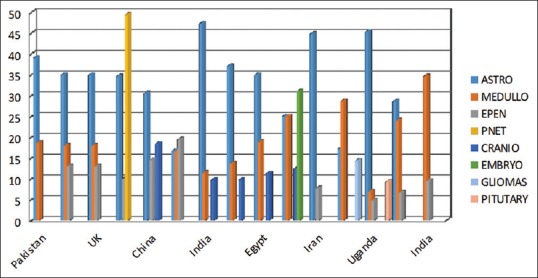
Aims: The aim of this study is to identify the clinicopathological profile of Pediatric CNS tumors in a tertiary care center located in South India in comparison with reports from other low-and middle-income Countries.
Settings and design: A retrospective analysis of medical records of all children diagnosed with brain tumors from January 2012 to November 2016 at our institute was done.
Subjects and methods: A retrospective study of clinical, pathological profile, and outcomes of children <18 years diagnosed with brain tumors at our institute from January 2012 to November 2016 was done. Histopathological categorization was done as per the WHO classification 2007. The multidisciplinary treatment with respect to surgery, radiation, and chemotherapy was noted and the outcomes were recorded.
Statistical analysis used: R for Statistical Computing (Version 3.0.2; 2013-09-25).
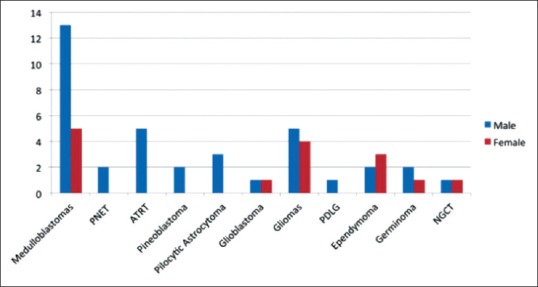
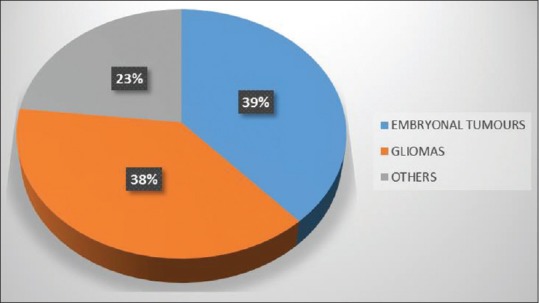
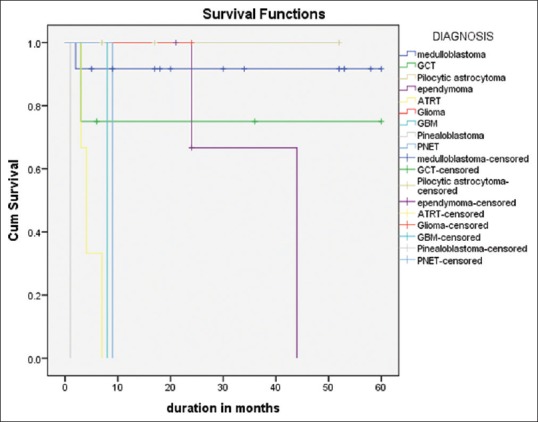
Results: A total of 52 children were diagnosed with male preponderance of 66.6%. Highest incidence was noted in the age group of 0-4 years (50%). Majority of them were supratentorial (59.6%). CNS embryonal tumors contributed to 48% of all our brain tumors. 73% of them underwent either resection or biopsy. Eight (15.3%) of them died due to the progression of disease, but 44% abandoned treatment due to the progression/recurrence of disease. Those lost to follow-up were mostly among the high-risk groups with poor prognosis such as pontine glioma, medulloblastoma (high risk), and primitive neuroectodermal tumor.
Conclusions: Although brain tumors constituted 30% of all our solid tumors, only 56% of them received appropriate treatment and 25% abandoned treatment. High rates of abandonment were a consequence of late diagnosis, complex multidisciplinary treatment involved, high treatment cost, lack of uniformity in management between different oncology centers and poor prognosis of the tumor subtype.
Keywords: Childhood brain tumors; low- income country; outcomes.
Conflict of interest statement
There are no conflicts of interest.
Figures
References
-
- Albright AL, Sposto R, Holmes E, Zeltzer PM, Finlay JL, Wisoff JH, et al. Correlation of neurosurgical subspecialization with outcomes in children with malignant brain tumors. Neurosurgery. 2000;47:879–85. - PubMed
-
- Parkin DM, Pisani P, Ferlay J. Global cancer statistics. CA Cancer J Clin. 1999;49:33–64, 1. - PubMed
-
- Smith MA, Freidlin B, Ries LA, Simon R. Trends in reported incidence of primary malignant brain tumors in children in the United States. J Natl Cancer Inst. 1998;90:1269–77. - PubMed
LinkOut - more resources
Full Text Sources
Other Literature Sources