


Efficacy of ventilator waveform observation for detection of patient-ventilator asynchrony during NIV: a multicentre study
- PMID: 29204431
- PMCID: PMC5703352
- DOI: 10.1183/23120541.00075-2017
Efficacy of ventilator waveform observation for detection of patient-ventilator asynchrony during NIV: a multicentre study
Abstract
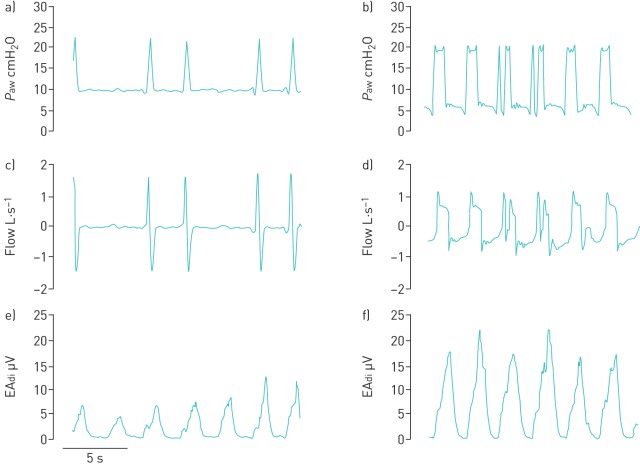
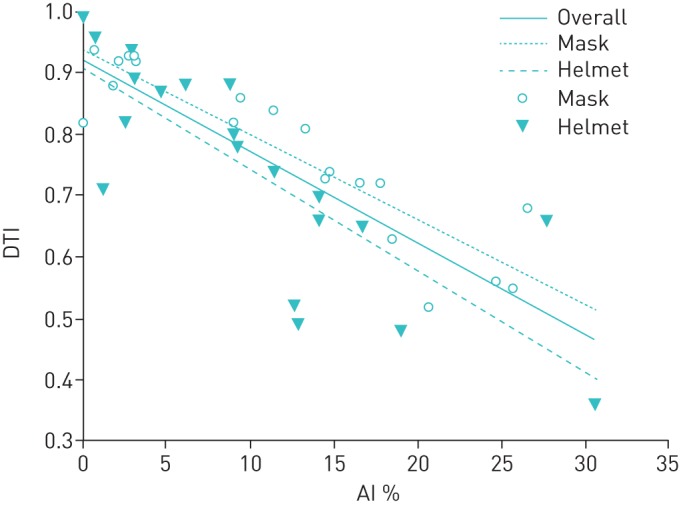
The objective of this study was to assess ability to identify asynchronies during noninvasive ventilation (NIV) through ventilator waveforms according to experience and interface, and to ascertain the influence of breathing pattern and respiratory drive on sensitivity and prevalence of asynchronies. 35 expert and 35 nonexpert physicians evaluated 40 5-min NIV reports displaying flow-time and airway pressure-time tracings; identified asynchronies were compared with those ascertained by three examiners who evaluated the same reports displaying, additionally, tracings of diaphragm electrical activity. We determined: 1) sensitivity, specificity, and positive and negative predictive values; 2) the correlation between the double true index (DTI) of each report (i.e., the ratio between the sum of true positives and true negatives, and the overall breath count) and the corresponding asynchrony index (AI); and 3) the influence of breathing pattern and respiratory drive on both AI and sensitivity. Sensitivities to detect asynchronies were low either according to experience (0.20 (95% CI 0.14-0.29) for expert versus 0.21 (95% CI 0.12-0.30) for nonexpert, p=0.837) or interface (0.28 (95% CI 0.17-0.37) for mask versus 0.10 (95% CI 0.05-0.16) for helmet, p<0.0001). DTI inversely correlated with the AI (r2=0.67, p<0.0001). Breathing pattern and respiratory drive did not affect prevalence of asynchronies and sensitivity. Patient-ventilator asynchrony during NIV is difficult to recognise solely by visual inspection of ventilator waveforms.
Conflict of interest statement
Conflict of interest: Disclosures can be found alongside this article at openres.ersjournals.com
Figures
References
-
- Sassoon CS, Foster GT. Patient-ventilator asynchrony. Curr Opin Crit Care 2001; 7: 28–33. - PubMed
-
- Chao DC, Scheinhorn DJ, Stearn-Hassenpflug M. Patient-ventilator trigger asynchrony in prolonged mechanical ventilation. Chest 1997; 112: 1592–1599. - PubMed
-
- Thille AW, Rodriguez P, Cabello B, et al. Patient-ventilator asynchrony during assisted mechanical ventilation. Intensive Care Med 2006; 32: 1515–1522. - PubMed
-
- de Wit M, Miller KB, Green DA, et al. Ineffective triggering predicts increased duration of mechanical ventilation. Crit Care Med 2009; 37: 2740–2745. - PubMed
-
- Nava S, Navalesi P, Carlucci A. Non-invasive ventilation. Minerva Anestesiol 2009; 75: 31–36. - PubMed
LinkOut - more resources
Full Text Sources
Other Literature Sources