Review
. 2017:2017:1673081.
doi: 10.1155/2017/1673081. Epub 2017 Oct 24.

The Role of Oxidative Stress, Mitochondrial Function, and Autophagy in Diabetic Polyneuropathy

Affiliations
Review

The Role of Oxidative Stress, Mitochondrial Function, and Autophagy in Diabetic Polyneuropathy

Sonia Sifuentes-Franco et al. J Diabetes Res. 2017.

Abstract

Diabetic polyneuropathy (DPN) is the most frequent and prevalent chronic complication of diabetes mellitus (DM). The state of persistent hyperglycemia leads to an increase in the production of cytosolic and mitochondrial reactive oxygen species (ROS) and favors deregulation of the antioxidant defenses that are capable of activating diverse metabolic pathways which trigger the presence of nitro-oxidative stress (NOS) and endoplasmic reticulum stress. Hyperglycemia provokes the appearance of micro- and macrovascular complications and favors oxidative damage to the macromolecules (lipids, carbohydrates, and proteins) with an increase in products that damage the DNA. Hyperglycemia produces mitochondrial dysfunction with deregulation between mitochondrial fission/fusion and regulatory factors. Mitochondrial fission appears early in diabetic neuropathy with the ability to facilitate mitochondrial fragmentation. Autophagy is a catabolic process induced by oxidative stress that involves the formation of vesicles by the lysosomes. Autophagy protects cells from diverse stress factors and routine deterioration. Clarification of the mechanisms involved in the appearance of complications in DM will facilitate the selection of specific therapeutic options based on the mechanisms involved in the metabolic pathways affected. Nowadays, the antioxidant agents consumed exogenously form an adjuvant therapeutic alternative in chronic degenerative metabolic diseases, such as DM.


Figures
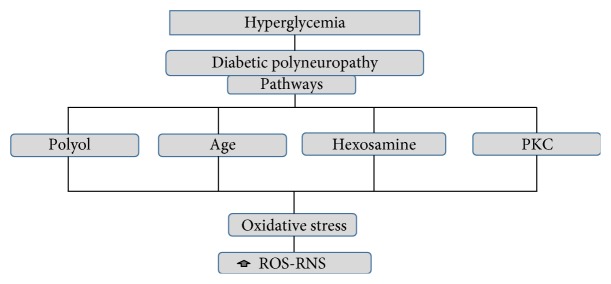
Figure 1
Figure 1
Interaction of hyperglycemia pathways with oxidative stress in DPN.
Figure 2
Figure 2
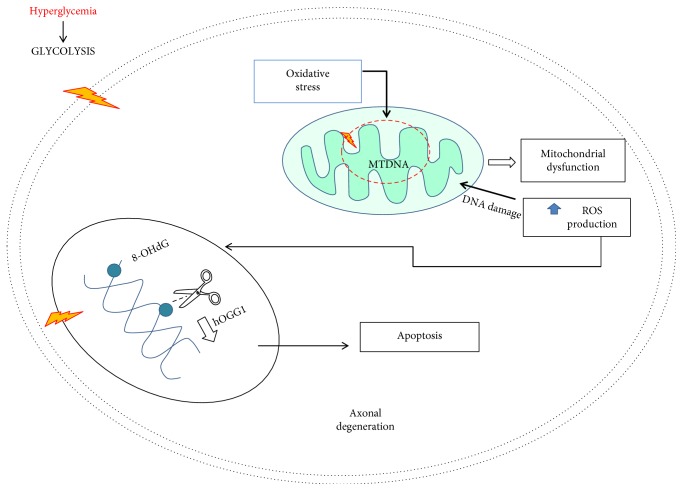
Hypothetical drawing of the effect of hyperglycemia on the increase of oxidative metabolism that induces damage to the mtDNA, which leads to mitochondrial dysfunction. The increase in the production of ROS augments damage to the nDNA with the generation of the product 8-OHdG and the decrease in repair of the DNA in DPN, which can ultimately cause axonal degeneration and cell death.
Figure 3
Figure 3
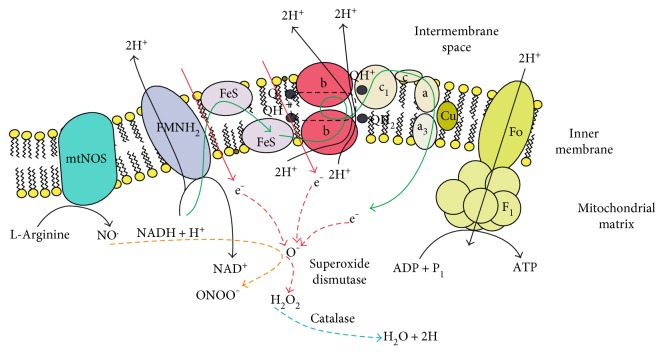
Formation of reactive oxygen and nitrogen species in mitochondria. The process is mediated by oxidative phosphorylation and the activity of the mitochondrial NO synthase: in physiological conditions the production of ROS and RNS are reduced by multiple steps that involved SOD, GPx and catalase. When the mitochondria suffers an insult the increase of the leakage of electrons to the matrix leads to an overload to the capacity of the enzymatic systems and leads to toxicity of the cell. Black arrows: vectors of reactions and products. Green arrows: the physiological pathway for formation of oxidative stress. Red arrows: leakage of electron to matrix. Dotted red and orange arrows: pathophysiological pathway for formation of ROS and RNS.
Figure 4
Figure 4
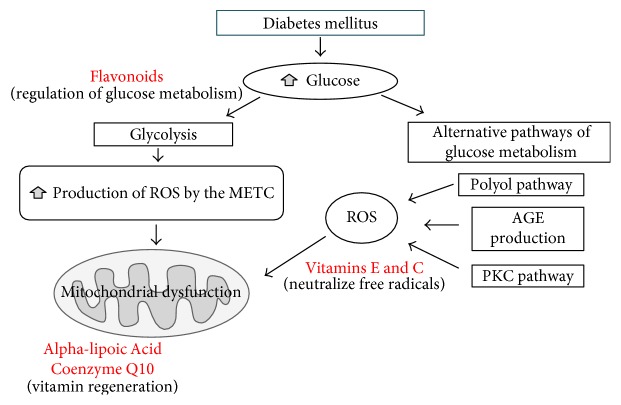
We show the theoretical mechanism of how hyperglycemia favors the activation of several metabolic pathways that favor the production of ROS causing mitochondrial dysfunction. The beneficial action of antioxidants in the regeneration of antioxidant vitamins and the effect of flavonoids in the regulation of hyperglycemia.

References

    1. Boulton A. J., Vinik A. I., Arezzo J. C., et al. Diabetic neuropathies: a statement by the American Diabetes Association. Diabetes Care. 2005;28:956–962. doi: 10.2337/diacare.28.4.956. - DOI - PubMed
    1. Smith A. G., Singleton J. R. Diabetic neuropathy. CONTINUUM: Lifelong Learning in Neurology. 2012;18:60–84. doi: 10.1212/01.con.0000411568.34085.3e. - DOI - PubMed
    1. Peltier A., Goutman S. A., Callaghan B. C. Painful diabetic neuropathy. British Medical Journal. 2014;348, article g1799 doi: 10.1136/bmj.g1799. - DOI - PubMed
    1. Vinik A. I., Mitchell B. D., Maser R. E., Freeman R. Diabetic autonomic neuropathy. Diabetes Care. 2003;26:1553–1579. doi: 10.2337/diacare.26.5.1553. - DOI - PubMed
    1. Ceriello A. New insights on oxidative stress and diabetic complications may lead to “casual” antioxidant therapy. Diabetes Care. 2003;26:1589–1596. doi: 10.2337/diacare.26.5.1589. - DOI - PubMed

Substances

LinkOut - more resources