


Advancing Intestinal Organoid Technology Toward Regenerative Medicine
- PMID: 29204508
- PMCID: PMC5704126
- DOI: 10.1016/j.jcmgh.2017.10.006
Advancing Intestinal Organoid Technology Toward Regenerative Medicine
Abstract
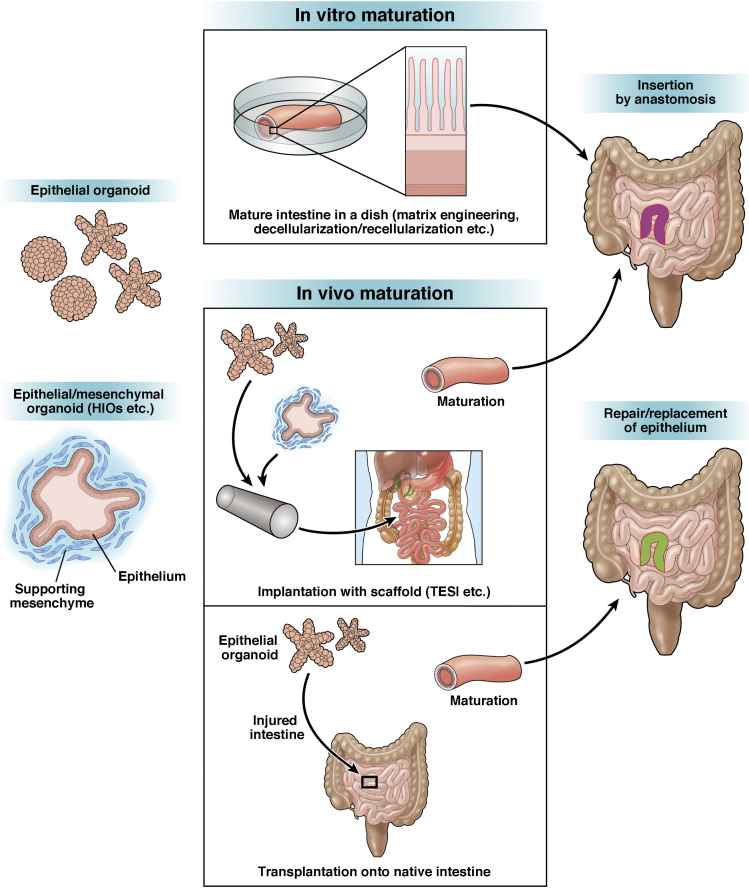
With the emergence of technologies to culture intestinal epithelial cells in vitro as various forms of intestinal organoids, there is growing interest in using such cultured intestinal cells as a source for tissue engineering and regenerative medicine. One such approach would be to combine the organoid technology with methodologies to engineer the culture environment, particularly the three-dimensional scaffold materials, to generate intestines that exquisitely recapitulate their original structures and functions. Another approach to use organoids for regenerative medicine would be to urge them to mature into functional intestines by implanting them into hosts. This process includes the tissue-engineered small intestine that uses synthetic scaffolds for tissue regeneration and direct organoid transplantation that takes advantage of submucosal tissues in the native intestines as a scaffold. Further study in these subfields could lead to the development of therapeutic options to use different types of organoids with various cell types in regenerative medicine for intestinal diseases in humans.
Keywords: 2D, two-dimensional; 3D, three-dimensional; ECM, extracellular matrix; HIO, human intestinal organoid; IBD, inflammatory bowel disease; IEC, intestinal epithelial cell; ISC, intestinal stem cell; Intestinal Organoid; Intestinal Stem Cells; Regenerative Medicine; SBS, short bowel syndrome; TESI, tissue-engineered small intestine; Tissue Engineering; Transplantation.
Figures
Similar articles
-
Short-term and long-term human or mouse organoid units generate tissue-engineered small intestine without added signalling molecules.Exp Physiol. 2018 Dec;103(12):1633-1644. doi: 10.1113/EP086990. Epub 2018 Nov 2. Exp Physiol. 2018. PMID: 30232817
-
Human tissue-engineered small intestine forms from postnatal progenitor cells.J Pediatr Surg. 2013 Jan;48(1):129-37. doi: 10.1016/j.jpedsurg.2012.10.029. J Pediatr Surg. 2013. PMID: 23331805
-
R-Spondin 1 (RSPO1) Increases Mouse Intestinal Organoid Unit Size and Survival in vitro and Improves Tissue-Engineered Small Intestine Formation in vivo.Front Bioeng Biotechnol. 2020 Jun 5;8:476. doi: 10.3389/fbioe.2020.00476. eCollection 2020. Front Bioeng Biotechnol. 2020. PMID: 32582652 Free PMC article.
-
Tissue engineering the small intestine.Clin Gastroenterol Hepatol. 2013 Apr;11(4):354-8. doi: 10.1016/j.cgh.2013.01.028. Epub 2013 Feb 4. Clin Gastroenterol Hepatol. 2013. PMID: 23380001 Review.
-
In Vivo Intestinal Research Using Organoid Transplantation.Keio J Med. 2022 Dec 25;71(4):73-81. doi: 10.2302/kjm.2022-0019-IR. Epub 2022 Dec 1. Keio J Med. 2022. PMID: 36450523 Review.
Cited by
-
Engineering the Future of Regenerative Medicines in Gut Health with Stem Cell-Derived Intestinal Organoids.Stem Cell Rev Rep. 2025 Jun;21(5):1449-1470. doi: 10.1007/s12015-025-10893-w. Epub 2025 May 17. Stem Cell Rev Rep. 2025. PMID: 40380985 Review.
-
Gastrointestinal cancer organoids-applications in basic and translational cancer research.Exp Mol Med. 2021 Oct;53(10):1459-1470. doi: 10.1038/s12276-021-00654-3. Epub 2021 Oct 18. Exp Mol Med. 2021. PMID: 34663939 Free PMC article. Review.
-
Precision-based modeling approaches for necrotizing enterocolitis.Dis Model Mech. 2020 Jun 24;13(6):dmm044388. doi: 10.1242/dmm.044388. Dis Model Mech. 2020. PMID: 32764156 Free PMC article. Review.
-
Defense of COVID-19 by Human Organoids.Phenomics. 2021;1(3):113-128. doi: 10.1007/s43657-021-00015-0. Epub 2021 Jul 14. Phenomics. 2021. PMID: 35233559 Free PMC article. Review.
-
Function and mechanism of mesenchymal stem cells in the healing of diabetic foot wounds.Front Endocrinol (Lausanne). 2023 Mar 16;14:1099310. doi: 10.3389/fendo.2023.1099310. eCollection 2023. Front Endocrinol (Lausanne). 2023. PMID: 37008908 Free PMC article. Review.
References
-
- Jeppesen P.B. Spectrum of short bowel syndrome in adults: intestinal insufficiency to intestinal failure. JPEN J Parenter Enteral Nutr. 2014;38:8S–13S. - PubMed
-
- Buchman A.L., Scolapio J., Fryer J. AGA technical review on short bowel syndrome and intestinal transplantation. Gastroenterology. 2003;124:1111–1134. - PubMed
-
- Salim S.Y., Söderholm J.D. Importance of disrupted intestinal barrier in inflammatory bowel diseases. Inflamm Bowel Dis. 2011;17:362–381. - PubMed
Publication types
LinkOut - more resources
Full Text Sources
Other Literature Sources
