


Trends in 30-day readmission rates after COPD hospitalization, 2006-2012
- PMID: 29206640
- PMCID: PMC5718159
- DOI: 10.1016/j.rmed.2017.07.058
Trends in 30-day readmission rates after COPD hospitalization, 2006-2012
Abstract
Background: Reduction in 30-day readmission rate after chronic obstructive pulmonary disease (COPD)-related hospitalization is a national objective. However, little is known about trends in readmission rates in recent years, particularly in priority populations defined by the Agency for Healthcare Research and Quality (AHRQ)(e.g., the elderly, women, racial/ethnic minorities, low-income and rural populations, and populations with chronic illnesses).
Methods: We conducted a retrospective cohort study using data from the State Inpatient Database of eight geographically-dispersed US states (Arkansas, California, Florida, Iowa, Nebraska, New York, Utah, and Washington) from 2006 through 2012. We identified all COPD-related hospitalizations by patients ?40 years old. The primary outcome was any-cause readmission within 30 days of discharge from the index hospitalization for COPD.
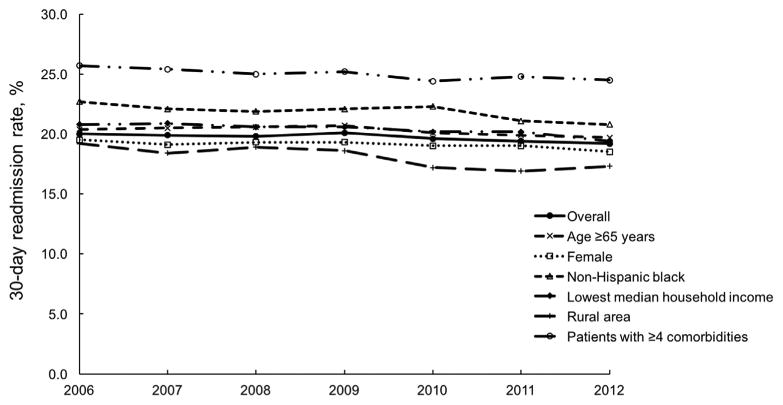
Results: From 2006 to 2012, a total of 845,465 hospitalizations at risk for 30-day readmissions were identified. Overall, 30-day readmission rate for COPD-related hospitalization decreased modestly from 20.0% in 2006 to 19.2% in 2012, an 0.8% absolute decrease (OR 0.991, 95%CI 0.989-0.995, Ptrend<0.001). This modest decline remained statistically significant after adjusting for patient demographics and comorbidities (adjusted OR 0.981, 95%CI 0.977-0.984, Ptrend<0.001). Similar to the overall population, the readmission rate over the 7-year period remained persistently high in most of AHRQ-defined priority populations.
Conclusions: Our observations provide a benchmark for future investigation of the impact of Hospital Readmissions Reduction Program on readmissions after COPD hospitalization. Our findings encourage researchers and policymakers to develop effective strategies aimed at reducing readmissions among patients with COPD in an already-stressed healthcare system.
Keywords: COPD; Epidemiology; Readmission.
Copyright © 2017 Elsevier Ltd. All rights reserved.
Conflict of interest statement
Figures
References
-
- Centers for Disease Control and Prevention. Chronic obstructive pulmonary disease among adults–United States, 2011. MMWR Morb Mortal Wkly Rep. 2012;61(46):938–943. - PubMed
-
- Kochanek KD, Xu J, Murphy SL, Minino AM, Kung HC. Deaths: final data for 2009. Natl Vital Stat Rep. 2011;60(3):1–116. - PubMed
-
- HCUPnet. [Accessed November 7, 2016]; http://hcupnet.ahrq.gov/HCUPnet.jsp.
-
- Ford ES, Murphy LB, Khavjou O, Giles WH, Holt JB, Croft JB. Total and state-specific medical and absenteeism costs of COPD among adults aged >/= 18 years in the United States for 2010 and projections through 2020. Chest. 2015;147(1):31–45. - PubMed
MeSH terms
Grants and funding
LinkOut - more resources
Full Text Sources
Other Literature Sources
Medical
