


Viral Drug Resistance Through 48 Weeks, in a Phase 2b, Randomized, Controlled Trial of the HIV-1 Attachment Inhibitor Prodrug, Fostemsavir
- PMID: 29206721
- PMCID: PMC5815643
- DOI: 10.1097/QAI.0000000000001602
Viral Drug Resistance Through 48 Weeks, in a Phase 2b, Randomized, Controlled Trial of the HIV-1 Attachment Inhibitor Prodrug, Fostemsavir
Abstract
Background: Fostemsavir is a prodrug of temsavir, an attachment inhibitor that binds to HIV-1 gp120, blocking viral attachment to host CD4 T-cells. The phase 2b trial AI438011 investigated the safety, efficacy, and dose-response of fostemsavir vs ritonavir-boosted atazanavir (ATV/r) in treatment-experienced, HIV-1-infected subjects.
Methods: Two hundred fifty-one treatment-experienced subjects with baseline (BL) susceptibility to study drugs [temsavir half-maximal inhibitory concentration (IC50) <100 nM, PhenoSense Entry assay] received fostemsavir or ATV/r, each with tenofovir disoproxil fumarate + raltegravir. Subjects meeting resistance-testing criteria were assessed for emergent viral drug resistance. Changes in temsavir IC50 from BL was given a conservative technical cutoff (>3-fold increase).
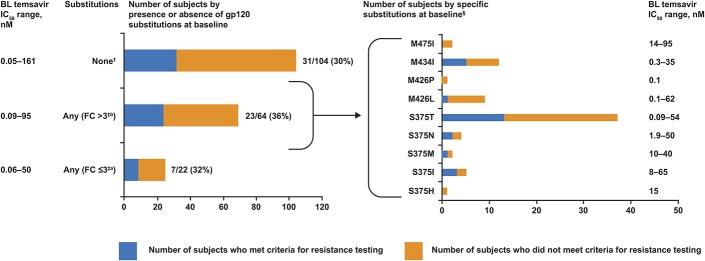
Results: 66/200 fostemsavir and 14/51 ATV/r subjects had resistance testing performed; 44/66 and 9/14 were successfully tested using the PhenoSense GT assay. No subjects had emergent tenofovir disoproxil fumarate or ATV resistance. Six fostemsavir-treated subjects developed emergent raltegravir resistance. 29/66 fostemsavir-treated subjects had an evaluable phenotype using PhenoSense Entry (which tests for viral susceptibility to temsavir) and 13/29 exhibited >3-fold increase in temsavir IC50 from BL. gp120 population sequencing was successful in 11/13 subjects and 7 had emergent substitutions in gp120 associated with reduced temsavir susceptibility (S375, M426, or M434). However, 5/13 fostemsavir-treated subjects achieved subsequent suppression to <50 copies/mL before the week 48 database lock, regardless of key gp120 substitutions.
Conclusions: Response rates remained similar across study arms regardless of BL nucleoside reverse transcriptase inhibitor, nonnucleoside reverse transcriptase inhibitor, and protease inhibitor resistance-associated mutations. Emergent changes in viral susceptibility occurred more frequently with fostemsavir compared with ATV/r. However, the full impact of temsavir IC50 changes and emergent HIV-1 gp120 substitutions, and thus appropriate clinical cutoffs, requires further study. Fostemsavir is being evaluated in a phase 3 trial in heavily treatment-experienced subjects.
Figures
References
-
- Ray N, Hwang C, Healy MD, et al. Prediction of virological response and assessment of resistance emergence to the HIV-1 attachment inhibitor BMS-626529 during 8-day monotherapy with its prodrug BMS-663068. J Acquir Immune Defic Syndr. 2013;64:7–15. - PubMed
-
- Zhou N, Nowicka-Sans B, McAuliffe B, et al. Genotypic correlates of susceptibility to HIV-1 attachment inhibitor BMS-626529, the active agent of the prodrug BMS-663068. J Antimicrob Chemother. 2014;69:573–581. - PubMed
Publication types
MeSH terms
Substances
LinkOut - more resources
Full Text Sources
Other Literature Sources
Medical
Molecular Biology Databases
Research Materials
Miscellaneous
