


An evidence-based framework on community-centred approaches for health: England, UK
- PMID: 29206912
- PMCID: PMC6445340
- DOI: 10.1093/heapro/dax083
An evidence-based framework on community-centred approaches for health: England, UK
Abstract
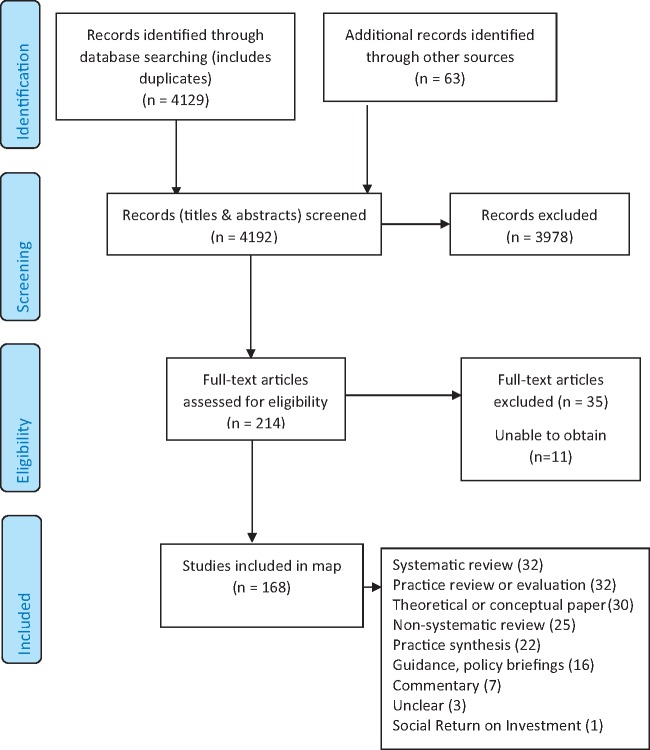
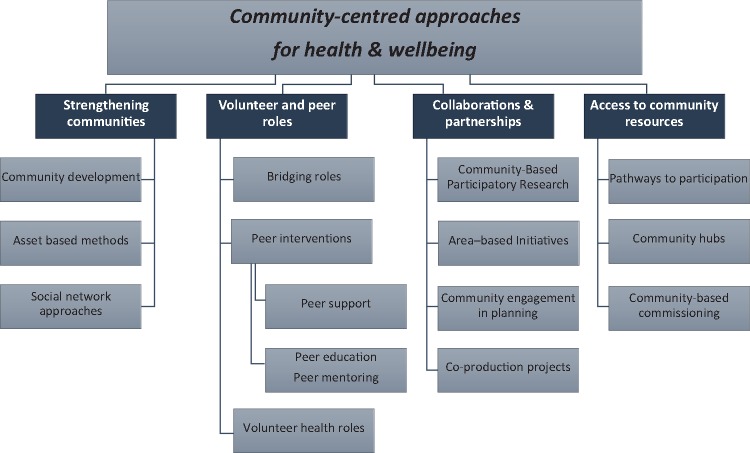
Community participation is a central concept for health promotion, covering a breadth of approaches, purposes and activities. This paper reports on a national knowledge translation project in England, UK, which resulted in a conceptual framework and typology of community-based approaches, published as national guidance. A key objective was to develop a conceptual framework linked to sources of evidence that could be used to support increased uptake of participatory methods across the health system. It was recognized that legitimacy of community participation was being undermined by a scattered evidence base, absence of a common terminology and low visibility of community practice. A scoping review, combined with stakeholder consultation, was undertaken and 168 review and conceptual publications were identified and a map produced. A 'family of community-centred approaches for health and wellbeing' was then produced as way of organizing the evidence and visually representing the range of intervention types. There are four main groups, with sub-categories: (i) strengthening communities, (ii) volunteer and peer roles, (iii) collaborations and partnerships and (iv) access to community resources. Each group is differentiated using key concepts and theoretical justifications around increasing equity, control and social connectedness. An open access bibliography is available to accompany the framework. The paper discusses the application of the family of community-centred approaches as a flexible planning tool for health promotion practice and its potential to be used as a framework for organizing and synthesizing evidence from a range of participatory methods.
Keywords: community participation; empowerment; evidence-based practice; public health; typology.
© The Author 2017. Published by Oxford University Press.
Figures
References
-
- Arksey H., O’Malley L. (2005) Scoping studies: towards a methodological framework. International Journal of Social Research Methodology, 8, 19–32.
-
- Bagnall A., Southby K., Mitchell B., South J. (2015). Bibliography and Map of Community-Centred Interventions for Health and Wellbeing. Leeds Beckett University, Leeds: [Online]: http://eprints.leedsbeckett.ac.uk/1782/ (last accessed 14 November 2017).
-
- Bracht N., Tsouros A. (1990) Principles and strategies of effective participation. Health Promotion International, 5, 199–208.
-
- Burton P., Croft J., Hastings A., Slater T., Goodlad R., Abbott J.. et al. (2004) What Works in Area-Based Initiatives? A Systematic Review of the Literature. Report no 53.Home Office, London.
-
- Cabinet Office Social Exclusion Task Force, (2010) Inclusion Health: Improving the Way We Meet the Primary Health Care Needs of the Socially Excluded. HM Government, Cabinet Office, Department of Health, London.
MeSH terms
LinkOut - more resources
Full Text Sources
Other Literature Sources
