


Characterization of urinary extracellular vesicle proteins in muscle-invasive bladder cancer
- PMID: 29207636
- PMCID: PMC5710916
- DOI: 10.18632/oncotarget.20043
Characterization of urinary extracellular vesicle proteins in muscle-invasive bladder cancer
Abstract
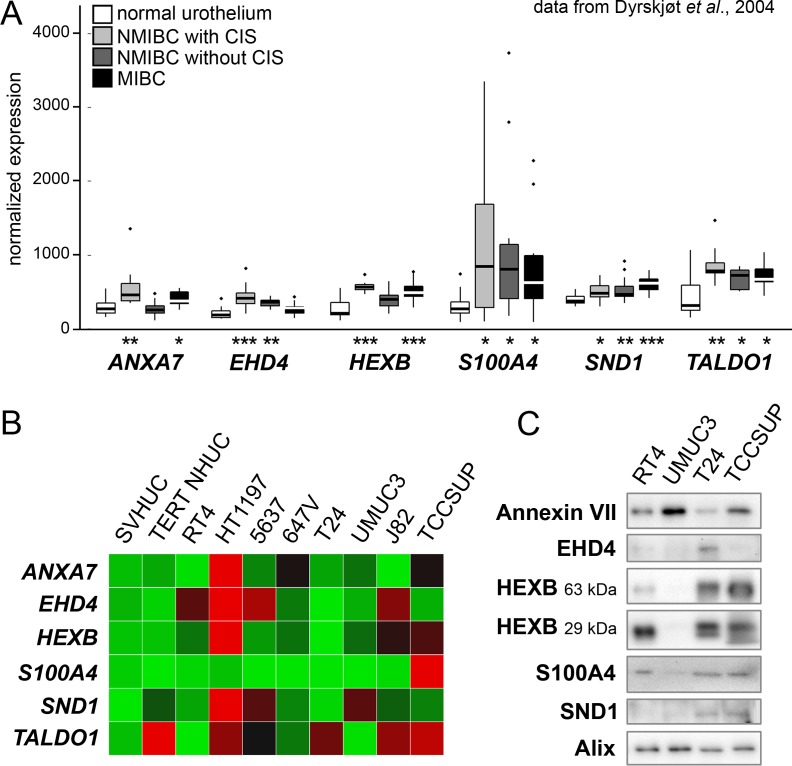
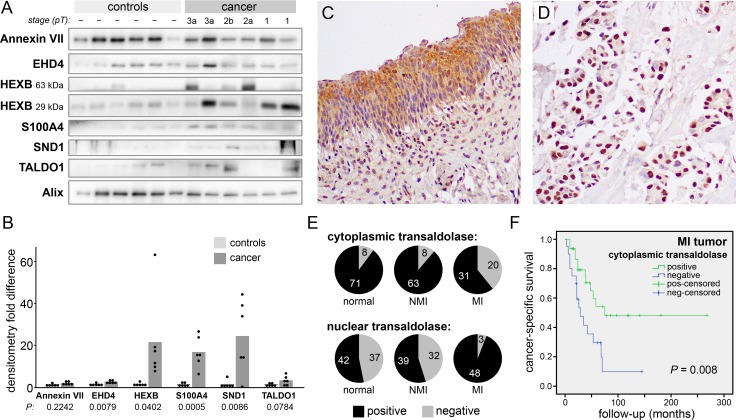
The mechanisms of bladder cancer progression are unknown, and new treatments and biomarkers are needed. Patient urinary extracellular vesicles (EVs) derive in part from bladder cancer cells and contain a specific protein cargo which may provide information about the disease. We conducted a proteomics study comparing EVs from the muscle-invasive bladder cancer (MIBC) cell line TCCSUP to EVs from normal urothelial line SVHUC. GO term analysis showed that TCCSUP EVs are enriched in proteins associated with the cell membrane, extracellular matrix, and inflammation and angiogenesis signaling pathways. Proteins characteristic of cancer EVs were further screened at the mRNA level in bladder cancer cell lines. In Western blots, three of six proteins examined showed greater than fifteenfold enrichment in patient urinary EVs compared to healthy volunteers (n = 6). Finally, we performed immunohistochemical staining of bladder tissue microarrays for three proteins of interest. One of them, transaldolase (TALDO1), is a nearly ubiquitous enzyme and normally thought to reside in the cytoplasm. To our surprise, nuclei were stained for transaldolase in 94% of MIBC tissue samples (n = 51). While cytoplasmic transaldolase was found in 89-90% of both normal urothelium (n = 79) and non-muscle-invasive samples (n = 71), the rate falls to 39% in MIBC samples (P < 0.001), and negative cytoplasmic staining was correlated with worse cancer-specific survival in MIBC patients (P = 0.008). The differential EV proteomics strategy reported here successfully identified a number of proteins associated with bladder cancer and points the way to future investigation.
Keywords: bladder cancer; exosomes; extracellular vesicles; proteomic; transaldolase.
Conflict of interest statement
CONFLICTS OF INTEREST None.
Figures

Similar articles
-
Identification of extracellular vesicle-borne periostin as a feature of muscle-invasive bladder cancer.Oncotarget. 2016 Apr 26;7(17):23335-45. doi: 10.18632/oncotarget.8024. Oncotarget. 2016. PMID: 26981774 Free PMC article.
-
Utility of SAM68 in the progression and prognosis for bladder cancer.BMC Cancer. 2015 May 6;15:364. doi: 10.1186/s12885-015-1367-x. BMC Cancer. 2015. PMID: 25944080 Free PMC article.
-
Proteomic characterization of macro-, micro- and nano-extracellular vesicles derived from the same first trimester placenta: relevance for feto-maternal communication.Hum Reprod. 2016 Apr;31(4):687-99. doi: 10.1093/humrep/dew004. Epub 2016 Feb 1. Hum Reprod. 2016. PMID: 26839151
-
Mass-spectrometry-based molecular characterization of extracellular vesicles: lipidomics and proteomics.J Proteome Res. 2015 Jun 5;14(6):2367-84. doi: 10.1021/pr501279t. Epub 2015 May 14. J Proteome Res. 2015. PMID: 25927954 Review.
-
Unraveling the multifaceted roles of extracellular vesicles in bladder cancer: diagnostic insights and therapeutic opportunities.Front Oncol. 2025 May 6;15:1554819. doi: 10.3389/fonc.2025.1554819. eCollection 2025. Front Oncol. 2025. PMID: 40395335 Free PMC article. Review.
Cited by
-
Urinary extracellular vesicles: a rising star in bladder cancer management.Transl Androl Urol. 2021 Apr;10(4):1878-1889. doi: 10.21037/tau-20-1039. Transl Androl Urol. 2021. PMID: 33968676 Free PMC article. Review.
-
PML hyposumoylation is responsible for the resistance of pancreatic cancer.FASEB J. 2019 Nov;33(11):12447-12463. doi: 10.1096/fj.201901091R. Epub 2019 Sep 16. FASEB J. 2019. PMID: 31557059 Free PMC article.
-
Multielectrode Spectroscopy Enables Rapid and Sensitive Molecular Profiling of Extracellular Vesicles.ACS Cent Sci. 2022 Jan 26;8(1):110-117. doi: 10.1021/acscentsci.1c01193. Epub 2022 Jan 7. ACS Cent Sci. 2022. PMID: 35111901 Free PMC article.
-
Extracellular vesicles in urological malignancies: an update.Nat Rev Urol. 2020 Jan;17(1):11-27. doi: 10.1038/s41585-019-0261-8. Epub 2019 Dec 11. Nat Rev Urol. 2020. PMID: 31827264 Review.
-
Liquid Biopsy Biomarkers in Bladder Cancer: A Current Need for Patient Diagnosis and Monitoring.Int J Mol Sci. 2018 Aug 24;19(9):2514. doi: 10.3390/ijms19092514. Int J Mol Sci. 2018. PMID: 30149597 Free PMC article. Review.
References
-
- Ries LA, Melbert D, Krapcho M, Stinchcomb DG, Howlader N, Horner MJ, Mariotto A, Miller BA, Feuer EJ, Altekruse SF, Lewis DR, Clegg L, Eisner MP, et al. SEER cancer statistics review, 1975–2005. Bethesda, MD: U.S. National Institutes of Health, National Cancer Institute; 2008.
-
- Messing EM, Madeb R, Young T, Gilchrist KW, Bram L, Greenberg EB, Wegenke JD, Stephenson L, Gee J, Feng C. Long-term outcome of hematuria home screening for bladder cancer in men. Cancer. 2006;107:2173–9. https://doi.org/10.1002/cncr.22224. - DOI - PubMed
-
- Scosyrev E, Noyes K, Feng C, Messing E. Sex and racial differences in bladder cancer presentation and mortality in the US. Cancer. 2009;115:68–74. https://doi.org/10.1002/cncr.23986. - DOI - PubMed
-
- Andersson L, Droller MJ. Bladder cancer: from pathogenesis to prevention. Scand J Urol Nephrol Suppl. 2008:5–6. https://doi.org/10.1080/03008880802283789. - DOI - PubMed
-
- Botteman MF, Pashos CL, Redaelli A, Laskin B, Hauser R. The health economics of bladder cancer: a comprehensive review of the published literature. Pharmacoeconomics. 2003;21:1315–30. - PubMed
Grants and funding
LinkOut - more resources
Full Text Sources
Other Literature Sources
Miscellaneous
