. 2018 Feb;176(2):1423-1432.
doi: 10.1104/pp.17.01331. Epub 2017 Dec 5.

Alternative Oxidase Isoforms Are Differentially Activated by Tricarboxylic Acid Cycle Intermediates

Affiliations

Alternative Oxidase Isoforms Are Differentially Activated by Tricarboxylic Acid Cycle Intermediates

Jennifer Selinski et al. Plant Physiol. 2018 Feb.

Abstract

The cyanide-insensitive alternative oxidase (AOX) is a non-proton-pumping ubiquinol oxidase that catalyzes the reduction of oxygen to water and is posttranslationally regulated by redox mechanisms and 2-oxo acids. Arabidopsis (Arabidopsis thaliana) possesses five AOX isoforms (AOX1A-AOX1D and AOX2). AOX1D expression is increased in aox1a knockout mutants from Arabidopsis (especially after restriction of the cytochrome c pathway) but cannot compensate for the lack of AOX1A, suggesting a difference in the regulation of these isoforms. Therefore, we analyzed the different AOX isoenzymes with the aim to identify differences in their posttranslational regulation. Seven tricarboxylic acid cycle intermediates (citrate, isocitrate, 2-oxoglutarate, succinate, fumarate, malate, and oxaloacetate) were tested for their influence on AOX1A, AOX1C, and AOX1D wild-type protein activity using a refined in vitro system. AOX1C is insensitive to all seven organic acids, AOX1A and AOX1D are both activated by 2-oxoglutarate, but only AOX1A is additionally activated by oxaloacetate. Furthermore, AOX isoforms cannot be transformed to mimic one another by substituting the variable cysteine residues at position III in the protein. In summary, we show that AOX isoforms from Arabidopsis are differentially fine-regulated by tricarboxylic acid cycle metabolites (most likely depending on the amino-terminal region around the highly conserved cysteine residues known to be involved in regulation by the 2-oxo acids pyruvate and glyoxylate) and propose that this is the main reason why they cannot functionally compensate for each other.


Figures

Figure 1.
Figure 1.
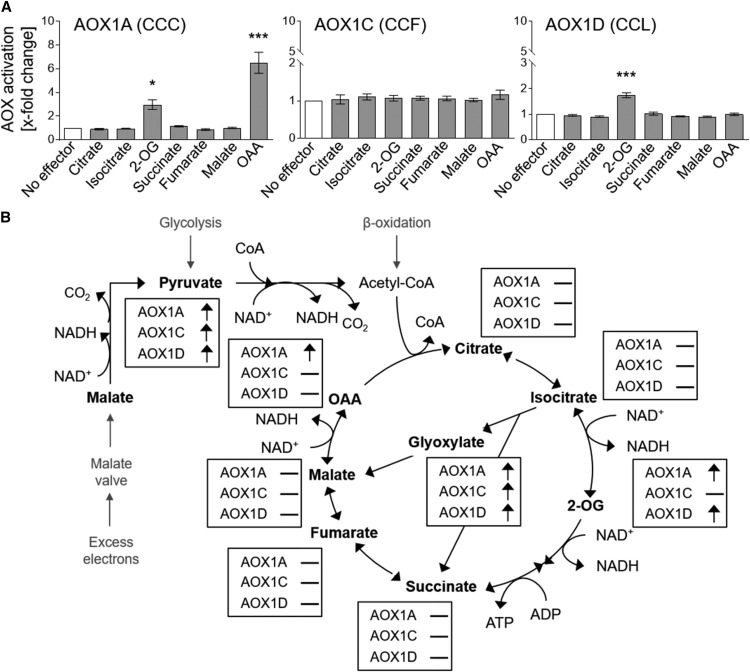
Influence of organic acids on the activity of AOX wild-type proteins. A, The effect of different organic acids on the activity of AOX1A-, AOX1C-, and AOX1D-WT proteins was analyzed. AOX activity was determined as described by Selinski et al. (2016) using 5 mm citrate, isocitrate, 2-OG, succinate, fumarate, malate, or OAA as effectors. Measurements were carried out as three independent biological replicates. Each biological replicate was measured twice, leading to a total of six values per column. Basal activities (no effector) were 5.7 ± 0.21 nmol oxygen min−1 density units (DU)−1 for AOX1A-WT, 39.28 ± 3.94 nmol oxygen min−1 DU−1 for AOX1C-WT, and 15.26 ± 0.67 nmol oxygen min−1 DU−1 for AOX1D-WT. Asterisks indicate that the differences (*, P < 0.05 and ***, P < 0.001) between the basal activity (no effector) and activities in the presence of the effectors are statistically significant as determined by two-way ANOVA with posthoc Tukey’s honestly significant difference (HSD) test. B, Schematic overview of AOX activation by TCAC intermediates.
Figure 2.
Figure 2.
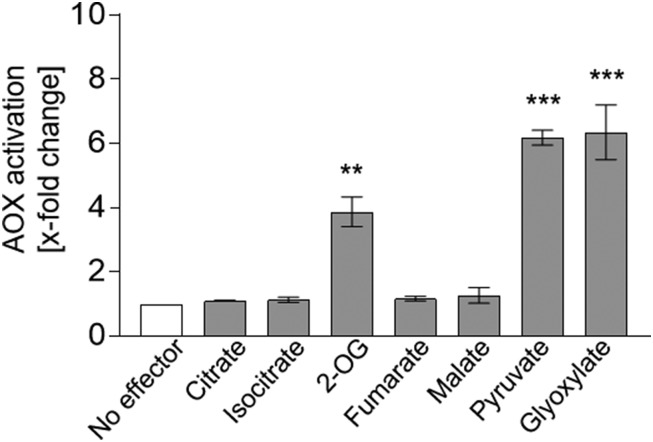
Influence of organic acids on the activity of the AOX pathway in plant mitochondria. The effect of different organic acids on the activity of the AOX pathway in isolated mitochondria from Arabidopsis was analyzed. AOX activity was determined as described by Jacoby et al. (2015) using 5 mm citrate, isocitrate, 2-OG, fumarate, malate, pyruvate, or glyoxylate as effectors. Measurements were carried out as three independent biological replicates. Each biological replicate was measured twice, leading to a total of six values per column. The basal activity (no effector) of the AOX pathway was 3.96 ± 0.6 nmol oxygen min−1 mg−1 protein. Asterisks indicate that the differences (**, P < 0.01 and ***, P < 0.001) between the basal activity (no effector) and activities in the presence of the effectors are statistically significant as determined by two-way ANOVA with posthoc Tukey’s HSD test.
Figure 3.
Figure 3.
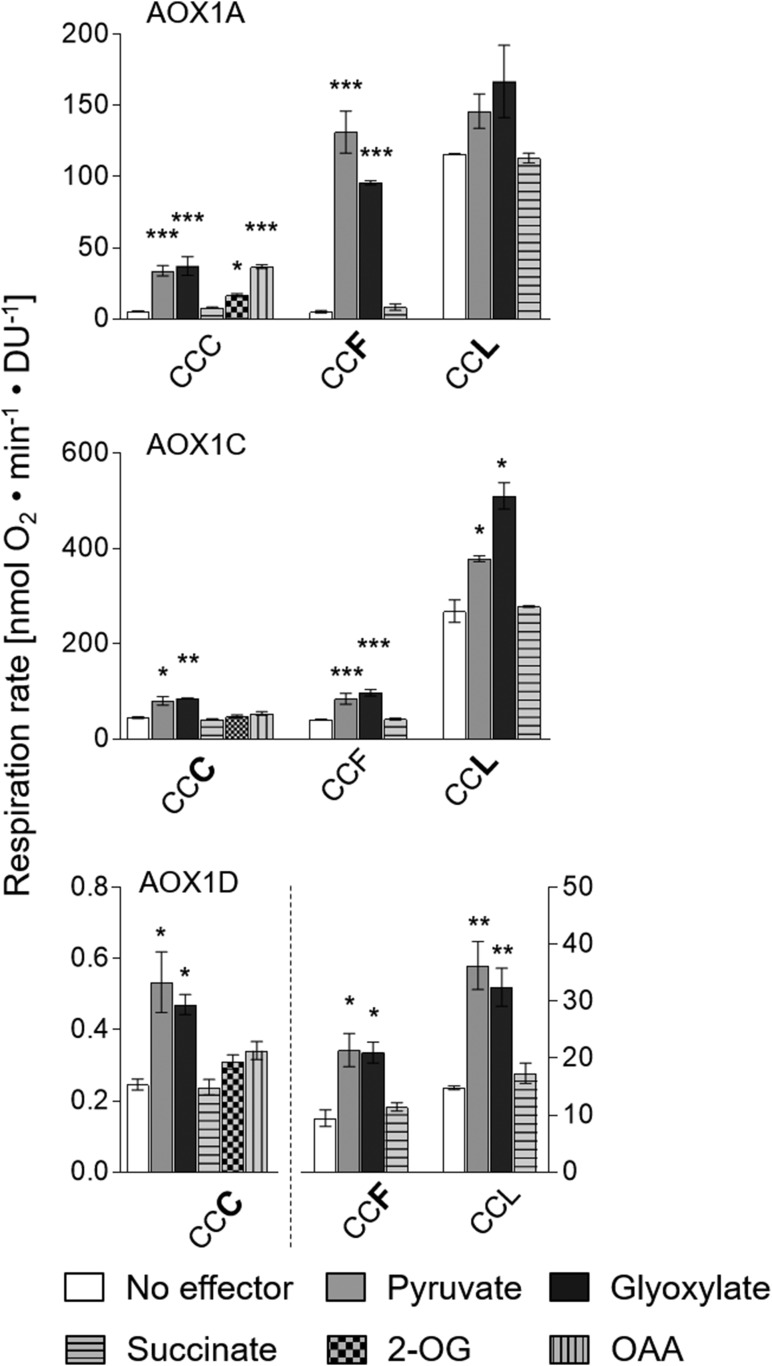
Convertibility of AOX isoforms into one another by substitutions of amino acid residues at position CysIII. Oxygen consumption measurements and calculations of specific respiration rates (nmol oxygen min−1 density units [DU]−1) were performed as described by Selinski et al. (2016). Measurements were carried out as three independent biological replicates. Each biological replicate was measured twice, leading to a total of six values per column. Basal activities (no effector) were 5.71 ± 0.15 nmol oxygen min−1 DU−1 for AOX1A-WT (CCC), 40.89 ± 0.87 nmol oxygen min−1 DU−1 for AOX1C-WT (CCF), and 14.81 ± 0.34 nmol oxygen min−1 DU−1 for AOX1D-WT (CCL). Asterisks indicate that the differences (*, P < 0.05; **, P < 0.01; and ***, P < 0.001) between the basal activity (no effector) and activities in the presence of the effectors are statistically significant as determined by two-way ANOVA with posthoc Tukey’s HSD test. Wild types are as follows: AOX1A, CCC; AOX1C, CCF; and AOX1D, CCL. Substitutions are presented in the one-letter code for amino acids in enlarged boldface letters. Note the difference in scale for AOX1D proteins: the left y axis belongs to AOX1D-CCC, and the right y axis belongs to AOX1D-CCF and AOX1D-CCL.

References

    1. Affourtit C, Albury MS, Crichton PG, Moore AL (2002) Exploring the molecular nature of alternative oxidase regulation and catalysis. FEBS Lett 510: 121–126 - PubMed
    1. Alexandre A, Lehninger AL (1984) Bypasses of the antimycin A block of mitochondrial electron transport in relation to ubisemiquinone function. Biochim Biophys Acta 767: 120–129 - PubMed
    1. Bari R, Kebeish R, Kalamajka R, Rademacher T, Peterhänsel C (2004) A glycolate dehydrogenase in the mitochondria of Arabidopsis thaliana. J Exp Bot 55: 623–630 - PubMed
    1. Bouché N, Fromm H (2004) GABA in plants: just a metabolite? Trends Plant Sci 9: 110–115 - PubMed
    1. Campo ML, Kinnally KW, Tedeschi H (1992) The effect of antimycin A on mouse liver inner mitochondrial membrane channel activity. J Biol Chem 267: 8123–8127 - PubMed

Publication types

LinkOut - more resources