. 2018 Nov;103(6):F539-F546.
doi: 10.1136/archdischild-2017-314005. Epub 2017 Dec 5.

Haemodynamic effects of umbilical cord milking in premature sheep during the neonatal transition

Affiliations

Haemodynamic effects of umbilical cord milking in premature sheep during the neonatal transition

Douglas A Blank et al. Arch Dis Child Fetal Neonatal Ed. 2018 Nov.

Abstract

Objective: Umbilical cord milking (UCM) at birth may benefit preterm infants, but the physiological effects of UCM are unknown. We compared the physiological effects of two UCM strategies with immediate umbilical cord clamping (UCC) and physiological-based cord clamping (PBCC) in preterm lambs.

Methods: At 126 days' gestational age, fetal lambs were exteriorised, intubated and instrumented to measure umbilical, pulmonary and cerebral blood flows and arterial pressures. Lambs received either (1) UCM without placental refill (UCMwoPR); (2) UCM with placental refill (UCMwPR); (3) PBCC, whereby ventilation commenced prior to UCC; or (4) immediate UCC. UCM involved eight milks along a 10 cm length of cord, followed by UCC.

Results: A net volume of blood was transferred into the lamb during UCMwPR (8.8 mL/kg, IQR 8-10, P=0.01) but not during UCMwoPR (0 mL/kg, IQR -2.8 to 1.7) or PBCC (1.1 mL/kg, IQR -1.3 to 4.3). UCM had no effect on pulmonary blood flow, but caused large fluctuations in mean carotid artery pressures (MBP) and blood flows (CABF). In UCMwoPR and UCMwPR lambs, MBP increased by 12%±1% and 8%±1% and CABF increased by 32%±2% and 15%±2%, respectively, with each milk. Cerebral oxygenation decreased the least in PBCC lambs (17%, IQR 13-26) compared with UCMwoPR (26%, IQR 23-25, P=0.03), UCMwPR (35%, IQR 27-44, P=0.02) and immediate UCC (34%, IQR 28-41, P=0.02) lambs.

Conclusions: UCMwoPR failed to provide placental transfusion, and UCM strategies caused considerable haemodynamic disturbance. UCM does not provide the same physiological benefits of PBCC. Further review of UCM is warranted before adoption into routine clinical practice.

Keywords: delayed cord clamping; fetal medicine; neonatology; premature; umbilical cord milking.


Conflict of interest statement

Competing interests: None declared.

Figures
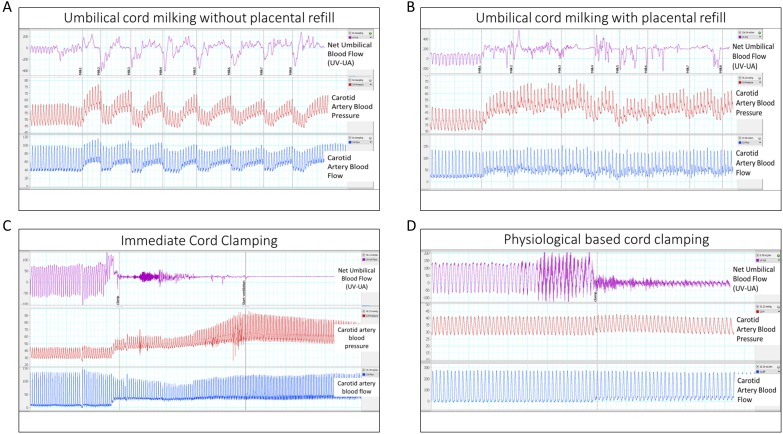
Figure 1
Figure 1
Single animal examples of all four experimental groups. (A) Umbilical cord milking without placenta refill resulted in no net placental transfusion and cerebral haemodynamic instability. (B) Umbilical cord milking with placental refill resulted in a significant increase in placental blood flow to the fetal lamb, but also significant cerebral haemodynamic instability. (C) Immediate cord clamping resulted in significant cerebral haemodynamic instability. (D) Physiological-based cord clamping resulted in haemodynamic stability, but no placental transfusion. UV-UA, umbilical venous flow minus umbilical arterial flow to calculate the net umbilical blood flow toward the fetal lamb.
Figure 2
Figure 2
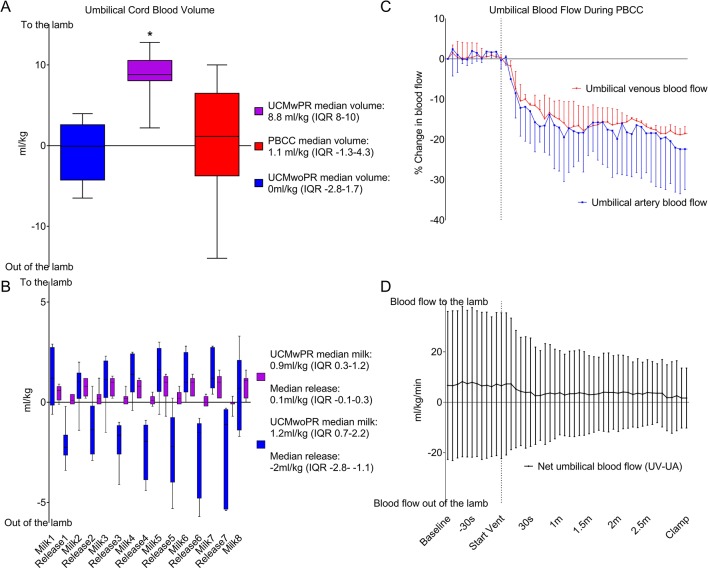
Volume of blood transferred to the lamb during umbilical cord milking and physiological-based cord clamping. (A) Volume of placental transfusion in umbilical cord milking without placental refill (UCMwoPR), umbilical cord milking with placental refill (UCMwPR) and physiological-based cord clamping (PBCC). *Indicates significant difference (P<0.05). (B) Volume and direction of umbilical cord blood volume during UCMwoPR and UCMwPR. (C) Umbilical cord blood flow during the first 3 min of ventilation in PBCC in the umbilical vein and umbilical artery. Umbilical venous and umbilical arterial blood flow were significantly reduced after the initiation of ventilation. (D) Net umbilical blood flow during PBCC (umbilical venous minus umbilical arterial blood flow). Total umbilical blood flow to the fetal lamb did not change during the first 3 min of ventilation.
Figure 3
Figure 3
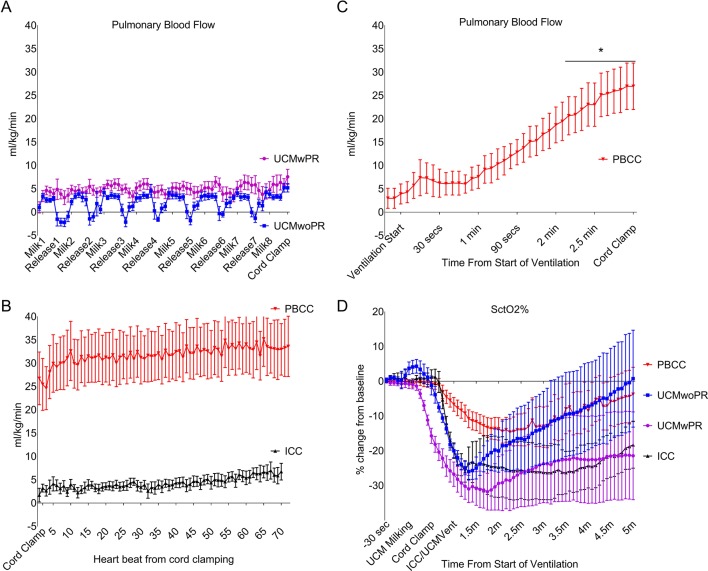
Pulmonary blood flow (PBF) and cerebral oxygenation (SctO2%). (A) PBF comparing umbilical cord milking without placenta refill (UCMwoPR) and umbilical cord milking with placental refill (UCMwPR) during umbilical cord milking (UCM). (B) PBF comparing physiological-based cord clamping (PBCC) and immediate cord clamping (ICC) immediately after cord clamping. (C) PBF in PBCC increased after ventilation. Prior to umbilical cord clamping (UCC), PBF increased by 26 mL/kg/min ±6 (P<0.0005). (D) SctO2% decreased significantly in all groups after UCC. The decrease was least in PBCC compared with UCMwoPR, UCMwPR and ICC.
Figure 4
Figure 4
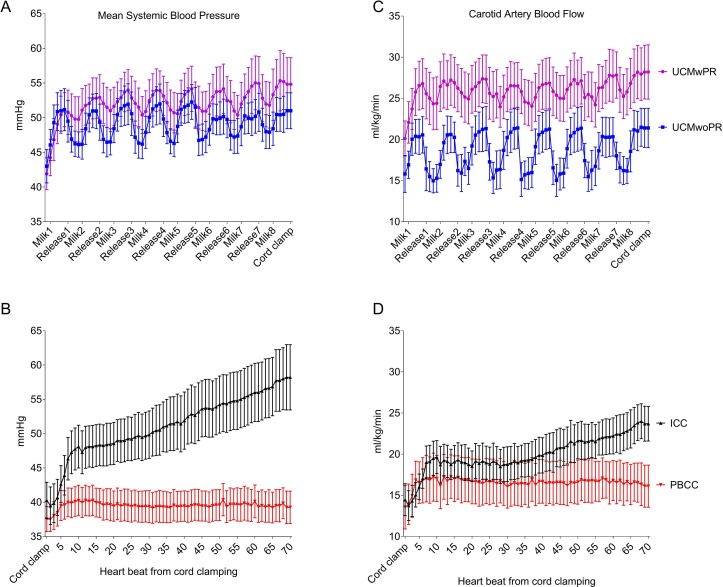
Mean blood pressure (MBP) and mean carotid artery blood flow (CABF) measured heartbeat to heartbeat. (A) MBP comparing umbilical cord milking without placenta refill (UCMwoPR) and umbilical cord milking with placental refill (UCMwPR) during umbilical cord milking. (B) MBP comparing physiological-based cord clamping (PBCC) and immediate cord clamping (ICC) immediately after umbilical cord clamping. (C) CABF comparing UCMwoPR and UCMwPR. (D) CABF comparing PBCC and ICC.

References

    1. Rabe H, Diaz-Rossello JL, Duley L, et al. Effect of timing of umbilical cord clamping and other strategies to influence placental transfusion at preterm birth on maternal and infant outcomes. Cochrane Database Syst Rev 2012;8:CD003248 10.1002/14651858.CD003248.pub3 - DOI - PubMed
    1. Ersdal HL, Linde J, Mduma E, et al. Neonatal outcome following cord clamping after onset of spontaneous respiration. Pediatrics 2014;134:265–72. 10.1542/peds.2014-0467 - DOI - PubMed
    1. Mercer JS, Erickson-Owens DA, Vohr BR, et al. Effects of placental transfusion on neonatal and 18 month outcomes in preterm infants: A randomized controlled trial. J Pediatr 2016;168:50–5. 10.1016/j.jpeds.2015.09.068 - DOI - PMC - PubMed
    1. Sommers R, Stonestreet BS, Oh W, et al. Hemodynamic effects of delayed cord clamping in premature infants. Pediatrics 2012;129:e667–e672. 10.1542/peds.2011-2550 - DOI - PMC - PubMed
    1. Kattwinkel J, Perlman J. The Neonatal Resuscitation Program: The Evidence Evaluation Process and Anticipating Edition 6. NeoReviews 2010;11:e673–e680. 10.1542/neo.11-12-e673 - DOI