. 2017 Dec 5;7(1):16989.
doi: 10.1038/s41598-017-17086-7.

Mitochondrial DNA Mutations Associated with Type 2 Diabetes Mellitus in Chinese Uyghur Population

Affiliations

Mitochondrial DNA Mutations Associated with Type 2 Diabetes Mellitus in Chinese Uyghur Population

Wenxi Jiang et al. Sci Rep. .

Abstract

A hospital-based case-control study was conducted to investigate potential association between mitochondrial DNA and Type 2 diabetes mellitus (T2DM) in Chinese Uyghur population. We sequenced mitochondrial DNA from 210 Uyghur individuals including 88 T2DM patients and 122 controls. Using haplogroup classification and association test, we found that haplogroup H (odds ratio [OR] = 1.40; 95% confidence interval [CI]: 1.20-1.64; P = 0.0005138) and D4 (odds ratio = 1.47; 95% CI: 1.22-1.77; P = 0.001064) were associated with an increased risk of T2DM in Chinese Uyghur population. Two markers of haplogroup D4 and H, MT-ATP8 m.8414 T > G (p.Leu17Phe) and m.2706 G > A encoding 16S rRNA in mitochondria, were predicted to affect the structure of MT-ATP8 and 16S RNA, respectively, and may be involved in the pathogenesis of T2DM. Our study provides a new clue for mitochondrial DNA in the etiology of T2DM in Chinese Uyghur population.


Conflict of interest statement

The authors declare that they have no competing interests.

Figures
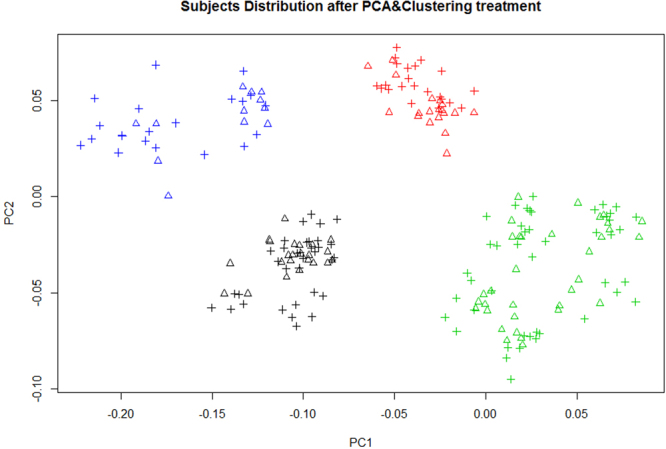
Figure 1
Figure 1
Subjects distribution according to the PCA analysis. We employed Smartpca from EIGENSOFT package and K-means method from Weka to classify all 210 subjects into 4 clusters. Different colors indicated different clusters. Triangle indicates case subjects. Crossover indicates control subjects. Principal component 1 (PC1) and principal component 2 (PC2) were the first two axes of PCA and represented 7.626% and 5.276% variance.
Figure 2
Figure 2
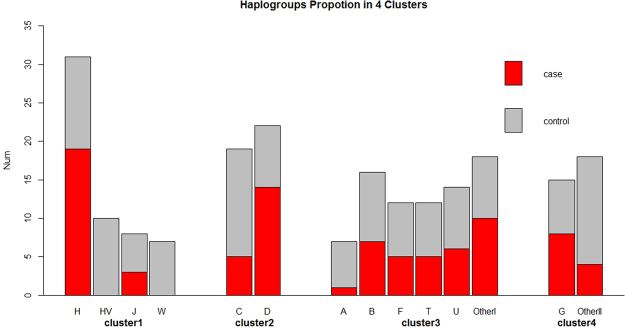
Distribution of haplogroups in 4 different clusters. Haplogroups with a sample size smaller than 6 (3%) are allocated into groups ‘OtherI’ and ‘OtherII’. Different colors indicated different clusters.
Figure 3
Figure 3
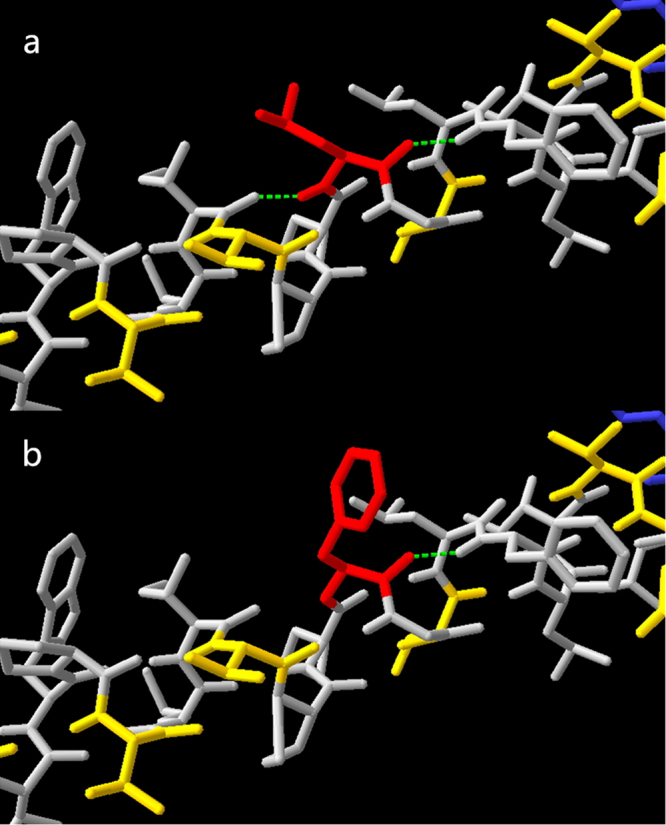
3D structure of MT-ATP8 protein. (a) MT-ATP8 with p.17 L, red sticks are 17th amino acid Leu; (b) MT-ATP8 with p.17 F, red sticks are 17th amino acid Phe. Green dotted line: H-bonds.
Figure 4
Figure 4
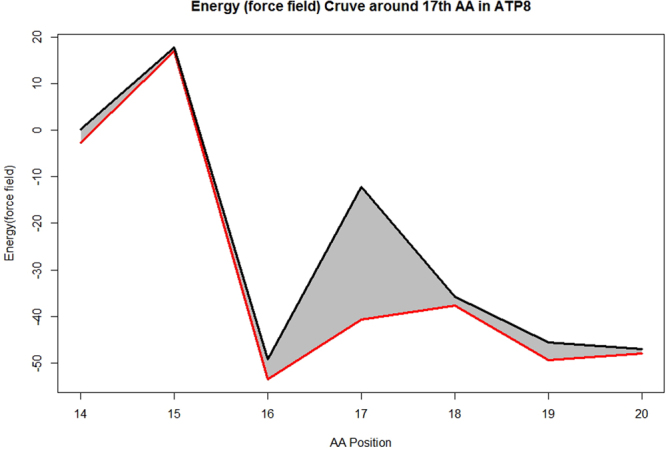
Force field curve around the 17th AA between 17 F and 17 L. Grey areas indicate higher energy caused by MT-ATP8 p.17 F. Black or line indicates the force field of MT-ATP8 with p.17 L or p.17 F, respectively.
Figure 5
Figure 5
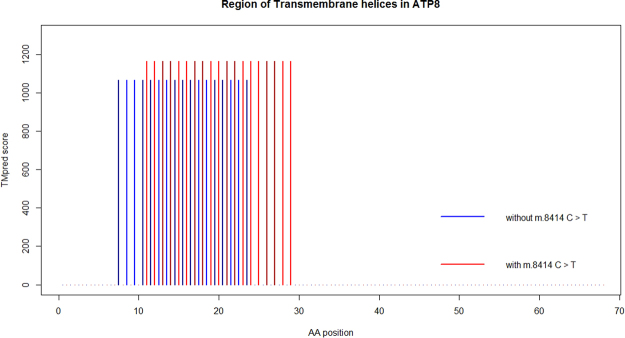
Possible transmembrane helices change in MT-ATP8. Red or blue vertical line indicates the transmembrane region of MT-ATP8 with m.8414 T or m.8414 C, respectively. Only scores above 500 were considered reliable by TMpred.
Figure 6
Figure 6
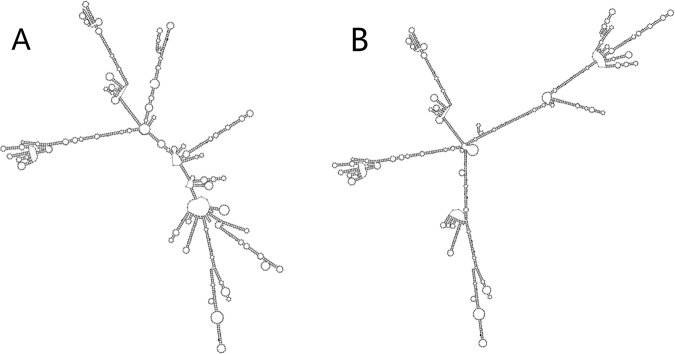
Secondary structure of 16S RNA. (A) Secondary structure of 16S RNA with m.2706 G. (B) Secondary structure with m.2706 G > A.
Figure 7
Figure 7
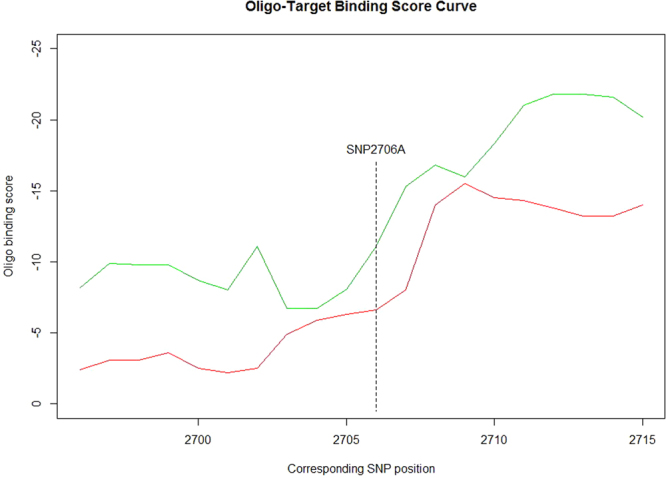
Oligo-Target binding curve. Green or red curve indicates the score of 16S rRNA with m.2706 G or m.2706 A, respectively. A more negative value indicates a tighter binding. Dashed line shows the position corresponding to m.2706 G > A.

References

    1. Zimmet P, Alberti KG, Shaw J. Global and societal implications of the diabetes epidemic. Nature. 2001;414:782–787. doi: 10.1038/414782a. - DOI - PubMed
    1. Roglic G, Unwin N. Mortality attributable to diabetes: estimates for the year 2010. Diabetes Res Clin Pract. 2010;87:15–19. doi: 10.1016/j.diabres.2009.10.006. - DOI - PubMed
    1. Whiting DR, Guariguata L, Weil C, Shaw J. IDF diabetes atlas: global estimates of the prevalence of diabetes for 2011 and 2030. Diabetes Res Clin Pract. 2011;94:311–321. doi: 10.1016/j.diabres.2011.10.029. - DOI - PubMed
    1. Tao Y, et al. The prevalence of type 2 diabetes and hypertension in Uygur and Kazak populations. Cardiovasc Toxicol. 2008;8:155–159. doi: 10.1007/s12012-008-9024-0. - DOI - PubMed
    1. Zhang J, et al. Adipose Tissues Characteristics of Normal, Obesity, and Type 2 Diabetes in Uygurs Population. J Diabetes Res. 2015;2015:905042. doi: 10.1155/2015/905042. - DOI - PMC - PubMed

Publication types