


Impact of remotely generated eddies on plume dispersion at abyssal mining sites in the Pacific
- PMID: 29208985
- PMCID: PMC5717004
- DOI: 10.1038/s41598-017-16912-2
Impact of remotely generated eddies on plume dispersion at abyssal mining sites in the Pacific
Erratum in
-
Publisher Correction: Impact of remotely generated eddies on plume dispersion at abyssal mining sites in the Pacific.Sci Rep. 2018 May 4;8(1):7440. doi: 10.1038/s41598-018-25181-6. Sci Rep. 2018. PMID: 29728571 Free PMC article.
Abstract
Proposed harvesting of polymetallic nodules in the Central Tropical Pacific will generate plumes of suspended sediment which are anticipated to be ecologically harmful. While the deep sea is low in energy, it also can be highly turbulent, since the vertical density gradient which suppresses turbulence is weak. The ability to predict the impact of deep plumes is limited by scarcity of in-situ observations. Our observations show that the low-energy environment more than four kilometres below the surface ultimately becomes an order of magnitude more energetic for periods of weeks in response to the passage of mesoscale eddies. The source of these eddies is remote in time and space, here identified as the Central American Gap Winds. Abyssal current variability is controlled by comparable contributions from tides, surface winds and passing eddies. During eddy-induced elevated flow periods mining-related plumes, potentially supplemented by natural sediment resuspension, are expected to spread and disperse more widely and rapidly. Predictions are given of the timing, location and scales of impact.
Conflict of interest statement
The authors declare that they have no competing interests.
Figures
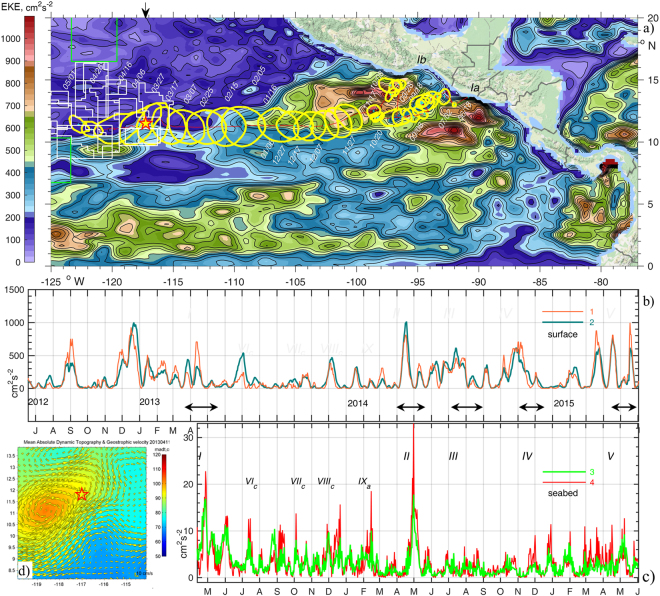
 ) and the averaged over adjacent four grid points around the moorings site (
 ). (c) EKE series in a layer 15–20 mab averaged over all three moorings (
 ) and at the northern site (
 ). Here EKE = 0.5·(u′2 + v′2), and u′, v′ are the deviations of u,v velocities from the mean ū, averaged over the shown 3 and 2 years respectively. Eddies arrivals are indicated with black arrows and latin numbers I-V, IX (anticyclonic) and VIc-VIIIc (cyclonic). (d) Inset shows SSH anomaly (colours) and geostrophic currents (arrows) on the date of moorings deployment (2013.04.11). Figure was plotted using MATLAB R2015b (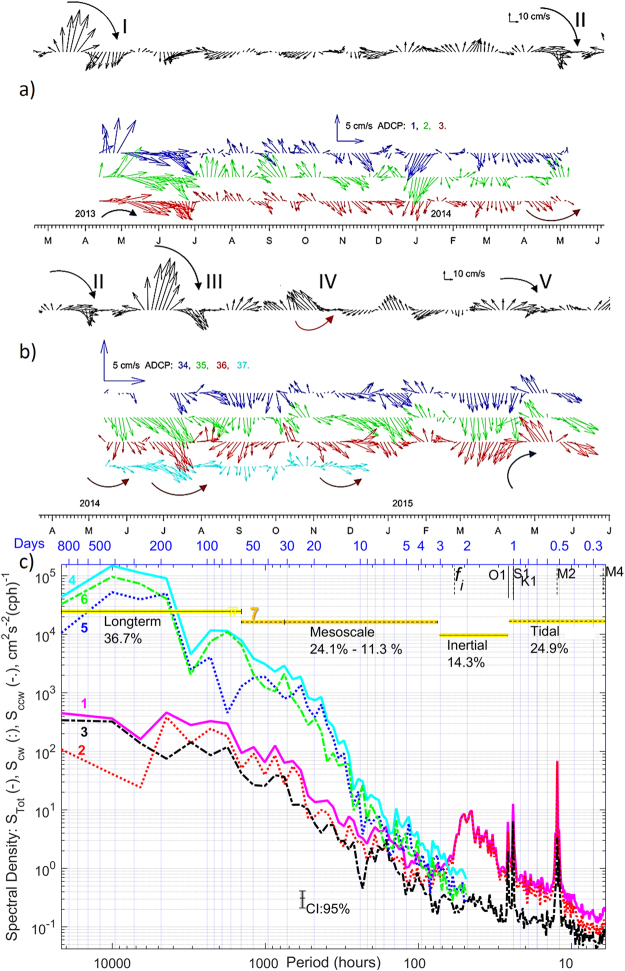
 ,
, ,3 for total, clockwise (cw) and counter-clockwise (ccw) components and similar lines
  ,
, ,
, for the surface currents. Lomb-Scargle, rotary spectra were calculated with unevenly sampled (1 and ¾ hours) data over the period 2013.04.11–2015.06.02. Confidence Intervals (CI = 95%) are included. Integration intervals over long-term, mesoscale, inertial, and tidal + high frequency internal wave’s bands and their contribution (%) in total spectra are shown with lines 7. High_Res_Figure_2 (

 (April 2013) at three different dates (red
  ,
, ,
, ) marked on inset surface elevation (ζ, m) graph. Mooring sites are labelled with M-1, M-2 and M-3. (b) Plume core tracks formed by neutral tracers released in period
  from ‘calm’ sources (1,4,5) and two more energetic sites (2,3) adjacent to ‘hotspots’ (shown in 12-hour intervals). (c) Observed (
 ) and modelled (
 ) residual current vectors averaged over 12 hours at 20 mab at mooring site 1. High_Res_Fig. 4 (
 passing period) containing 5.7·105 individual particles suspended in a water (grey dots) and settled on seafloor (colours). The area with substantial accumulated sediment layer thickness (in m) is shown over bathymetry (grey lines, 50 m). Points along the nodule collector tracks were aligned with equally-spaced Archimedes spiral, and shown on a dashed in-cut to indicate the scale of the harvested zone during the last day (red) and since the beginning of experiment (green). Red and green triangles indicate three mooring sites, labelled with M-1, M-2 and M-3, and two sediment core sampling sites respectively. (b), Settling footprint after 10 days of a similar SPM release over period
  without eddy impact. High_Res_Fig. 5 (
 red (maximum) lines computed in numerical Experiments III under eddy impact using two vertical mixing schemes: KL10 (bold) and PP81 (thin). Cyan lines
  show the averaged (solid) and maximum (dashed) thickness of sediments settled during the other 10 days of SPM release, when the impact of the eddy vanished. Yellow symbols 4 show JGOFS– sediment trap rates and their location in Eastern Pacific. Symbols
  ,
, show visual and measured data from 15 sediment traps collected in BIE,, while empty diamonds show BIE trap values scaled by suspended mass ratio R = 31.8 over 10 days between this numerical experiment (454,756t) and in-situ BIE trials (1,427t of sediments were dispersed during 19 days at a rate of 4.2 kg·s−1 by a six-meter-wide “benthic disturber” that was towed in 49 parallel rows within a 3300 m × 150 m polygon). Green line 7 indicates the natural sedimentation rate at two A5 stations. High_Res_Fig. 6 (
References
-
- Philbrick, N. In the heart of the sea: the tragedy of the whaleship Essex. (Viking, 2000).
-
- Ferreira, M. A., Johnson, D. & da Silva, C. P. Measuring success of ocean governance: a set of indicators from Portugal. J. Coast. Res., 982–986, 10.1163/15718085-12341367 (2016).
-
- Thiel H, Foell EJ, Schriever G. Potential environmental effects of deep seabed mining. Berichte aus dem Zentrum für Meeres- und Klimaforschung der Universität Hamburg. 1991;26:243.
-
- Borowski C, Thiel H. Deep-sea macrofaunal impacts of a large-scale physical disturbance experiment in the Southeast Pacific. Deep Sea Res. (II Top. Stud. Oc) 1998;45:55–81. doi: 10.1016/S0967-0645(97)00073-8. - DOI
Publication types
LinkOut - more resources
Full Text Sources
Other Literature Sources
Miscellaneous
