


The effects of daily intake timing of almond on the body composition and blood lipid profile of healthy adults
- PMID: 29209458
- PMCID: PMC5712498
- DOI: 10.4162/nrp.2017.11.6.479
The effects of daily intake timing of almond on the body composition and blood lipid profile of healthy adults
Abstract
Background/objectives: Timing of almond intake during a day may result differently in the perspectives of body composition and changes of lipid profile. The current study was conducted to compare the effects of daily almond intake as a preload versus as a snack on body composition, blood lipid profile, and oxidative and inflammation indicators among young Korean adults aged 20-39 years old.
Subjects/methods: Participants were randomly assigned to one of three groups: a pre-meal almond group (PM), a snack almond group (SN) in which participants were instructed to consume 56 g of almonds either as a preload before meals or as a snack between meals, respectively, and a control group (CL) in which participants were provided high-carbohydrate iso-caloric control food. Measurements were performed at baseline, weeks 8 and 16.
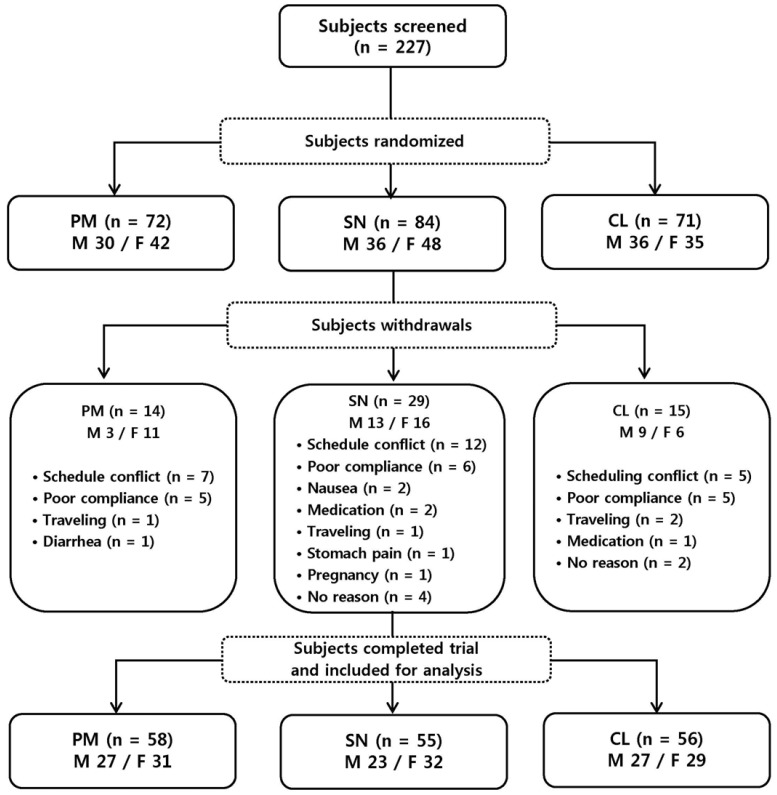
Results: A total of 169 (M 77/F 92) out of the 227 participants completed the study between June 2014 and June 2015 (n = 58 for PM; 55 for SN; and 56 for CL). A significant decrease in body fat mass was observed in the PM group at both weeks 8 and 16 compared with the CL. There were significant intervention effects on changes of body fat mass (P = 0.025), body fat percentages (P = 0.019), and visceral fat levels (P < 0.001). Consuming almonds as a daily snack reduced the levels of total cholesterol (P = 0.043) and low-density lipoprotein (LDL) cholesterol (P = 0.011) without changing high-density lipoprotein (HDL) cholesterol compared with the CL.
Conclusion: Almond consumption as a preload modified body fat percentages, whereas snacking on almonds between meals improved blood lipid profiles. This trial was registered at ClinicalTrials.gov as NCT03014531.
Keywords: Almonds; body composition; snacking.
Conflict of interest statement
CONFLICT OF INTEREST: The authors declare no potential conflicts of interests.
Figures
References
-
- U.S. Department of Agriculture. USDA National Nutrient Database for standard reference. Release 28 [Internet] Washington, D.C.: U.S. Department of Agriculture; 2016. [cited 2016 November 12]. Available from: http://ndb.nal.usda.gov.
-
- Bolling BW, Chen CY, McKay DL, Blumberg JB. Tree nut phytochemicals: composition, antioxidant capacity, bioactivity, impact factors. A systematic review of almonds, Brazils, cashews, hazelnuts, macadamias, pecans, pine nuts, pistachios and walnuts. Nutr Res Rev. 2011;24:244–275. - PubMed
-
- Li SC, Liu YH, Liu JF, Chang WH, Chen CM, Chen CY. Almond consumption improved glycemic control and lipid profiles in patients with type 2 diabetes mellitus. Metabolism. 2011;60:474–479. - PubMed
Associated data
LinkOut - more resources
Full Text Sources
Other Literature Sources
Medical
