. 2018 May;41(3):489-498.
doi: 10.1007/s10545-017-0114-7. Epub 2017 Dec 5.

Plasma lipidomics as a diagnostic tool for peroxisomal disorders

Affiliations

Plasma lipidomics as a diagnostic tool for peroxisomal disorders

Katharina Herzog et al. J Inherit Metab Dis. 2018 May.

Abstract

Peroxisomes are ubiquitous cell organelles that play an important role in lipid metabolism. Accordingly, peroxisomal disorders, including the peroxisome biogenesis disorders and peroxisomal single-enzyme deficiencies, are associated with aberrant lipid metabolism. Lipidomics is an emerging tool for diagnosis, disease-monitoring, identifying lipid biomarkers, and studying the underlying pathophysiology in disorders of lipid metabolism. In this study, we demonstrate the potential of lipidomics for the diagnosis of peroxisomal disorders using plasma samples from patients with different types of peroxisomal disorders. We show that the changes in the plasma profiles of phospholipids, di- and triglycerides, and cholesterol esters correspond with the characteristic metabolite abnormalities that are currently used in the metabolic screening for peroxisomal disorders. The lipidomics approach, however, gives a much more detailed overview of the metabolic changes that occur in the lipidome. Furthermore, we identified novel unique lipid species for specific peroxisomal diseases that are candidate biomarkers. The results presented in this paper show the power of lipidomics approaches to enable the specific diagnosis of different peroxisomal disorders.


Conflict of interest statement

None.

Figures

Fig. 1
Fig. 1
Phospholipid profiles in plasma from patients with peroxisomal disorders. a) Score plot of the multivariate model based on PLS-DA depicting variations in phospholipid profiles. Shown are the first (X-variate) and second component (Y-variate) of the model, the percentage of variance explained by the components is indicated in parentheses. b) Un-supervised hierarchical clustering plot of phospholipid species with the highest VIP score as determined by OPLS-DA between plasma samples from ZSD patients and controls. Data were logarithm-transformed, and colors in the heat-map reflect the logarithm of the relative metabolite abundance (z-score): red color indicates higher, and blue color indicates lower values than the mean abundance per metabolite
Fig. 2
Fig. 2
Differences in phospholipid composition in plasma samples from patients with DBP deficiency. a) Score plot of the multivariate PLS-DA model of plasma samples from patients with DBP deficiency classified by disease severity. The first (X-variate) and second component (Y-variate) of the PLS-DA model are depicted, and the percentage of variance explained by the components is indicated in parentheses. Plasma samples from three very mild type III DBP patients are highlighted (sample no. F, N, and S). b) Left panel: volcano plot of plasma samples from three very mild type III DBP patients as indicated in (a) versus samples from controls. Phospholipid species that were increased in plasma samples from DBP patients when compared to controls are depicted as green dots, and species that were decreased in plasma samples from DBP patients are depicted as red dots. Right panel: two examples of statistically significantly different phospholipid species as shown in the left panel are shown as box-and-whisker plots
Fig. 3
Fig. 3
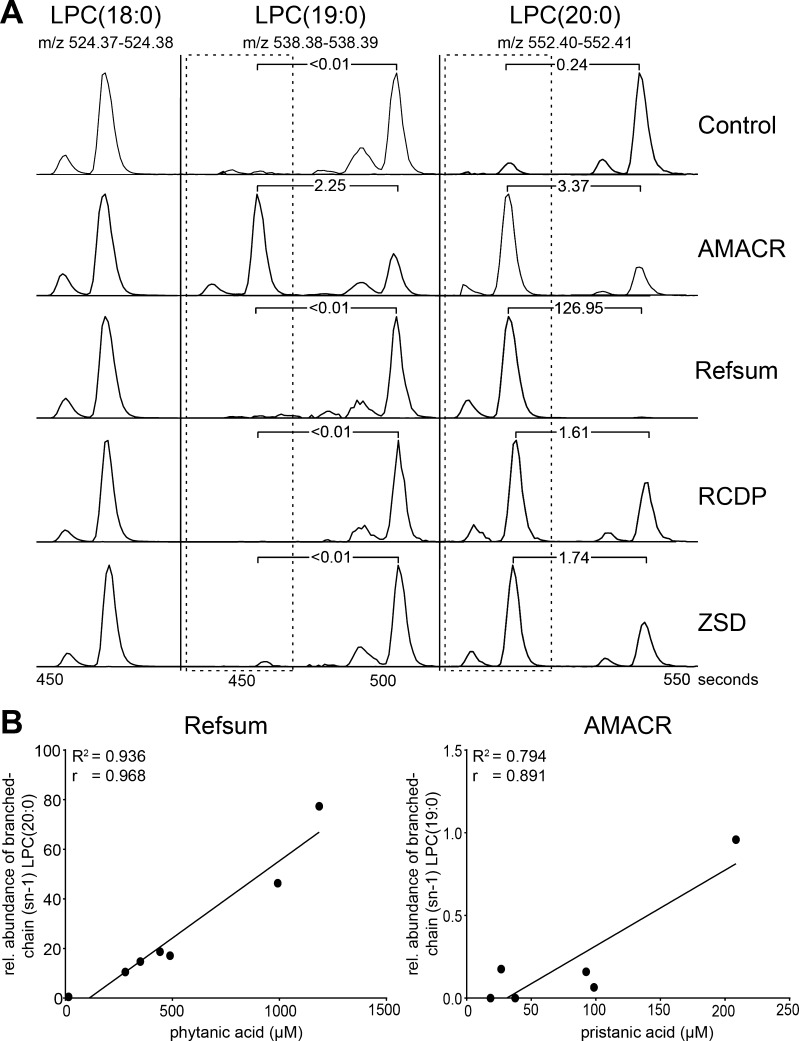
Unique phospholipid species in plasma from patients with Refsum disease and AMACR deficiency. a) Representative extracted ion chromatograms of straight-chain and branched-chain fatty acids (highlighted by dotted line). The ratios of the branched-chain peak (sn-1)/straight-chain peak (sn-1) are indicated. b) Scatter plot of the correlation of phytanic acid and branched-chain (sn-1) LPC20:0 levels in plasma samples from patients with Refsum disease (left panel), and pristanic acid and branched-chain (sn-1) LPC(19:0) levels in plasma samples from patients with AMACR deficiency (right panel) are shown. The coefficient of determination (R2) indicates the estimate of goodness of fit of the linear regression model, and the Pearson correlation coefficient (r) indicates the measure of correlation
Fig. 4
Fig. 4
Correlation of phospholipid species with aberrant metabolites used for diagnosis of peroxisomal disorders. Scatter plots showing the correlations of (phospho)lipid species levels (as indicated for each plot) and total C26:0 levels in plasma samples from ZSD patients, and patients with DBP deficiency; total phytanic acid levels in plasma samples from patients with RCDP and Refsum disease; and total pristanic acid levels in plasma samples from patients with AMACR deficiency. Pearson correlation coefficient (r) indicates the measure of correlation

References

    1. Abe Y, Honsho M, Nakanishi H, et al. Very-long-chain polyunsaturated fatty acids accumulate in phosphatidylcholine of fibroblasts from patients with Zellweger syndrome and acyl-CoA oxidase1 deficiency. Biochim Biophys Acta. 2014;1841:610–619. doi: 10.1016/j.bbalip.2014.01.001. - DOI - PubMed
    1. Berger J, Dorninger F, Forss-Petter S, Kunze M. Peroxisomes in brain development and function. Biochim Biophys Acta. 2016;1863:934–955. doi: 10.1016/j.bbamcr.2015.12.005. - DOI - PMC - PubMed
    1. Dorninger F, Brodde A, Braverman NE, et al. Homeostasis of phospholipids - the level of phosphatidylethanolamine tightly adapts to changes in ethanolamine plasmalogens. Biochim Biophys Acta. 2015;1851:117–128. doi: 10.1016/j.bbalip.2014.11.005. - DOI - PMC - PubMed
    1. Ferdinandusse S, Denis S, Clayton PT, et al. Mutations in the gene encoding peroxisomal alpha-methylacyl-CoA racemase cause adult-onset sensory motor neuropathy. Nat Genet. 2000;24:188–191. doi: 10.1038/72861. - DOI - PubMed
    1. Ferdinandusse S, Denis S, Mooyer PAW, et al. Clinical and biochemical spectrum of D-bifunctional protein deficiency. Ann Neurol. 2006;59:92–104. doi: 10.1002/ana.20702. - DOI - PubMed

Publication types

Supplementary concepts

LinkOut - more resources