


Isolation of Petrocidin A, a New Cytotoxic Cyclic Dipeptide from the Marine Sponge-Derived Bacterium Streptomyces sp. SBT348
- PMID: 29211005
- PMCID: PMC5742843
- DOI: 10.3390/md15120383
Isolation of Petrocidin A, a New Cytotoxic Cyclic Dipeptide from the Marine Sponge-Derived Bacterium Streptomyces sp. SBT348
Abstract
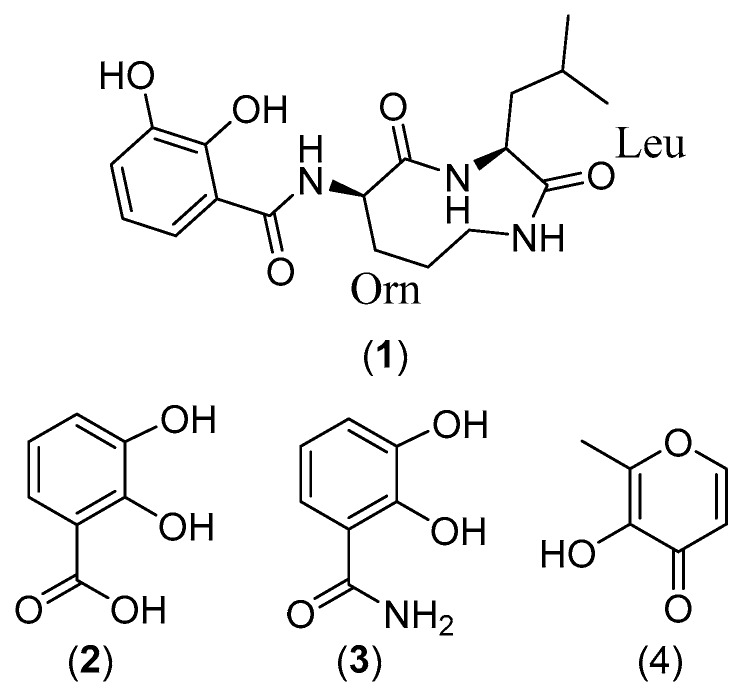
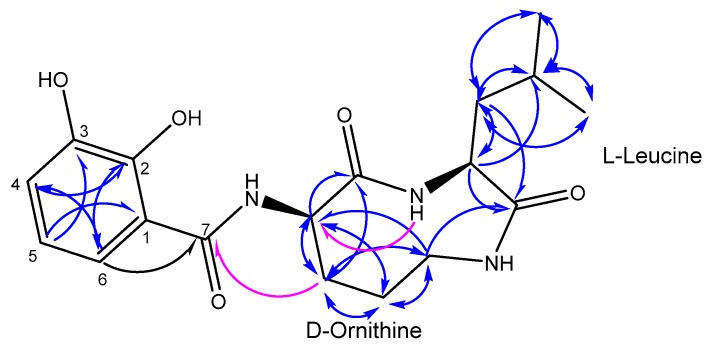
A new cyclic dipeptide, petrocidin A (1), along with three known compounds-2,3-dihydroxybenzoic acid (2), 2,3-dihydroxybenzamide (3), and maltol (4)-were isolated from the solid culture of Streptomyces sp. SBT348. The strain Streptomyces sp. SBT348 had been prioritized in a strain collection of 64 sponge-associated actinomycetes based on its distinct metabolomic profile using liquid chromatography/high-resolution mass spectrometry (LC-HRMS) and nuclear magnetic resonance (NMR). The absolute configuration of all α-amino acids was determined by HPLC analysis after derivatization with Marfey's reagent and comparison with commercially available reference amino acids. Structure elucidation was pursued in the presented study by mass spectrometry and NMR spectral data. Petrocidin A (1) and 2,3-dihydroxybenzamide (3) exhibited significant cytotoxicity towards the human promyelocytic HL-60 and the human colon adenocarcinoma HT-29 cell lines. These results demonstrated the potential of sponge-associated actinomycetes for the discovery of novel and pharmacologically active natural products.
Keywords: actinomycetes; cyclic dipeptide; cytotoxic; sponges; streptomyces.
Conflict of interest statement
The authors declare no conflict of interest.
Figures
References
-
- Nouioui I., Ruckert C., Willemse J., van Wezel G.P., Klenk H.P., Busche T., Kalinowski J., Bredholt H., Zotchev S.B. Actinoalloteichus fjordicus sp. nov. isolated from marine sponges: Phenotypic, chemotaxonomic and genomic characterisation. Anton Leeuwenhoek. 2017;110:1705–1717. doi: 10.1007/s10482-017-0920-9. - DOI - PMC - PubMed
-
- De Menezes C.B.A., Afonso R.S., de Souza W.R., Parma M., de Melo I.S., Zucchi T.D., Fantinatti-Garboggini F. Williamsia spongiae sp nov., an actinomycete isolated from the marine sponge Amphimedon viridis. Int. J. Syst. Evol. Microbiol. 2017;67:1260–1265. - PubMed
MeSH terms
Substances
LinkOut - more resources
Full Text Sources
Other Literature Sources
