Screening of cognitive impairment by general internists using two simple instruments
- PMID: 29213771
- PMCID: PMC5619106
- DOI: 10.1590/S1980-57642012DN06010007
Screening of cognitive impairment by general internists using two simple instruments
Abstract
General internists (GIs) tend to overlook cognitive impairment in the elderly. Lack of time to diagnose and/or poor knowledge on how to use screening instruments may be the reasons for this shortcoming.
Objectives: To verify the efficacy of simple instruments in the screening of cognitive impairment in elders.
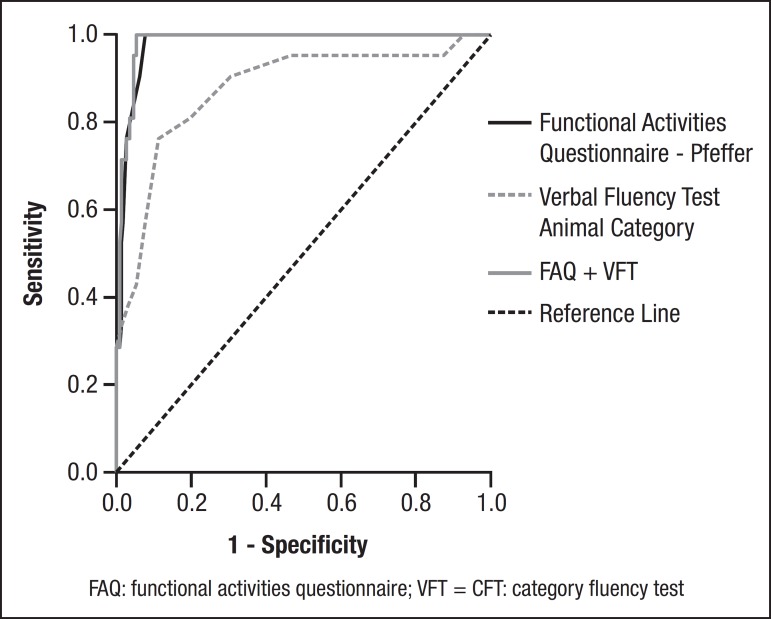
Methods: In a previous study, 248 patients aged ≥65 that had been assisted by GIs within outpatient services of a public university hospital in São Paulo, Brazil, were evaluated. The Mini-Mental State Examination and/or the Informant Questionnaire on Cognitive Decline in the Elderly (short-IQCODE) were employed to classify patients into probable cognitively impaired cases or otherwise. Other tests and questionnaires were also applied, but were not used to perform this classification. After full assessment and consensus meetings, cases were classified into dementia, cognitively impaired not demented, and without cognitive impairment. In this study, the sensitivity and specificity of the combined use of the category fluency test (CFT) and the Functional Activities Questionnaire (FAQ) was evaluated as if used as screening instruments for the whole sample.
Results: The combined use of the CFT and/or FAQ showed sensitivity of 88.3% and specificity of 76.5% in the screening of cognitive impairment for the whole sample.
Conclusions: Two simple and easy-to-apply instruments showed high sensitivity and reasonable specificity, and are probably useful for the screening of cognitive impairment in the elderly in outpatient services.
Médicos generalistas (MGs) normalmente não detectam comprometimento cognitivo em idosos. Falta de tempo para realizar a triagem de comprometimento cognitivo e pouco conhecimento sobre a forma de realizá-la podem ser as razões desta falha.
Objetivos: Verificar a eficácia de instrumentos simples no rastreio de comprometimento cognitivo em idosos.
Métodos: Em um estudo prévio, 248 pacientes com idade ≥65, que tinham sido assistidos por MGs em serviços ambulatoriais de um hospital universitário público em São Paulo, Brasil, foram avaliados. O Mini-Exame do Estado Mental e/ou o Questionário com Informante sobre Declínio Cognitivo em Idosos (Short-IQCODE) foram utilizados para classificar os pacientes em casos prováveis de cognição prejudicada ou não. Outros testes e questionários também foram aplicados, mas não foram usados para esta classificação. Depois de avaliação completa e reuniões de consenso, os casos foram classificados como demência, cognição alterada não demência e sem comprometimento cognitivo. Neste estudo avaliamos a sensibilidade e a especificidade do uso de dois instrumentos, o teste de fluência verbal (TFV) e o Questionário de Atividades Funcionais (QAF), se eles tivessem sido empregados como instrumentos de rastreio para toda a amostra.
Resultados: O uso combinado do TFV e/ou do QAF mostrou sensibilidade de 88,3% e especificidade de 76,5% no rastreio de comprometimento cognitivo em toda a amostra.
Conclusões: Dois instrumentos simples e de fácil aplicação mostraram alta sensibilidade e razoável especificidade e são provavelmente úteis para o rastreio de comprometimento cognitivo de idosos em ambulatórios.
Keywords: cognitive impairment; dementia; functional activity; general internists; questionnaire; screening; verbal fluency.
Conflict of interest statement
Disclosure: The authors report no conflicts of interest.
Figures
References
-
- Rodrigues MA, Facchini LA, Piccini RX, Tomasi E, Thumé E, Silveira DS, et al. Use of outpatient services by the elderly in the South and Northeast of Brazil. Cad Saude Publica. 2008;24:2267–2278. - PubMed
-
- Takada LT, Caramelli P, Radanovic M, Anghinah R, Hartmann AP, Guariglia CC, et al. Prevalence of potentially reversible dementias in a dementia outpatient clinic of tertiary university-affiliated hospital in Brazil. Arq Neuropsiquiatr. 2003;6:925–929. - PubMed
-
- Wimo A, Winblad B, Jönsson L. The worldwide societal costs of dementia: estimates for 2009. Alzheimers Dement. 2010;6:98–103. - PubMed
-
- Boustani M, Peterson B, Hanson L, Harris R, Lohr KN. Screening for dementia in the primary care: a summary of the evidence for the US preventive services task force. Ann Intern Med. 2003;138:927–937. - PubMed
-
- Valcour VG, Masaki H, Curb JD, Blanchette PL. The detection of dementia in the primary care setting. Arch Int Med. 2000;160:2964–2968. - PubMed
LinkOut - more resources
Full Text Sources