


Mortality and Its Predictors among HIV Infected Patients Taking Antiretroviral Treatment in Ethiopia: A Systematic Review
- PMID: 29214077
- PMCID: PMC5682904
- DOI: 10.1155/2017/5415298
Mortality and Its Predictors among HIV Infected Patients Taking Antiretroviral Treatment in Ethiopia: A Systematic Review
Abstract
Background: Even though the benefit of antiretroviral therapy (ART) is well established, there is a regional variation in the extent of its benefit. The aim of this review is to highlight mortality and its predictors in Ethiopian adult HIV patients who were on ART.
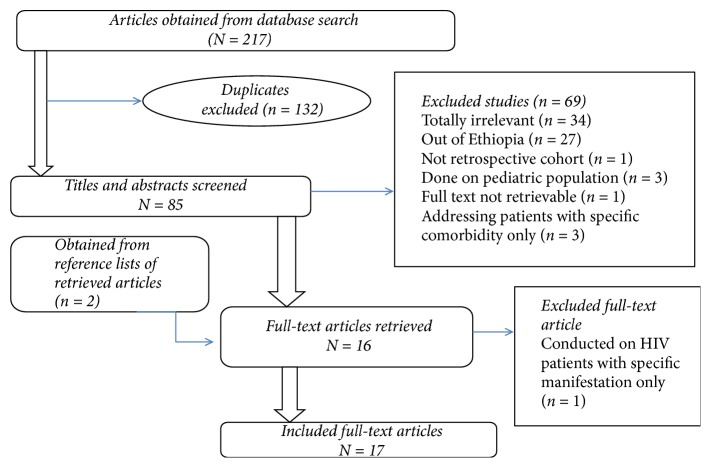
Methods: Relevant articles were searched on PubMed and Google Scholar databases. The search terms used in different combinations were predictor/determinant/factors, mortality/death/survival, HIV, ART/HAART, and Ethiopia.
Result: 5-40.8% of the patients died during the follow-up period. More than half (50-68.8%) of the deaths occurred within 6 months of initiating ART. Advanced stage disease (stage III and stage IV), nonworking functional status (bedridden and ambulatory), low baseline CD4 count, low baseline hemoglobin level, TB coinfection, lower baseline weight, and poor treatment adherence were commonly identified as predictors of death in HIV patients.
Conclusion: 5-40.8% of HIV patients in Ethiopia die in 2-5 years of initiating antiretroviral treatment. Most of the deaths in HIV patients occur early in the course of treatment. Special emphasis should be given for patients with advanced stage disease, nonworking functional status, low baseline CD4 count, low baseline hemoglobin level, TB coinfection, lower baseline weight, and poor treatment adherence.
References
-
- UNAIDS. Geneva, Switzerland: UNAIDS; 2013. UNAIDS report on the global AIDS epidemic.
-
- WHO. Geneva, Switzerland: WHO; 2013. Consolidated guidelines on the use of antiretroviral drugs for treating and preventing HIV infection: summary of key features and recommendations.
-
- HAPCOF. Report on progress towards implementation of the UN declaration of commitment on HIV/AIDS. 2010
-
- Sapa W. B., Negassi N. T., Chofore A. H. Survival pattern and its determinants among adult HIV-infected patients after initiation of HAART in Dilla hospital Ethiopia. Journal of AIDS & Clinical Research. 2016;1(1):1–6.
Publication types
LinkOut - more resources
Full Text Sources
Other Literature Sources
Research Materials
