The Impact of Smoking and TP53 Mutations in Lung Adenocarcinoma Patients with Targetable Mutations-The Lung Cancer Mutation Consortium (LCMC2)
- PMID: 29217530
- PMCID: PMC7008001
- DOI: 10.1158/1078-0432.CCR-17-2289
The Impact of Smoking and TP53 Mutations in Lung Adenocarcinoma Patients with Targetable Mutations-The Lung Cancer Mutation Consortium (LCMC2)
Abstract
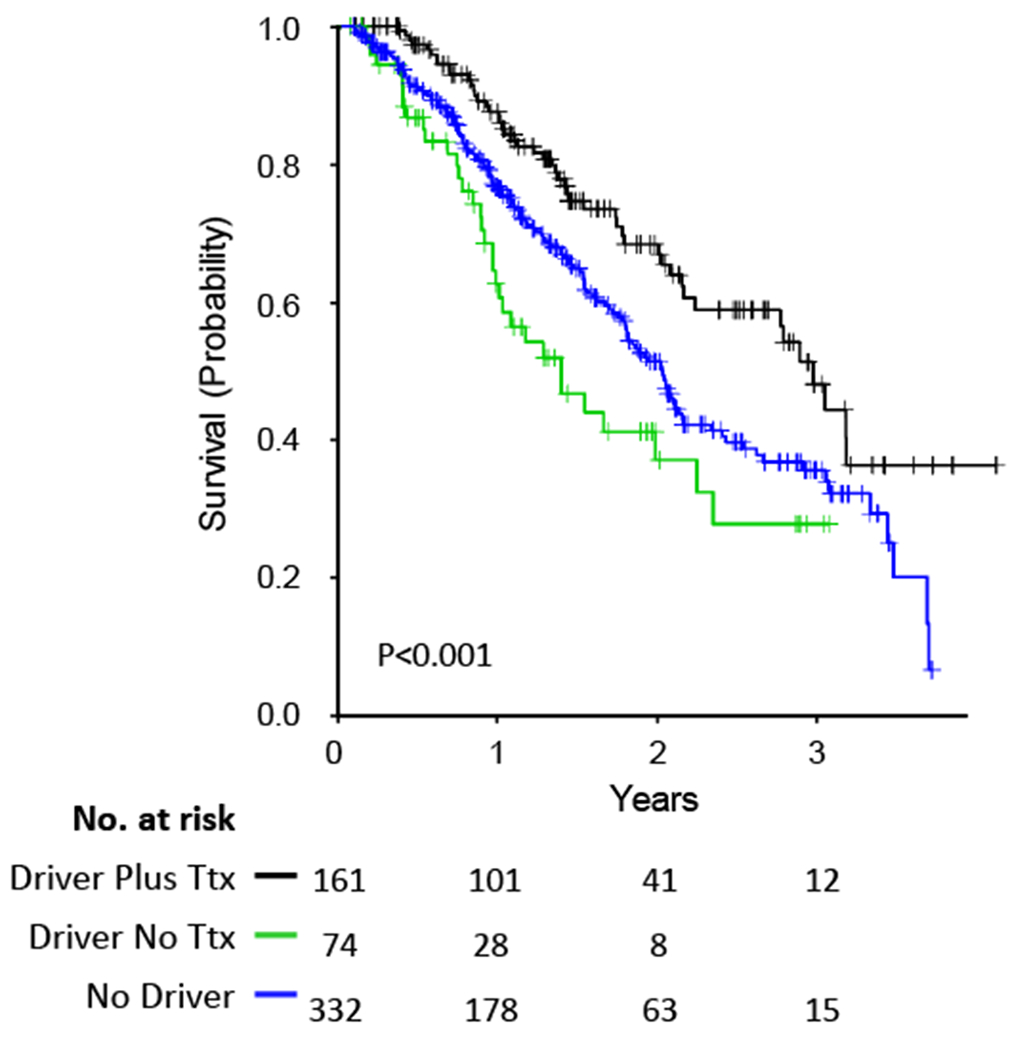
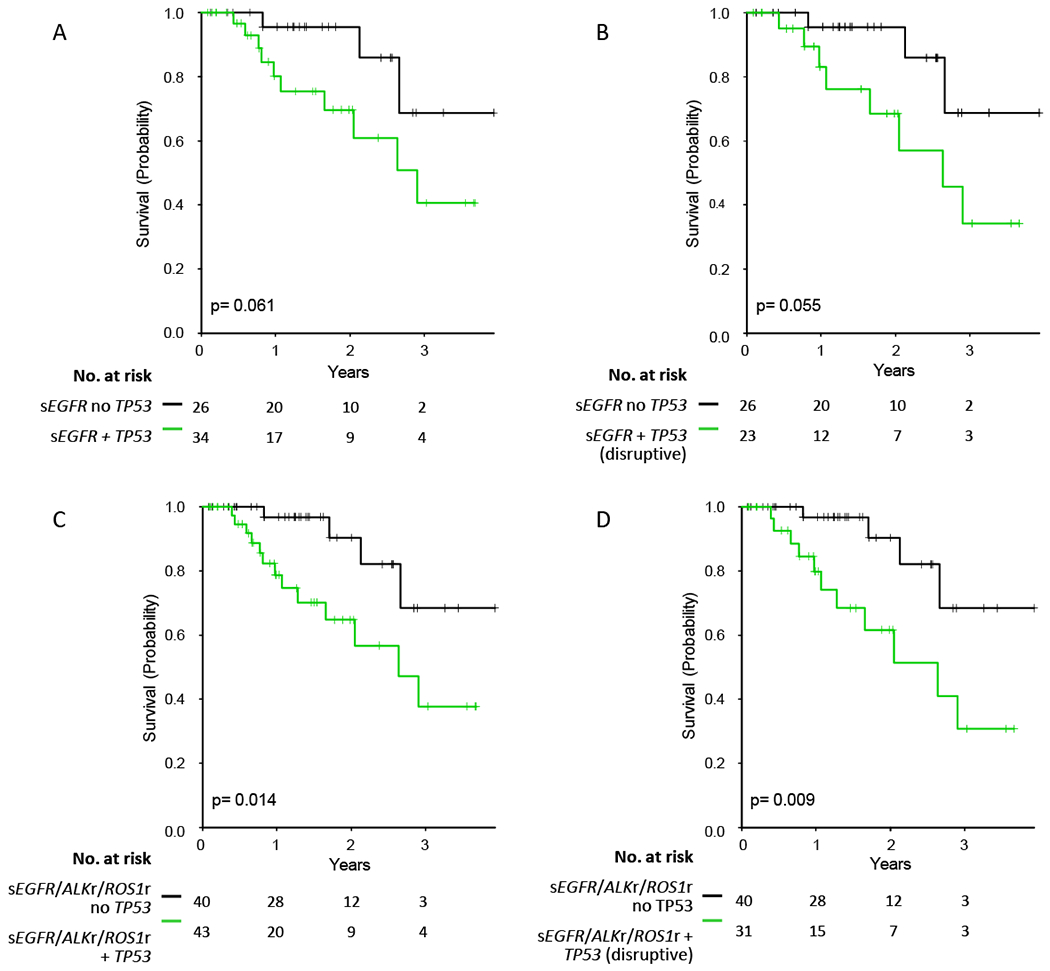
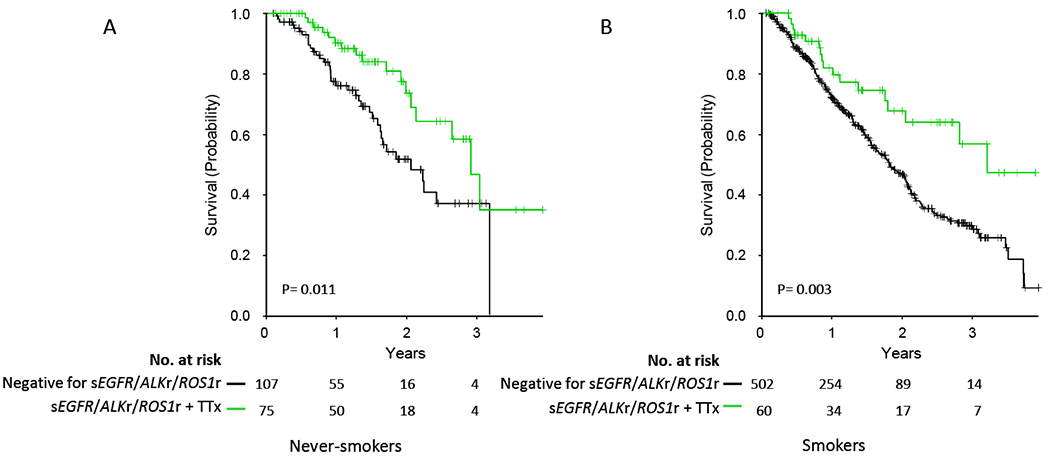
Purpose: Multiplex genomic profiling is standard of care for patients with advanced lung adenocarcinomas. The Lung Cancer Mutation Consortium (LCMC) is a multi-institutional effort to identify and treat oncogenic driver events in patients with lung adenocarcinomas.Experimental Design: Sixteen U.S. institutions enrolled 1,367 patients with lung cancer in LCMC2; 904 were deemed eligible and had at least one of 14 cancer-related genes profiled using validated methods including genotyping, massively parallel sequencing, and IHC.Results: The use of targeted therapies in patients with EGFR, ERBB2, or BRAF p.V600E mutations, ALK, ROS1, or RET rearrangements, or MET amplification was associated with a survival increment of 1.5 years compared with those with such mutations not receiving targeted therapy, and 1.0 year compared with those lacking a targetable driver. Importantly, 60 patients with a history of smoking derived similar survival benefit from targeted therapy for alterations in EGFR/ALK/ROS1, when compared with 75 never smokers with the same alterations. In addition, coexisting TP53 mutations were associated with shorter survival among patients with EGFR, ALK, or ROS1 alterations.Conclusion: Patients with adenocarcinoma of the lung and an oncogenic driver mutation treated with effective targeted therapy have a longer survival, regardless of prior smoking history. Molecular testing should be performed on all individuals with lung adenocarcinomas irrespective of clinical characteristics. Routine use of massively parallel sequencing enables detection of both targetable driver alterations and tumor suppressor gene and other alterations that have potential significance for therapy selection and as predictive markers for the efficacy of treatment. Clin Cancer Res; 24(5); 1038-47. ©2017 AACR.
©2017 American Association for Cancer Research.
Conflict of interest statement
The authors declare no potential conflicts of interest.
Figures
Comment in
-
The effect of smoking and TP53 mutations on molecular-targeted therapy in lung adenocarcinoma patients.J Thorac Dis. 2018 Nov;10(Suppl 33):S4013-S4016. doi: 10.21037/jtd.2018.09.43. J Thorac Dis. 2018. PMID: 30631542 Free PMC article. No abstract available.
-
Significance of testing for TP53 gene mutations in lung adenocarcinoma using targeted gene sequencing.J Thorac Dis. 2018 Nov;10(Suppl 33):S4147-S4150. doi: 10.21037/jtd.2018.10.66. J Thorac Dis. 2018. PMID: 30631578 Free PMC article. No abstract available.
-
Prioritizing mutational profiling for targeted therapy of lung adenocarcinoma.J Thorac Dis. 2019 Mar;11(Suppl 3):S216-S219. doi: 10.21037/jtd.2019.02.29. J Thorac Dis. 2019. PMID: 30997180 Free PMC article. No abstract available.
References
-
- Siegel RL, Miller KD, Jemal A: Cancer Statistics, 2017. CA Cancer J Clin 67:7–30, 2017 - PubMed
-
- Paez JG, Janne PA, Lee JC, et al. : EGFR mutations in lung cancer: correlation with clinical response to gefitinib therapy. Science 304:1497–500, 2004 - PubMed
-
- Lynch TJ, Bell DW, Sordella R, et al. : Activating mutations in the epidermal growth factor receptor underlying responsiveness of non-small-cell lung cancer to gefitinib. The New England journal of medicine 350:2129–39, 2004 - PubMed
-
- Soda M, Choi YL, Enomoto M, et al. : Identification of the transforming EML4-ALK fusion gene in non-small-cell lung cancer. Nature 448:561–6, 2007 - PubMed
Publication types
MeSH terms
Substances
Grants and funding
LinkOut - more resources
Full Text Sources
Other Literature Sources
Medical
Research Materials
Miscellaneous