. 2018 Jan 24;38(4):803-813.
doi: 10.1523/JNEUROSCI.1657-17.2017. Epub 2017 Dec 7.

Overexpression of the Histone Dimethyltransferase G9a in Nucleus Accumbens Shell Increases Cocaine Self-Administration, Stress-Induced Reinstatement, and Anxiety

Affiliations

Overexpression of the Histone Dimethyltransferase G9a in Nucleus Accumbens Shell Increases Cocaine Self-Administration, Stress-Induced Reinstatement, and Anxiety

Ethan M Anderson et al. J Neurosci. .

Abstract

Repeated exposure to cocaine induces lasting epigenetic changes in neurons that promote the development and persistence of addiction. One epigenetic alteration involves reductions in levels of the histone dimethyltransferase G9a in nucleus accumbens (NAc) after chronic cocaine administration. This reduction in G9a may enhance cocaine reward because overexpressing G9a in the NAc decreases cocaine-conditioned place preference. Therefore, we hypothesized that HSV-mediated G9a overexpression in the NAc shell (NAcSh) would attenuate cocaine self-administration (SA) and cocaine-seeking behavior. Instead, we found that G9a overexpression, and the resulting increase in histone 3 lysine 9 dimethylation (H3K9me2), increases sensitivity to cocaine reinforcement and enhances motivation for cocaine in self-administering male rats. Moreover, when G9a overexpression is limited to the initial 15 d of cocaine SA training, it produces an enduring postexpression enhancement in cocaine SA and prolonged (over 5 weeks) increases in reinstatement of cocaine seeking induced by foot-shock stress, but in the absence of continued global elevations in H3K9me2. The increase in stress-induced reinstatement is paralleled by heightened anxiety measures, suggesting that countering the cocaine-induced decreases in endogenous G9a with ectopic G9a overexpression leads to lasting anxiogenic effects. Finally, we found an enduring reduction in phosphorylated cAMP-response element binding protein levels in the NAcSh that could account for the increased anxiety. These data demonstrate a novel role for G9a in promoting comorbid cocaine addiction and anxiety and suggest that increased epigenetic repression of transcription through H3K9 during cocaine use can have long-lasting and unexpected negative consequences on behavior.SIGNIFICANCE STATEMENT Cocaine addiction is a neuropsychiatric disorder that is detrimental to society and currently has no effective treatments. The difficulty in treating drug addiction is compounded by the high comorbidity with other psychiatric illnesses, including anxiety disorders. Here, we demonstrate that G9a, an epigenetic repressor of gene expression, acting in the nucleus accumbens, a brain reward region, is capable of increasing both addiction- and anxiety-like behaviors in rats. These findings are intriguing because repeated cocaine exposure decreases G9a in this region and thereby enhances expression of certain addiction-promoting genes. However, our results suggest that countering this cocaine-induced decrease in G9a activity actually exacerbates addiction and sensitivity to relapse under stressful situations.

Keywords: G9a; H3K9; accumbens; addiction; anxiety; cocaine.


Figures

Figure 1.
Figure 1.
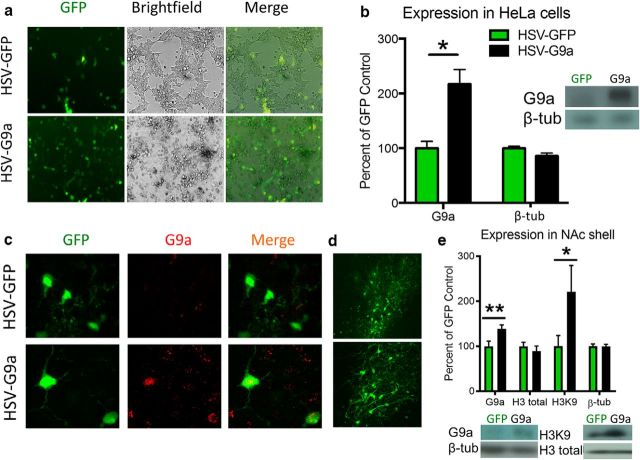
HSV-G9a-mediated G9a overexpression and H3K9me2. a, GFP expression in both HSV-G9a- and HSV-GFP-expressing HeLa cells. b, Protein levels of G9a and β-tubulin after HSV infection in vitro (HSV-GFP: n = 4, HSV-G9a: n = 8). c, 100× images of NAcSh tissue infected with HSV-GFP or HSV-G9a in vivo and immunolabeled for GFP and G9a. d, GFP expression after HSV infection at 20× magnification. e, Protein levels of G9a, Histone H3, H3K9me2, and β-tubulin in the NAcSh 3 d after HSV expression (HSV-GFP: n = 4, HSV-G9a: n = 4). Data are expressed as mean ± SEM. *p < 0.05 and **p < 0.01 compared with HSV-GFP.
Figure 2.
Figure 2.
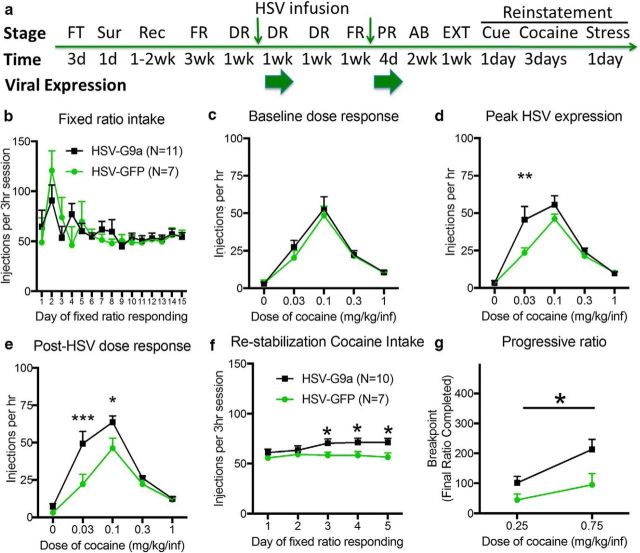
G9a overexpression increases cocaine SA behaviors. a, Experimental time course depicting operant training with food pellets (FT), surgery (Sur), recovery (Rec), and fixed ratio (FR) cocaine SA training, followed by FR dose–response (DR) testing before, during, and after HSV-mediated expression of HSV-GFP or HSV-G9a. A second HSV infusion is given prior cocaine SA testing on a PR reinforcement schedule. Small green arrows represent HSV infusion times after counterbalancing groups for cocaine intake and dose–response; large green arrows represent viral expression periods limited to FR dose–response and progressive ratio testing. Extinction (EXT) and reinstatement tests were performed after a 2-week abstinence period (AB). b, Average cocaine reinforcers in study groups during cocaine SA acquisition/stabilization training before HSV infusions. c, FR dose–response testing before (c), during (d), and after (e) peak HSV-mediated expression of GFP or G9a (HSV-GFP: n = 7, HSV-G9a: n = 11). f, Restabilization of cocaine SA after the first HSV infusion. g, Cocaine SA on a PR schedule during GFP or G9a expression after a second HSV infusion. HSV-GFP: n = 7, HSV-G9a: n = 10. Data are expressed as mean ± SEM. *p < 0.05, **p < 0.01, and ***p < 0.001 compared with HSV-GFP.
Figure 3.
Figure 3.
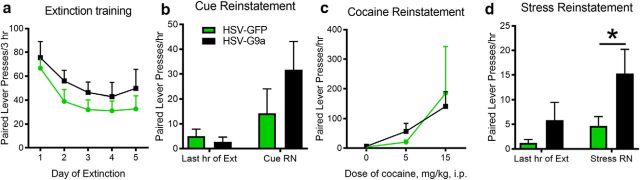
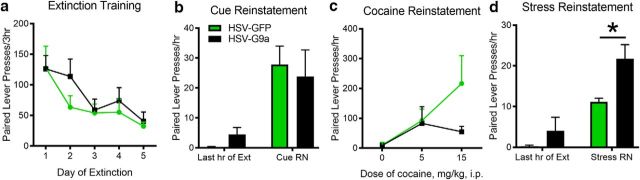
G9a overexpression during prior cocaine SA leads to selective increases in foot-shock stress-induced reinstatement. Shown are paired lever presses over 5 d of extinction in 3 h sessions (HSV-GFP: n = 7, HSV-G9a: n = 10; a), after noncontingent light and tone cue presentation (HSV-GFP: n = 6, HSV-G9a: n = 7; b), after intraperitoneal injections of saline or cocaine (HSV-GFP: n = 6, HSV-G9a: n = 9; c), or subsequent to intermittent foot shocks for 30 min (HSV-GFP: n = 6, HSV-G9a: n = 7; d). Data are expressed as mean ± SEM. *p < 0.05 compared with HSV-GFP.
Figure 4.
Figure 4.
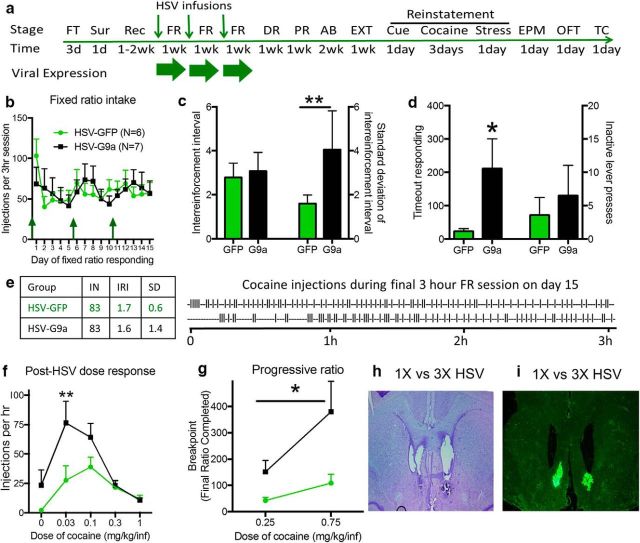
G9a overexpression during only the acquisition/stabilization phase leads to increased compulsivity and lasting increases in cocaine SA behaviors. a, Experimental time course depicting operant training with food pellets, surgery, recovery, and FR cocaine SA acquisition training, followed by PR and dose–response testing. After a 2-week abstinence period, rats also experienced extinction training and 3 reinstatement tests: cue-induced, cocaine-induced, and after 30 min of foot-shock stress. Rats were then tested in the EPM and open-field test (OFT) before tissue collection (TC). Small green arrows represent HSV infusion times and large green arrow represents viral expression periods. b, Average cocaine SA in study groups during HSV-mediated expression. c, Average inter-reinforcement intervals (left) and SDs of the intervals (right) on the last day of cocaine SA training (day 15). **p < 0.01 for an F test compared with HSV-GFP. d, Timeout responding (left) and inactive lever presses (right) for rats on the last 2 d of cocaine SA during HSV expression. e, Representative traces of cocaine SA behavior (vertical traces) for an HSV-GFP and HSV-G9a rat on day 15 over the 3 h session. f, Average cocaine SA (FR5) in study groups during dose–response testing. **p < 0.01 compared with HSV-GFP. g, Cocaine SA on a PR schedule after GFP or G9a expression during prior acquisition/stabilization of cocaine SA. h, Nissl stain showing tissue damage from either 1 (left) or 3 infusions (right) of HSV-GFP. i, Expression of GFP after either 1 (left) or 3 infusions (right) of HSV. *p < 0.05 for a significant main effect of group. Data are expressed as mean ± SEM. HSV-GFP: n = 6, HSV-G9a: n = 7.
Figure 5.
Figure 5.
G9a overexpression during only the acquisition/stabilization phase leads to selective increases in foot-shock stress-induced reinstatement. Shown are paired lever presses over 5 d of extinction (HSV-GFP: n = 5, HSV-G9a: n = 6; a), after noncontingent light and sound cue presentation (HSV-GFP: n = 5, HSV-G9a: n = 5; b), after intraperitoneal injections of saline or cocaine (HSV-GFP: n = 4, HSV-G9a: n = 5; c), or after intermittent foot shocks for 30 min (HSV-GFP: n = 4, HSV-G9a: n = 4; d). Data are expressed as mean ± SEM. *p < 0.05 compared with HSV-GFP.
Figure 6.
Figure 6.
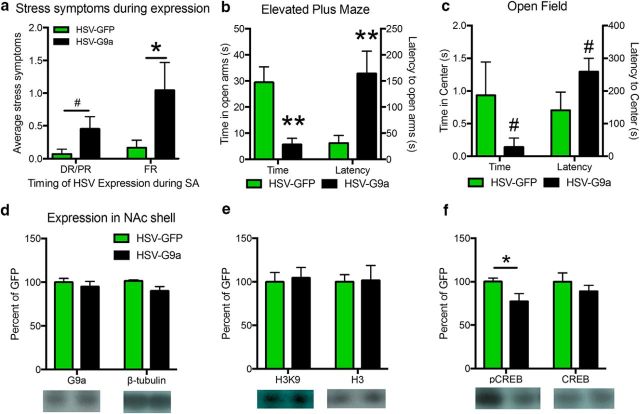
G9a overexpression during cocaine SA leads to lasting increases in anxiety-like behaviors and decreases in phosphorylated CREB in the NAcSh. a, Anxiety-like behaviors scored in animals self-administering cocaine with HSV expression during FR dose–response (DR) and PR (Experiment 1), HSV-GFP: n = 7, HSV-G9a: n = 11, and HSV expression during initial 15 d of cocaine SA (Experiment 2), HSV-GFP: n = 6, HSV-G9a: n = 7. b, Time spent in the open arms and latency to enter the open arms in the EPM test in animals completing Experiment 2. c, Time spent in the center and latency to the center in the open field test (HSV-GFP: n = 5, HSV-G9a: n = 6). df, Western blot results from NAcSh tissue after final behavioral tests for G9a (d), β-tubulin (e), H3K9me2, Histone H3 total and phosphorylated and total CREB levels (f) (HSV-GFP: n = 5, HSV-G9a: n = 5). Data are expressed as mean ± SEM. #p < 0.10, *p < 0.05, and **p < 0.01 compared with HSV-GFP controls.

References

    1. Anderson EM, Wissman AM, Chemplanikal J, Buzin N, Guzman D, Larson EB, Neve RL, Nestler EJ, Cowan CW, Self DW (2017) BDNF-TrkB controls cocaine-induced dendritic spines in rodent nucleus accumbens dissociated from increases in addictive behaviors. Proc Natl Acad Sci U S A 114:9469–9474. 10.1073/pnas.1702441114 - DOI - PMC - PubMed
    1. Augier E, Vouillac C, Ahmed SH (2012) Diazepam promotes choice of abstinence in cocaine self-administering rats. Addict Biol 17:378–391. 10.1111/j.1369-1600.2011.00368.x - DOI - PubMed
    1. Bachtell RK, Choi KH, Simmons DL, Falcon E, Monteggia LM, Neve RL, Self DW (2008) Role of GluR1 expression in nucleus accumbens neurons in cocaine sensitization and cocaine-seeking behavior. Eur J Neurosci 27:2229–2240. 10.1111/j.1460-9568.2008.06199.x - DOI - PubMed
    1. Back SE, Brady KT (2008) Anxiety disorders with comorbid substance use disorders: diagnostic and treatment considerations. Psychiatr Ann 38:724–729. 10.3928/00485713-20081101-01 - DOI - PMC - PubMed
    1. Barrot M, Wallace DL, Bolaños CA, Graham DL, Perrotti LI, Neve RL, Chambliss H, Yin JC, Nestler EJ (2005) Regulation of anxiety and initiation of sexual behavior by CREB in the nucleus accumbens. Proc Natl Acad Sci U S A 102:8357–8362. 10.1073/pnas.0500587102 - DOI - PMC - PubMed

Publication types

MeSH terms