Review
. 2017 Nov 23:8:855.
doi: 10.3389/fphar.2017.00855. eCollection 2017.

Drugs and Targets in Fibrosis

Affiliations
Review

Drugs and Targets in Fibrosis

Xiaoyi Li et al. Front Pharmacol. .

Abstract

Fibrosis contributes to the development of many diseases and many target molecules are involved in fibrosis. Currently, the majority of fibrosis treatment strategies are limited to specific diseases or organs. However, accumulating evidence demonstrates great similarities among fibroproliferative diseases, and more and more drugs are proved to be effective anti-fibrotic therapies across different diseases and organs. Here we comprehensively review the current knowledge on the pathological mechanisms of fibrosis, and divide factors mediating fibrosis progression into extracellular and intracellular groups. Furthermore, we systematically summarize both single and multiple component drugs that target fibrosis. Future directions of fibrosis drug discovery are also proposed.

Keywords: drug; fibrosis; pathological mechanism; pharmacology; target.


Figures
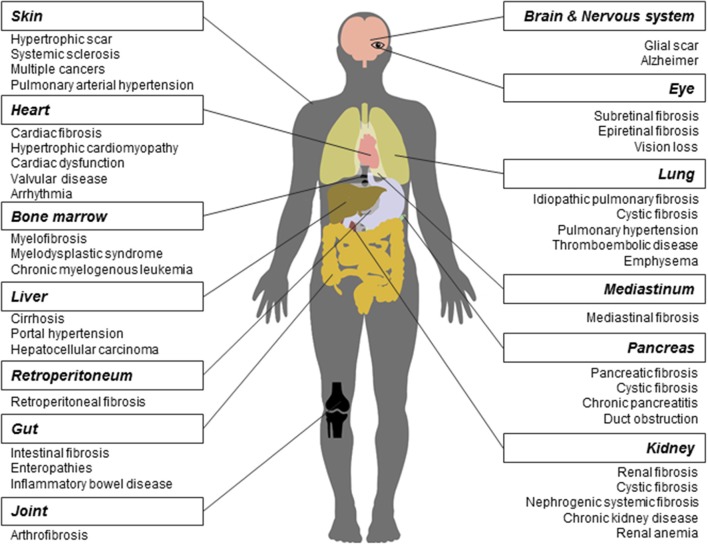
Figure 1
Figure 1
Fibrosis and related diseases in various tissues and organs. Fibrosis is a pathological process that could occur in many tissues and organs and is associated with multiple diseases. Commonly reported fibrosis and associated diseases are listed.
Figure 2
Figure 2
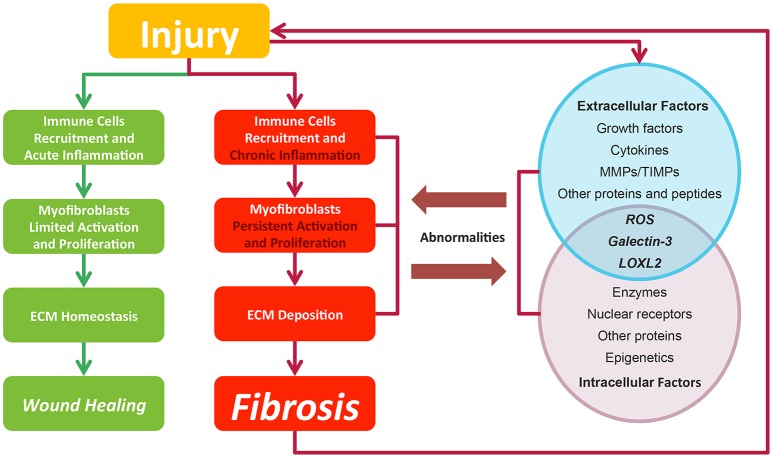
In normal wound healing condition, there is a series of ordered process: injury, immune cell recruitment and acute inflammation, myfibroblasts limited activation, and proliferation and ECM homeostasis, leading to wound closure after injury. While in pro-fibrotic condition, pathological process including chronic inflammation, myfibroblasts persistent activation, and proliferation and ECM deposition leading to fibrosis. Fibrosis itself could result in a secondary assault. Extracellular and intracellular factors interact with each other. Their abnormalities contribute to the fibrosis progression and in return are affected by pathological changes. Green lines and blocks represent normal wound healing while red lines and blocks represent fibrosis progression.

References

    1. Akhmetshina A., Venalis P., Dees C., Busch N., Zwerina J., Schett G., et al. (2009). Treatment with imatinib prevents fibrosis in different preclinical models of systemic sclerosis and induces regression of established fibrosis. Arthritis Rheum. 60, 219–224. 10.1002/art.24186 - DOI - PubMed
    1. Alaimo S., Giugno R., Pulvirenti A. (2016). Recommendation techniques for drug-target interaction prediction and drug repositioning. Methods Mol. Biol. 1415, 441–462. 10.1007/978-1-4939-3572-7_23 - DOI - PubMed
    1. Ali A. H., Carey E. J., Lindor K. D. (2015). Recent advances in the development of farnesoid X receptor agonists. Ann Transl Med 3:5. 10.3978/j.issn.2305-5839.2014.12.06 - DOI - PMC - PubMed
    1. Alkhouri N., Carter-Kent C., Feldstein A. E. (2011). Apoptosis in nonalcoholic fatty liver disease: diagnostic and therapeutic implications. Expert Rev. Gastroenterol. Hepatol. 5, 201–212. 10.1586/egh.11.6 - DOI - PMC - PubMed
    1. Allen J. T., Spiteri M. A. (2002). Growth factors in idiopathic pulmonary fibrosis: relative roles. Respir. Res. 3:13. 10.1186/rr162 - DOI - PMC - PubMed